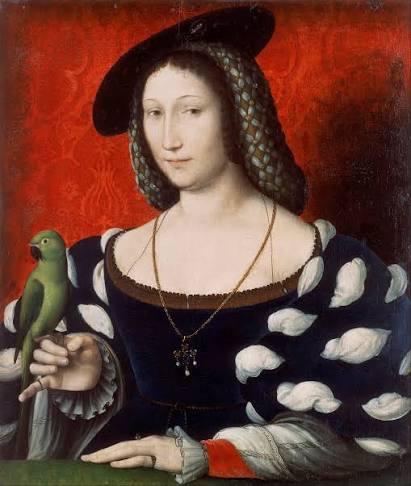
Marguerite de Navarre is the sister and wife of kings. While coping with being an agent of her brother and navigating the religious turmoil, she still found the time to become a bestselling author and perhaps the “first modern woman.”
Sources
Cholakian, Patricia F. and Rouben C. Marguerite de Navarre: Mother of the Renaissance (Columbia University Press, 2006).
Gristwood, Sarah. “I Wrote a Book About Renaissance Queens. Today’s Stories of Sex Assault Sound Like Something Out of the 16th Century.” History News Network. 3 December 2017. Last Accessed: 7/9/2026.
Knecht, Robert J. Renaissance Warrior and Patron: The Reign of Francis I (Cambridge University Press, 1994).
Transcript
Sometime in the year 1544 in England, a precocious eleven-year-old girl came up with a special gift for her stepmother Catherine. She translated a poem from French into English herself and bound it in a manuscript, titled The Miroir or Glass of the Sinful Soul. The girl may have also embroidered the book cover herself with silk threads in flower and Celtic knot patterns, although we don’t know for sure. The stepmother, who always treated the girl like the biological daughter she never had, cherished the gift. It was among her personal possessions when she died, and it still rests today in the University of Oxford’s Bodlean Library.
If any of you are Tudor history buffs, you probably already knew or at least guessed that the stepmother was King Henry VIII’s sixth and final wife Catherine Parr and the girl was the future Queen Elizabeth I of England. It’s a small moment, but it’s one that is in a way rare and profound. In this window of time, three generations of women were connected across time: Catherine Parr, Elizabeth Tudor, and the poem’s original author, Marguerite de Valois or to go by the title she held by the end of her life, Marguerite Queen of Navarre. They were all women born into the halls of power, yet they did experience hardships and were at various points at the mercy of men. Despite such obstacles, all three also left their own marks on history.
Of course, none left as large a mark as the eleven-year-old Elizabeth would, even though at the time she was still the third in line for the English throne with an older brother no one had reason to assume wouldn’t live and one day have heirs of his own. Not only that, but many inside and outside of England believed she was technically born out of wedlock; long story. But even in the shadow of Elizabeth’s own unlikely and eventually perilous rise to the top, the other two women also made their own stands. Catherine Parr defended and sponsored church reformers and early Protestants, even though at one point it nearly got her sentenced to death by her own husband. Marguerite of Navarre was also a friend and protector of the church reform movement and even some of the early representatives of the Protestant Reformation. She constantly had to navigate between the demands of her king and brother and her own religious sympathies. Also she was not only a patron of the arts, but a writer herself, one of the first women who made her voice heard across Europe through the printing press. Finally while she was not the first, she was an early case of a woman who used her wealth and social position to host gatherings of intellectuals and writers, a particular French phenomenon known as the salon.
This is a story of how one woman was a princess and a queen, but through her own efforts she also became something rather modern, a literary celebrity and a public intellectual.
This is Turning Modern.
Marguerite de Valois, future queen of Navarre, came from a poor, low-profile branch of her family. That family was the French royal family, so it wasn’t like she lived in squalor and obscurity, although the family was poor enough they chose not to hold celebrations over her birth, not least because she was just a daughter. Her prospects were thin or at least they would have been if not for France’s Salic Law, which had come into full force by her lifetime and which barred women and men descended from royal women from inheriting the French throne. The reigning king Louis XII was a distant cousin, but the Salic Law meant that Louis XII’s heir happened to be her younger brother, François.
Theirs was a small and close-knit family. The marriage of Marguerite and Francois’ mother, Louise of Savoy, to their father Charles Count of Angoulême had been an arranged one, yet Louise and Charles genuinely loved each other…despite Charles having two mistresses. Forget it Jake, it’s France. Anyway, when Charles died in 1496, Louise was devastated and devoted her life to her only son François. Marguerite followed suit. Of course this is the sort of thing you would expect from a patriarchal society, but François did embody life-changing prospects for both his mother and his sister. It certainly helped that even as a teenager François struck the model of the ideal Renaissance prince – handsome (if a little big-nosed), well-built, charming, naturally chivalrous, and with a genuine passion for art, literature and fashion. He definitely cut a more attractive figure next to the elderly and miserly King Louis XII. Louise of Savoy affectionately called Francois “her Ceaser”, and for the most part Marguerite and Francois remained close for the rest of their lives, so much so that their relationship would inspire malicious rumors of incest.
After the death of his wife Anne of Brittany, Louis XII acquired a new queen, Mary Tudor, the beautiful and vivacious young sister of the new king of England, Henry VIII. She was over three decades younger than her new husband. Louis XII died just a few months after the marriage, causing people to joke that sex with an attractive young bride was what killed the old king. Students at the Sorbonne even put together a satirical play that showed the king being given a filly that carried him off to Hell.
Marguerite herself was nearly married to the English prince who would become Henry VIII and even to Mary and Henry’s father, King Henry VII, when he was still alive. One account says that when Marguerite was approached by representatives of King Louis, she told them off, saying, “When my brother becomes king, I will marry a man who is young, rich, and noble— without having to cross the [English] Channel!” Perhaps because her mother opposed the match as well, Louis XII actually dropped the plan.
Louise of Savoy had fretted that Mary Tudor would finally give Louis XII a male heir. Instead, her son François was now king. Marguerite ascended along with her brother. In fact, she rose far more than a French king’s sister should have, to the point you can see where the rumors of incest began. In the early years of François’ reign it was actually Marguerite who was for all intents and purposes the queen of France, and not François’ actual wife, the old king Louis XII’s daughter Claude. It was Marguerite who made the usual public appearances reserved for the queen of France, while Claude went to church, played cards with her ladies, and did the important work of being pregnant and giving birth. It was even Marguerite who went to François’ royal coronation while Claude stayed home, heavily pregnant. Despite Marguerite’s defiant prophecy, she was already married to a man she would have almost certainly not chosen on her own: Duke Charles of Alençon, another distant relation of the royal family who stood in the line of succession. His family’s fiefdom happened to be a rich slice of territory, so the marriage was just a way of keeping a wealthy far-off relation close. He was sickly, not particularly intelligent, and while like many young prominent noblemen he was a commander in the armed forces he wasn’t a terribly competent soldier. Marguerite’s feelings about Charles would soften later in life, but in a poem she wrote after his death, The Prisons, she described him this way: “having neither read nor studied, / he would never have been taken for an orator.” For a girl who adored her athletic and intellectual brother, this husband must have been a disappointment, but this time she apparently had no say. Either she spent whatever leverage she had rejecting the betrothal to Henry VII or it was much easier for her to escape a marriage to an old foreign king than to a young man close to home.
Complicating the matter is the chance that Marguerite was possibly attracted to a man who better matched her dreams, the dashing and witty Guillaume Gouffier, Lord of Bonnivet. We can only mostly reconstruct Marguerite’s history with Bonnivet from a trail of hints left across her writings, especially her short story collection The Heptameron. Perhaps in her mother and brother’s mind, Marguerite had to be married off precisely because she was an attractive girl with an extroverted personality who was already attracting men while being drawn to them. If some of the stories in The Heptameron had any basis in reality, one man went so far as to “accidentally” fall of his horse into some mud so he would have an excuse to be naked in Marguerite’s presence. As for Bonnivet himself, I have to admit this is speculation on my part. It is perhaps important context for the far darker turn their relationship would take.
Marguerite of Navarre’s modern biographers, Patricia Francis and Rouben Cholakian, believe something traumatic happened to Marguerite, perhaps in 1520. While her husband was elsewhere, she and her brother were staying at the main estate of Bonnivet, who was a close confidant of the king. After Marguerite fell asleep, Bonnivet snuck into her room through a trap door and assaulted her. Marguerite tried to push him off and scratch him while screaming for help. Her attendants ran into the room and in the darkness Bonnivet was able to make his escape. Furious, Marguerite swore she would tell her brother and see Bonnivet put to death. However, an older woman among her attendants advised her to keep quiet despite herself. Marguerite had done nothing wrong, but people knew she had enjoyed Bonnivet’s company at one time or another. They might even say, she warned, that she had seduced Bonnivet and contrived his death. Marguerite was convinced. She got up the next day and joined her brother and Bonnivet for breakfast as if nothing had happened. Marguerite may have also been heeding the words of Anne de Beaujeu, another woman from the royal family who had been the regent of France for a time. Anne had written a sort of self-help book for aristocratic women, in which she wrote, ““Whatever your age, guard against being deceived . . . you can be blamed even for something very slight. There is no man of worth, however noble he may be, who does not use treachery, nor to whom it does not seem good sport to deceive or trick women of rank.” Sadly the advice shared by Marguerite’s attendant and Anne de Beaujeu is still sadly a part of women’s experience even centuries later.
Of course, we don’t know for sure that such a thing happened. However, the story I just described is in the short story collection Marguerite wrote, The Heptameron, only instead of Marguerite and François they are a nameless Flemish noblewoman, her brother, and a family friend. However, in his gossipy chronicles the abbot of Brantôme declared that the story was true and that the assailant was Bonnivet. If anyone would have known it would have been Brantôme, whose grandmother and mother would have been ladies-in-waiting to Marguerite at the time. And as the Cholakians point out, throughout the stories of The Heptameron, “rape and seduction are prominent themes.”
While we may know of Marguerite’s traumatic past, we don’t know much about how she saw her marriage. They had no children, and Marguerite spent much of her time away in Paris at the royal court. At the same time, she turned more to religion, spending time in religious meditations and writing devout poetry. Her guide was Guillaume Brisonnet, bishop of Meaux, who was famous and in some circles notorious for being an advocate for church reform. In this time, Marguerite began to establish a reputation as a church reformer who in some eyes skirted around outright heresy. Yet, she never became a Protestant. Instead, she belonged to a group one might call moderate reformers, who agreed with Martin Luther and his crew that the Church was in need of drastic change but they still strongly accepted papal authority and the hierarchy of the Catholic Church. The hardline stance of the Council of Trent forced the moderate reformers to get in line or to abandon the Church and drew a sharper line between Catholics and Protestants, but that would not happen until after Marguerite’s death. For the time being, there was still a space in which one could be sympathetic to some Protestant ideas and still more or less be a good Catholic, although it was a difficult and even dangerous space to be in.
At the Battle of Pavia in 1525, fought between France and the forces of Emperor Charles V of the Holy Roman Empire, King François was taken prisoner. Bonnivet was killed in the fighting. Marguerite’s husband Alençon also survived. He was one of the few high-profile nobles at the battle who lived and escaped capture, but this was at best a mixed blessing. One account claimed he simply misjudged the situation and mistakenly ordered his regiment to retreat in the chaos; another said he deliberately left the scene of the battle when it seemed like the French cause was doomed. In any case, as Alençon returned home, a crowd would gather wherever he stopped to rest or spend the night and jeer at him as a coward and pelt him with insults and stones. Louise of Savoy blamed him for the imprisonment of her son and retaliated by keeping him and Marguerite apart. The stress of his humiliation worsened his already poor health, to the point that it became clear he was dying. Marguerite defied her own mother’s orders to stay with her husband in his final moments and he died in her arms.
While Louise of Savoy during her son’s imprisonment became the ruler of France, François explicitly asked that Marguerite handle the negotiations for his release. Although negotiations stalled at first, she did succeed, but she also advised her brother to break the terms of the treaty she herself negotiated as soon as he crossed over France’s borders. Like her mother, Marguerite was pragmatic when she needed to be.
Marguerite was too valuable a commodity in dynastic terms to be left unmarried. Her next marriage was politically useful, but she probably did have more of a choice this time. Her groom was King Henri II of Navarre, a small kingdom in the Pyrenees that had been made even smaller after the southern half of the kingdom was invaded by Spain but Henri had also inherited some lands in southwestern France. Henri was ten years younger than Marguerite and was many things Alençon was not: a valiant soldier, a natural speaker, and a wit with an interest in literature. Tellingly, Marguerite spent less time at Paris and more time at her husband’s estate at Nerac in southwest France. Henri did have his mistresses, but there are hints that he and Marguerite were attracted to each other. And they did have two children, a daughter named Jeanne, who would become the mother of the future King Henri IV of France, and Jean, a baby who died soon after birth. This loss devastated Marguerite, and afterward for the rest of her life she would dress in a widow’s black.
At Nerac, Marguerite of Navarre truly came into her own. With the encouragement of a Protestant publisher, Simon du Bois, she published “The Mirror of the Sinful Soul”, the very poem that the future Queen Elizabeth of England would translate for her stepmother Catherine Parr. Almost certainly inspired by the death of her son, Marguerite wrote the poem about triumphing over her own weaknesses and even death itself through faith. The poem was, in sixteenth century terms, a bestseller. It was translated into Latin for international release and republished no less than eleven times in her lifetime.
It was also at Nerac where Marguerite established her own salon, where writers, theologians, and artists who sought her patronage or protection would visit. She also patroned and commissioned works from her own favored stable of writers and scholars. One such man was the physician François Rabelais, the author of the satirical French prose epic Gargantua and Pantagruel. It was Marguerite who also commissioned the first translation of Boccaccio’s short story collection The Decameron into French and had it published. When the religious firebrand Jean Calvin was on the run from authorities, it was Nerac where he sought sanctuary until the heat died down. Marguerite did not hesitate to step in to protect other moderate reformers and even outright Protestants, even from her own brother.
The day came when she had to back down, though. In 1534, pro-Protestant pamphlets were seen around Paris and its environs. On the so-called Day of the Placards, when pamphlets were found even in the king’s private apartments, he was terrified and enraged. The crackdown on the French Protestants or Huguenots truly began then. Marguerite tried to convince her brother that the pamphlets must have instead been distributed by the Huguenots’ enemies to discredit them, but this time she pushed too hard. She left Nerac for Navarre and for over two months neither she nor François wrote to each other, an unprecedented gap in their correspondence, suggesting either that one of them was giving the other the silent treatment or the letters were discreetly destroyed. Despite all that, few doubted that she was a good Catholic. It’s telling that both the Pope Paul III and the staunchly Protestant city council of the Swiss city of Berne both warmly wrote to her and asked her for favors.
While she fulfilled her traditional role as the sister and wife of kings, dispensing favors and securing her own network of clients, she also embarked on a career as an author. She continued publishing her poetry. She may have also intended to publish her own short story collection The Heptameron, which was clearly inspired by The Decameron, but sadly it was unfinished by the time of her death.
While she clearly took a personal pride in publishing her own writing, criticisms by the French clergy over “The Mirror of the Sinful Soul”, especially in the wake of the Day of the Placards, stung her enough that she rarely published anything after 1533. Over a decade later, she lost her beloved brother François. Their relationship had become somewhat strained, both by François reneging on his promise to work on restoring the stolen half of her husband’s kingdom and on the growing persecutions of the Huguenots and other so-called heretics that alarmed Marguerite. Still, when he died she wrote a poem lamenting his absence. It reads, “My life was filled with sugar and honey / when it was sustained by his, / but now it is nothing but absence and bitterness.” Perhaps it was the loss of the rest of her small family – Louise of Savoy had died in 1531 – that caused Marguerite to turn to the more mystical sides of Christianity. This alienated a few of her Protestant friends, including Jean Calvin, but Marguerite was never one to let others define her own understanding of God.
One day in 1549, Marguerite may have watched as Haley’s Comet passed the Earth. If she did, she may have wondered if it was predicting her own death. Not long after she would have seen the comet, she did become sick with pneumonia so severe that she lost the ability to speak for several days. She died on December 1 that year at the age of 57.
One of the women who knew her well was her lady-in-waiting, a young English noblewoman named Anne Boleyn. Anne would share both Marguerite’s reformist sympathies and her independent streak, although the latter played a role in getting her executed at the orders of her own husband, Henry VIII. Anne Boleyn’s daughter Elizabeth would be very same future queen of England who would translate Marguerite’s own words as a present. Of course, such connections are easily explained by the frankly incestuous world of European high nobility and royalty. And yet, there is something in how closely connected these women were, like members of an intimate spiritual lineage.
Marguerite seemed herself to stand astride both the old world and the new. Some of her religious sentiments like her fixation on arcane mysticism had a sense of the medieval, but she also showed an open-mindedness and a constant spiritual reevaluation and experimentation that made both Catholics and Protestants uncomfortable and revealed something of the modern. She served as a patron, a protector, and a political agent like any good queen since ancient times, but at the same time she had something of a career as a writer, whose works were so successful they set early sales records for the nascent print industry. I honestly think one can go so far as agree with the translator Samuel Putnam, who referred to Marguerite of Navarre as the “first modern woman.”
Thank you for listening.


Leave a Reply