Category: age of anxiety

  • How an Independence War Inspired a Ski Competition

    How an Independence War Inspired a Ski Competition

    A rebel leader and future king makes a dramatic escape across the Swedish countryside in the dead of December. This is the story of how this adventure inspired a famous competition centuries later.

    Sources

    Gustafsson, Harald. “A State That Failed?: On the Union of Kalmar, Especially Its Dissolution.” Scandinavian Journal of History 31:3-4 (2006): 205-220.

    “Gustav Vasa Couldn’t Ski?” Nordstjernan. Last accessed: 8/22/2026.

    Kent, Neil. A Concise History of Sweden (Cambridge University Press, 2008).

    Nordstrom, Byron J. The History of Sweden (Greenwood Press, 2002).

    “Pre-history.” Vasaloppet.se. vasaloppet.se/en/about-us/history/pre-history. Last accessed: 8/22/2026.

    Sundmark, Björn. “Snowy State: The Children’s History of Sweden” in Nordic Utopias and Dystopias: From Aniara to Allatta!, eds. Maria Ahlbäck, Jouni Teittinen, and Maria Lassén-Seger (John Benjamins Publishing Company, 2022).

    Swart, Peder. Gustaf Is Krönika (G.E. Klemming, 1870).

    Transcript

    Every year on the first Sunday of March in Sweden, there is a national ski race, the Vasaloppet, that in recent years has drawn an average of 15,000 participants. The race starts in Sälen near the Norwegian border, a region famous for its ski resorts, and ends almost 60 miles to the east at the town of Mora. The race has taken place annually since 1922 except for the years between 1942 and 1945 for reasons that hopefully don’t need an explanation

    However, its origins reach even further back by a number of centuries. The course of the race is a reversal of a legendary trek undertaken by Sweden’s first king of the modern age, Gustav Vasa, who according to legend skied the distance from Mora to Sälen before he was king and when he was still just a fugitive fleeing from a foreign tyrant.

    This is far more than just a legend that’s inspired a legacy of athleticism. It’s a story wrapped up in Swedish nationalism and the origins of modern Sweden, specifically the country’s War of Liberation that aimed for independence from Danish rule.

    This is Turning Modern.

    *

    On June 17, 1397, at the city of Kalmar in southeast Sweden, Queen Margaret of Denmark signed a treaty that formally unified the kingdoms of Denmark, Norway, and Sweden under one crowned head. She was the hereditary queen of Denmark herself. Meanwhile her husband Haakon had been the king of Norway and Sweden. After the death of their only son and heir Olaf and then Haakon’s own death, Margaret was proclaimed queen of Sweden and Norway in her own right. Remembered by history as the Union of Kalmar, the treaty Margaret signed was a compromise of sorts. Technically, all the Scandinavian kingdoms would remain mostly independent. Each of the three kingdoms would retain their own representative assemblies and their own laws, but they would share one monarch, one trade policy, and one foreign policies.

    The Kalmar Union wasn’t just the product of a dynastic accident. It was the result of months of heated negotiations between representatives of the three kingdoms. It was also seen as a necessity. Much like how parts of eastern and central Europe united under the Hapsburgs in response to the threat of the Ottoman Empire, the kingdoms of Scandinavia also had a common foe, the Hanseatic League, a confederation of northern German towns. The Hanseatic League vied with Scandinavia for control over the lucrative trade network between the North and Baltic Seas. The rivalry reached a crescendo when Denmark suffered a crippling defeat after clashing with the Hanseatic League. By the time Queen Margaret made her bid to become queen of all three kingdoms, bitter memories of the Hanseatic League and how they forced Denmark and by extension all of Scandinavia to accept a policy of quote-unquote “free trade” were still very fresh.

    While the Kalmar Union wasn’t entirely an accident of births, deaths, and marriages, credit should also go to Queen Margaret, who was from all accounts a fierce negotiator and a brilliant administrator in her own right. Unfortunately, she was also the only one who could keep the Kalmar Union running smoothly. The union started showing cracks as soon as she died in 1412. Her son Olaf was the only one besides her who would have had any legitimacy in all three kingdoms, and he was long dead. She tried to solve the problem by setting up her great-nephew Erik of Pomerania as a co-monarch and adopting him as both her son and heir, even though her hand remained firmly on the wheel until her death. Unfortunately, as a king Erik was as appetizing as sour milk. It’s telling that he’d always be remembered in Scandiavian historiography as “Erik of Pomerania”, stressing the fact that he came from northern Germany and was not a proper Scandinavian. Major revolts broke out in both Sweden and Norway, and eventually Erik was deposed and fled back across the Baltic.

    The Kalmar Union never recovered, but it remained in place…more or less. Even though at least in theory the Kalmar Union was meant to be a federation of equals, Denmark kept asserting itself as the dom. And while the Kalmar Union stayed in place on paper, at times Norway and Sweden elected their own kings over the Union no matter what Denmark had to say, and war did break out between the three kingdoms although without formally and permanently overturning the Union. Still, starting in the second half of the fifteenth century, Sweden was ruled by a series of regents who were arguably all but kings in name and picked by the Swedish national council, even if they still paid lip service to Denmark.

    In hindsight, the Kalmar Union was on course to crash headfirst into an iceberg. But I think it is possible it might still have worked indefinitely in one form or another; after all, Norway and Denmark would remain unified under one monarchy until the 19th century. Instead, we get King Christian II of Denmark, whose reign ended up being the stake in the Union’s heart. Depending on what source you read, Christian II was either a bloodsoaked tyrant or a reformer ahead of his time. Unsurprisingly, the most likely truth is that he was both. On the reformer side of the equation, he promoted humanist education, was said to sympathize with commoners and hate the aristocracy, and reformed laws in a way that benefited peasants by demolishing most of the last remnants of feudalism, including the ability of landlords to trade serfs like livestock. As for the tyrant side…well, we’ll get to that.  

    No doubt Christian II was aware of how the great dynasties of the rest of Europe – the Hapsburgs, the Tudors, and the Valois – were all consolidating and expanding their territories. He even married Isabella, the sister of Emperor Charles V. As he sought to bring the three kingdoms closer together, Sweden stood out as a problem child. For decades, almost all levels of Swedish society were increasingly unhappy about the partnership with Denmark. Miners and merchants alike grumbled over how their businesses was impacted by Denmark’s trade policies while the nobility resented Christian II’s reforms and how Denmark made an alliance with the state that would soon become Russia, the Grand Principality of Moscow, which was already threatening Sweden’s eastern borders. It didn’t help that this was also the time of the Reformation. So the fact that Christian II’s most powerful supporter on the Swedish council, Gustav Trolle, happened to be an archbishop gave the tensions a religious dimension. Christian II scored a decisive victory against the separatists in 1520 with a battle that saw the rebellious regent of Sweden, Sten Sture, fatally wounded. Striking what looked like a conciliatory and merciful tone, Christian II invited the elites of Sweden for his coronation as king of Sweden in Stockholm.

    After the celebrations were over, though, Christian II did not sit down with them for negotiations as they expected. Instead, he had over a hundred noblemen, city council members, merchants, and even two bishops arrested. Archbishop Trolle declared that they were guilty of heresy, taking advantage of the spread of Lutheranism in Sweden at the time. However, veryone knew their real offenses were being involved in the separatist movement. One by one they were dragged out to the city square and beheaded, their bodies unceremoniously burned and the ashes scattered. He didn’t stop there; he had a number of influential women imprisoned as well and had the bodies of Sten Sture and his son torn out of their graves. A possibly accurate, possibly apocryphal account claims that Christian once said this to his correspondent, the scholar Erasmus: “Mild measures are of no use; the remedies that give the whole body a good shaking are the best and surest.” Clearly Christian had put his philosophy into practice.

    It was not only a clearcut atrocity, but for Christian II himself it was an unforced error. Ever accepting Christian as their ruler was now a total non-starter for the Swedish. There’s no debate that the Kalmar Union was also a casualty of what would become known as the Stockholm Massacre. It didn’t help that once Christian II became aware of the magnitude of the backlash he blamed Archbishop Trolle, which only further enraged the Pope who was already furious that Christian had laid his hands on two bishops. Then he shifted the blame to his own officers, which of course only caused the men whose swords he relied on to grumble mutinously.

    Three of the victims of the Stockholm Massacre were the father, uncle, and brother-in-law of a prestigious and well-liked nobleman named Gustav Vasa. All three had been prominent supporters of Sture. Luckily, Vasa had been outside of Stockholm at Gripsholm Castle. Since Gripsholm Castle was close enough to the city, Gustav fled westward toward Norway. It was of course still part of Christian II’s domains, but either it would have been easier to go underground than in his homeland or Gustav was hoping to catch a boat to England or Germany from there.

    Vasa’s westward flight became the backdrop of many Swedish legends, some more plausible than others. My own favorite out of these stories has Gustav hiding out dressed as a peasant in the home of a commoner named Sven when some Danish soldiers burst in and demanded to know the identity of Sven’s guest. Thinking quickly, Sven’s wife struck Gustav on the back with a spade while yelling at him for being a lazy farm laborer. The soldiers reasoned that the mysterious peasant couldn’t have been Gustav Vasa because no commoner would dare strike a nobleman no matter the circumstances. Needless to say, this is generally considered one of the more implausible accounts.

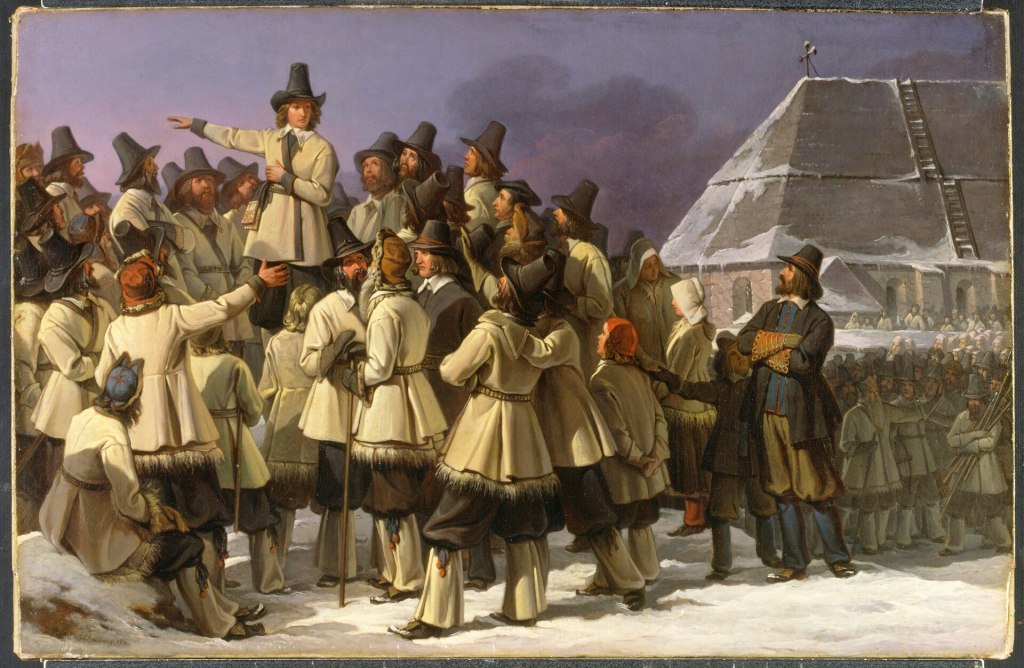
    But the most famous story from Gustav Vasa’s time as a fugitive is the very story that inspired the Vasaloppet. Since it was in the dead of December, Gustav traveled to Norway, trying to rally support wherever he went. When he attempted to get the townspeople of Mora to rebel against Christian II, they refused. The versions of the story I found claimed that the people of Mora didn’t want to become traitors and were tired of war from the last attempt to break away from Denmark, but I suspect if the story is true maybe they thought who cares if the king murdered a bunch of nobles and rich people in the big city. Whatever the reason, Gustav’s words met only blank stares. Since the Danes were closing in, he fled Mora not on horseback or snow shoes, but on skis. Not long after Gustav’s departure, the people of Mora heard rumors from other travelers who had been in the vicinity of Stockholm that Christian II wasn’t satisfied with all the blood he spilled and planned to carve a path of destruction across Sweden, rounding up anyone suspected of disloyalty and killing them on the spot. Either that or they had heard about the Stockholm Massacre for the first time; the accounts I could find diverge a bit on that part.

    Whatever changed their minds, the town council of Mora agreed to send two men, Engelbrekt Jonsson and Lars Jakobsson, to catch up with Gustav Vasa and tell him that they would join any rebellion against Danish rule. The two men skied the entire way and delivered the message to Gustav Vasa, convincing him to abandon his plan to hide out in Norway and instead return to Mora where he could help organize a rebellion. Returning on their skis back to Mora, there Gustav Vasa received oaths of loyalty from the leaders there and organized the people into a fighting force that more volunteers from around the region flocked to join. With their help, Gustav marched south, seizing some of the tax revenues collected and inspiring revolts in other parts of the country. The burgeoning rebellion also got support from Lübeck, the wealthy port city leading the Hanseatic League which had a vested interest in weakening Denmark and which had been annoyed by Christian II’s policy of raising tolls. The Swedish rebellion was even backed by Christian’s own uncle Frederick, who had been sharing with Christian power over the Duchy of Schleswig-Holstein on the Danish-German border. By the summer of 1523, the Swedish Council elected Gustav Vasa as king of Sweden.

    As for Christian II, his luck just kept getting worse. At about the same time Gustav Vasa was declared king of Sweden, his own country also rebelled against him and he was replaced with his own disloyal uncle Frederick. Christian fled to the Netherlands, hoping his brother-in-law Charles V would intervene and put him back on his throne, but Christian only got empty promises. So by 1531, Christian took matters into his own hands and set sail for Oslo. Even before he became king of Norway, Christian had ruled over Norway as regent, and he had always been popular there, so he had high hopes of starting a revolt. However, the army he was hoping for didn’t materialize like it did for Gustav Vasa. Christian tried to return to the Netherlands and was granted safe conduct by his uncle, but it turned out Frederick was lying and at the first opportunity he had Christian imprisoned. In a sign that Christian’s reputation as a reformer wasn’t entirely fluff, there was a conspiracy to put him back on the throne after Frederick died, but ultimately Christian was sent back into his cushy imprisonment and instead Frederick’s son, confusingly also named Christian, became king of Denmark and Norway after defeating Christian II’s sympathizers. He was still in captivity when he died in 1559.

    So the million-dollar question is, did the first modern king of Sweden really ski across the Swedish countryside to escape the Danes? I wish I could give you something conclusive, but…I don’t know. The main early source for the story is Peder Svart’s chronicle of Gustav Vasa’s life, which was dictated by the king himself, but Gustav Vasa was very much aware of the power of public relations and wouldn’t have been above embellishing or flat-out making up stories. Also I found an article claiming that a genealogist local to Mora has found correspondence written by Gustav Vasa suggesting he didn’t know about the existence of skiing. I’m a little skeptical of this claim, since skiing has been a Scandinavian pastime and means of transportation since literally the Stone Age and we know there were ski divisions in Swedish armies even back in the Middle Ages. But, to be completely honest, I couldn’t even find much about this outside the article itself, which you can find referenced in the show notes, much less the actual correspondence. Even so, it’s not the only source I found that’s at least a little skeptical of the claim that Gustav Vasa skied himself.

    All that said, the fact that the story does give specific names of two men who would have been either still alive or known by people still alive in Mora does make me think the story was at least partially true. Maybe the messengers sent to him from Mora actually did make the round trip on skis but Gustav himself made the journey in a more conventional way. That might explain how the two skiers sent from Mora were able to catch up with him. So, if I had to guess, I would say Gustav Vasa didn’t make the trip in skis, but the two men who convinced him to return to Mora did. But I’ll leave it there, since I’m really brushing up against the limits of my research resources and I don’t want to get deluged with hundreds of emails and social media posts from Swedish people angry that I poked too hard at a beloved national legend. 

    Thank you for listening.

  • The Forgotten Woman Who Helped Shape The Protestant Reformation

    The Forgotten Woman Who Helped Shape The Protestant Reformation

    Someone sticks up for a university student accused of heresy. This starts the public career of one of the most assertive, formidable voices of the early Protestant Reformation, a voice that would probably be better remembered if not for the fact that they were a woman.

    Sources

    MacCulloch, Diarmaid. The Reformation: A History (Viking, 2003).

    Mark, Joshua J. “Argula von Grumbach’s To the University of Ingolstadt.” World History Encyclopedia. 23 March 2022. https://www.worldhistory.org/article/1971/argula-von-grumbachs-to-the-university-of-ingolsta/

    Stjerna, Kirsi. Women and the Reformation (John Wiley & Sons, 2008).

    Transcript

    In the year 1523, an 18-year-old student at the University of Ingolstadt named Arsacius Seehofer was accused of having Lutheran views and harboring heretical pamphlets. Seehofer was expelled and imprisoned and was nearly condemned to be burned at the stake, if not for the intervention of his powerful father who pulled strings to get his case transferred to the secular courts. In tears, Seehofer made a public renunciation.

    However, Seehofer’s father wasn’t his only advocate. In September of 1523, a noblewoman, Argula von Stauff von Grumbach, wrote a letter demanding a meeting with the rector and governing council of the university. In the letter she declared rather imperiously, “How in God’s name can you and your university expect to prevail, when you deploy such foolish violence against the word of God… I am compelled as a Christian to write to you.” A genuine sympathy for Seehofer also comes through in the words:  “You have forgotten one thing: that he is only eighteen years old, and still a child. Others won’t forget.” She did not hesitate to take no aim at the faculty and administrators of the University of Ingolstadt themselves: “Are you not ashamed that Seehofer had to deny all the writings of Martin, who put the New Testament into German, simply following the text? That means that the holy Gospel and the Epistles and the story of the Apostles and so on are all dismissed by you as heresy. It seems there is no hope of a proper discussion with you.” Nor did she shy away from the fact she was writing to them as a woman: “What I have written you is no woman’s chit-chat, but the word of God; and I wrote as a member of the Christian Church, against which the gates of Hell cannot prevail.” Her letter was a tour de force of theological argument, drawing on 80 quotations from Scripture.  

    Her letter did not sway the authorities although eventually Seehoffer was released and continued his academic career, later becoming a professor himself. In another sense, though, Stauff’s letter was a success. She had a copy of it published and it appeared in the stalls of booksellers, becoming an instant bestseller that went through 14 editions in only two months. In her own time her name became as well-known as those of Martin Luther, Ulrich Zwingli, or Jean Calvin. Yet, today she’s mostly known only to scholars and people with a vested interest in the history of Protestantism, at least in the anglophile world. Few of her prolific writings have been translated into English to this day. And  yet, she was a celebrated and decisive advocate for the Protestant Reformation from the beginning. The historian Kirsi Sjirnaasserts, “Had she been a man, the past centuries would have recognized her as one of the important personalities of the German Reformation.”

    This is Turning Modern.

    To use her full name, Argula von Stauff von Grumbach was born near the top of the pyramid. She was born into the Stauff aristocratic clan of Bavaria, who were prestigious in their own right but they also claimed to be related to the famous and infamous Hohenstauffen dynasty of medieval Holy Roman Emperors. Grumbach would sometimes sign her name in a way that would call  attention to her birth name rather than her marital surname of Grumbach. She was well aware of how much political and social capital her name got her, and she was going to use it.

    Most historians’ guesstimates hold that she was born sometime around 1492. Despite her family’s social weight, they represented the relatively poor branch of the family since her father Bernhardt lost much of his inheritance and lands in a legal dispute with his brother. At least, her father was entrusted with a governorship by the Duke of Bavaria which brought with it a generous income. Although Grumbach claimed she never learned Latin, her education was apparently up to par, and her father provided her with a German translation of some of the books of the Bible along with various theological tomes. Like many girls from prominent aristocratic households, she had to serve time as a lady-in-waiting for an even more prestigious family, in her case Kunigunde of Austria, sister of the Holy Roman Emperor Maximilian I and the Duke of Bavaria’s mother. At the Bavarian court, Grumbach happened to get to know Martin Luther’s former confessor, Johann von Staupitz. Although Staupitz remained a respectable Catholic until his death, it was probably through Staupitz that Grumbach became familiar with Luther and started becoming interested in his ideas.

    It’s tempting to speculate that tragedy sharpened the appeal of Lutheranism in Grumbach’s eyes. Her mother and father died within a little over a week of each other, victims of an outbreak of the plague. She was married off to a nobleman and administrator from northern Bavaria, Friedrich von Grumbach. We know very little about the marriage, but it was almost certainly not a happy one, since Friedrich was always a staunch Catholic and was poorly educated compared to his wife. A reference in a letter she wrote to a cousin gives the hint that she felt, in her own words, persecuted by her husband. Even so, Grumbach did her duty as a noblewoman and had four children. Nor was her husband able to stop her. She struck up correspondences with not only early supporters of Luther like Andreas Osiander, who was even allowed to tutor her children, but with Luther himself. From her contacts, Grumbach received recommendations for early Protestant writings. By 1523, she declared that she had read everything Luther had ever written in German.

    The Arsacius Seehofer scandal was her debut into the growing conflict between traditional Catholics and the reformers who would become known as Protestants. Her letter never received a response from its intended readers. Indeed, a faculty member at the University of Ingolstadt, Professor Hauer, gave a ser,on that were clearly aimed right at Grumbach, calling her an “arrogant fool”, “shameless whore”, and “heretical bitch.” The Ingolstadt faculty wrote to the Duke of Bavaria, urging him to outlaw any further publications of her letters and calling upon him to, in their words, “tame the hag.” Despite the ammunition her gender gave her enemies, though, her writings did strike a chord among sympathizers. Not only did published copies of her letter enter wide circulation around Germany, further letters she wrote urging tolerance of Lutherans to the Duke of Saxony and the Count Palatine of Simmern were somehow copied and published without her permission. Grumbach herself was very well aware of the particular rage her opponents had for her as a woman. In a letter she wrote to the city council of Ingolstadt, she remarked, “I hear that some are so angry with me that they do not know how best to speed my passage from life into death. But I know for sure that they cannot harm me unless the power to do so has been given them by God. He will keep me safe, for His name’s sake…I would dearly like to know what they have to gain if they were to murder me right now.”

    Despite the threats from her husband and the wider world, Grumbach continued to publicly identify with the Lutheran cause. While Luther did praise her bravery and happily asked her for advice on how to wean a baby—since he and his wife Katarina had their first child—he did not cite her writings in any of his endless theological disputes with his enemies. Stjernasuggests that Grumbach’s outspokenness on religious matters made even Luther uncomfortable.

    On the contrary, Grumbach did not think she was all that unique. Her writings mention a “school of women” that she thought held similar criticisms of the Church’s persecution of so-called heretics and how it pressured the German princes into allowing such oppression to take place. She knew the First Epistle to Timothy in the New Testament attributed to Saint Paul stated that women should be silent in church. Yet, Grumbach argued that Christian women had an obligation to speak up when men failed to do so, and that there was a “school of women” who will proclaim the truth with the full backing of Scripture. More radically, Grumbach’s letters constantly assumed or asserted her own right to read the Bible for herself and form her own interpretations and conclusions…not unlike the subject of another of our episodes, Marguerite of Navarre.

    In her own life, she went further and made her own views known. She made efforts to bring prominent reformers together to debate theological issues, lobbied reformers and princes to dedicate more effort to social problems like poverty, and urged the German princes and city councils to do more to protect reformers from persecution. She even personally attended the diets at the cities of Nuremberg and Regensburg in 1523 and 1524, where political matters related to the Lutherans and their persecution were hotly debated. However, she was disappointed by the experience, complaining in one letter that some of the reformers spent more time getting drunk than convincing the German princes to do more to back their cause.

    After the diets, by 1524 Grumbach for whatever reason started to step away from the public spotlight. Her last act was publishing a poem firing back at a satirical poem mocking her by, among other things, telling her to go back to weaving and suggesting she was sleeping with Luther. After that, Grumbach rarely made a public appearance until 1530 when she made an appearance at the Diet of Augsburg and met with Luther himself at the Bavarian city of Coburg. After that, she slipped back into obscurity, although a few accounts claim that she continued advocating for Protestantism, especially by funding the establishment of new churches and even preaching to crowds of people herself. Sometime in or around 1530, her husband died and she soon found a new husband, a Protestant man, Count Poppo von Schlick. This marriage does not seem to have been terribly happy either despite their shared religious values. The couple may have even informally separated not long after her marriage. In any case, he died only several years afterward. Throughout her life Grumbach was overshadowed by death; she had also outlived three of her four children.

    The year of her own death is not clear. She may have lived well into the 1560s. If a letter written by the Duke of Bavaria is any indication, she may have kept up as a Protestant agitator to the very end, distributing banned books and even officiating at funerals. If this woman being referenced is her, then she was imprisoned but quickly released due to her old age. One source vaguely suggests she ended up becoming a martyr, but there is no concrete evidence she was ever killed for her beliefs, and it’s quite possible she was only remembered as a martyr because she was a woman at the mercy of a Catholic husband.

    Her appearance in the drama of the Protestant Reformation was dramatic but short-lived.  This made it all the easier for her to be forgotten, in spite of her involving herself in one of the first public controversies of the Reformation, her letter to the University of Ingolstadt representing one of the first popular pieces of Protestant writing outside the works of Luther, and her advocacy for the German princes to defend the Reformation. Perhaps, though, as her reactions to the diets she attended suggest, in her own life Grumbach herself chose obscurity, disappointed by the men whose cause she tried to defend.   

  • The Peasant Revolt That Changed Eastern Europe

    The Peasant Revolt That Changed Eastern Europe

    A soldier named György Dózsa helps turn an army of peasant crusaders into a full-on revolution. His war on the nobles who ruined his country’s recent reforms is destined to have an impact, just not the one he wanted…

    Sources

    Albert-László. Barabási. Bursts: The Hidden Patters Behind Everything We Do From Your E-Mail to Bloody Crusades (Plume, 2011).

    Makkai, Laszlo. “Neo-serfdom: Its Origin and Nature in East Central Europe.” Slavic Review 34.2 (1975): 225-238.

    Molnár, Miklós. A Concise History of Hungary (Cambridge University Press, 2001).

    Pascu, Ștefan. A History of Transylvania, trans. D. Robert Ladd (Wayne University Press, 1982).

    Transcript

    If you ever lived or traveled in Hungary, you may have had in your hands at some point a piece of currency that bore the face of a man named György Dózsa – or, at least, what is imagined to be his face, since there are no surviving contemporary depictions of him. One of these pieces was the 20-forints bill, which was in circulation from about 1947 to 1992.  It shows this imagined yet once flesh and blood man looking sternly to his left. He wears the hat and coat of a burgher or perhaps a peasant of the time, with a close-cut beard. His face is marked with a distinct look of determination.

    György Dózsa is one of those figures who straddles historical fact and legend. Under Hungary’s post-World War II Communist government, György became a hero of class struggle. But even after the fall of Communism, György’s image persisted as an embodiment of Hungarian nationalism.

    And yet, famous as he is, György Dózsa likely died one of the most brutal deaths I’ve ever read about in history at the hands of his own country.

    This is Turning Modern.

    By the second half of the fifteenth century, Hungary was faced with a real existential crisis. The Ottoman Empire had taken Constantinople, the capital of the last direct vestige of the Roman Empire, and had steamrolled over Bulgaria, Serbia, and Bosnia. Besides southern Italy, Hungary was now the obvious item on the Ottomans’ list of future conquests.

    Usually when people learn about this period of European history, they are usually exasperated by how those in power seemed to sit on their hands as the Ottomans took over Anatolia and then Greece and the rest of the Eastern Europe, especially when they learn about how much many Popes and monarchs of western and central Europe left the Byzantines trying to sail a sinking ship. This at least wasn’t always the case, however. Case in point: a historic royal election that took place in 1458.

    The nobles of Hungary elected their kings in a general assembly called the Diet. Actually, at least a hint of some old elective principle wasn’t that unusual among European monarchies, even if it was usually just basically a strange little detail in the background The Hungarian nobility was more openly assertive when it came to choosing their rulers than some others, but even then, every monarch since the founding of the kingdom in the eleventh century was connected to the royal bloodline at least distantly or through marriage. At least, that was the case until 1458. After the death of the last king, the Austrian Hapsburg Ladislaus V, the Diet of Hungary elected Mathias Hunyadi. His father Janos was a celebrated war hero, who had been among the few of the time to win decisive victories against the Ottomans. He also happened to be a nobleman who had more wealth and land than the monarchy itself. After Janos’ death, Mathias’ older brother, also named Ladislaus, became head of the family. Unfortunately, Ladislaus was in a feud with King Ladislaus V’s chief chancellor, Count Ulrich of Selje, and at Ladislaus’ order the count was assassinated. Enraged and no doubt fearing what his most powerful subject might do as an encore, Ladislaus V had both the Hunyadi brothers imprisoned. Soon enough, Ladislaus Hunyadi was unceremoniously put to death. Matthias may have followed him, especially since the rest of his family started leading a rebellion, but then Ladislaus V became ill and died without an heir. When Ladislaus V fled the rebels in Hungary for his homeland of Austria he dragged a still imprisoned Matthias with him. Matthias remained a prisoner until after Ladislaus V died.

    Just a couple of months later, the man who was a prisoner standing at the precipice of death was now king himself. He could claim no ancestry from a past monarch nor was he from a distinguished foreign dynasty. His historic election was made for various reasons, including the fact he was a compromise candidate preventing a civil war between rival claimants and factions, but he also owed his crown to his father’s reputation and his own personal popularity among the magnates. Most importantly, Matthias was hired to do the job of protecting Hungary from the Ottomans, and he did it superbly. Under the reign of Mathias Corvinus, as he became known, Hungary became the most well-oiled machine out of all the European states of the time. It had the famous Black Army, the largest standing army in Europe and an impressive array of fortifications at Belgrade. Nor was Mathias’ reforms all related to just the military. He put more control over Hungary’s judiciary and administration in the hands of professionals, rather than just the nobility. Determined to make Hungary a place that would attract the best scholars, artists, and engineers in Europe, he funded one of the largest libraries ever seen, the Bibliotheca Corvinica, and was arguably the first monarch outside Italy who embraced the Renaissance. All of this was just part of his own project of creating a nation that could stand up to the Ottomans.

    It was during the reformist reign of Mathias Corvinus that György Dózsa was born, sometime around the year 1470, in the village of Dalnók in Transylvania. He was a child of the Székely people, a community some accounts have claimed were descended from the Huns or the Turks but who were instead likely descended from Hungarians granted special privileges and liberties in exchange for them living in and patrolling the kingdom’s then uninhabited peripheries. By the time György was reaching adulthood, King Mathias had died. He had tried to set up his only son Janos as his successor. However, since Janos was the son of Matthias and his mistress, he had a serious disadvantage as a candidate. Besides, the top nobles of Hungary had reason to regret their choice. Mathias had done his job too well. His government demanded more taxes from them to fund the bureaucratic machine he turned Hungary into and if the nobles tried to start a rebellion he actually treated them brutally like traitors. If history has set laws one of them is that even in times of crisis the rich and powerful may admit a crisis is happening but they’ll reassess the minute actually dealing with the crisis becomes inconvenient. It didn’t help that the Ottoman threat to Hungary had receded, partially because of Mathias. So, they reasoned like so many other people in power throughout history, what was the problem in the first place?

    When Mathias died in the spring of 1490, for their next king the nobles went back to their old strategy of electing a prince from a neighboring country who had at least some kind of ancestral claim but wasn’t familiar with the ins and outs of Hungarian politics. Their choice was the already reigning king of Bohemia, Vladislaus, whose great-grandmother Mary of Anjou had been the Queen of Hungary in her own right. Crowned as Vladislaus II, the nobles soon gave the new king a nickname: “Yes, Alright”, so named because that is reportedly what he said every time a great magnate asked him for permission or for a favor. If they deliberately set out to find Mathias Corvinus’ exact opposite, they couldn’t have done better. The Black Army fell apart from a lack of funds and the massive bureaucracy Mathias Corvinus built either withered away or was coopted by the high nobility and the leaders of the Hungarian church. Even the low-ranking, “common” nobility was starting to feel the pressure from above. The tax burden that Mathias Corvinus tried to make at least somewhat more equitable by the standards of the era now shifted from the high nobility to low-ranking provincial nobles, the city burghers, and the landholding peasantry. To quote historian Miklós Molnár’s description of this period, “Social classes that had begun to rise found themselves sinking back, and the whole country sank with them.”

    György Dózsa would have lived through this change in regime. As a young man he may have already heard peasants complaining about the more corrupt and plutocratic regime of King Vladislaus II and pining for the good old days of the one they were already calling King Mathias the Just. Early accounts also claim that György was something of a young thug, who allegedly killed a government official and robbed merchants. In his book Bursts, the scientist Albert-László Barabási argues that these early stories of György were probably just distorted and biased accounts of him clashing with local officials who were infringing upon the ancient rights of the Székely people. In the years following King Matthias’ death, many royal privileges that protected certain local communities from tax assessments were weakened or abolished altogether, so it was certainly possible. All the same, a pattern of defying authority through violence had already been set in György’s life.

    The world in which György came of age was a tinderbox. On top of the tensions from tax rates and corruption, it was widely believed among the peasants and the rank-and-file clergy that the Ottoman Turks were heralds of the coming apocalypse. The peasants and low-tier clergy were also hearing from the Hussites of Bohemia, a religious movement that had many criticisms of the Church hierarchy similar to what the Protestants would argue in coming years and whose leader Jan Huss was notoriously betrayed and executed by officials despite a promise of safe passage. Much of the discontentment and outright rage people felt toward the Church that erupted in Hans Bohm’s would-be revolt was also simmering in Hungary.

    György became a mercenary, who might have fought against the Ottoman Turks at Belgrade in 1513. One legend claims he personally overcame and slew an infamous Turkish commander who was a skilled swordsman, for which King Vladislaus rewarded György with a noble title. It would have been around this time that György would have heard about a decree issued by Pope Leo X in 1513, calling on even the common people to participate in organizing a crusade to take Constantinople back from the Ottoman Empire.

    Unfortunately, the leading clergy in Hungary made one major mistake in entrusting recruitment for the crusade to the Franciscan monks of Hungary. For decades the Franciscan monasteries of Hungary had been hotbeds of revolutionary sentiment, perhaps because they recruited their numbers from young men who belonged to the segments of the peasantry that benefited from Mathias Corvinus’ reforms but were now floundering under the new regime. The monks and friars preached that the common people owed obedience only to the king and not the nobles, and that the Apocalypse where God will free the poor from oppression would happen within their lifetimes. One of these men was a friar and parish priest named Lőrinc Mészáros, who was one of the more successful organizers of the crusades.

    In fact, clergy like Lőrinc did their work too well. So many peasants were leaving their fields to take up arms with the growing armies around the city of Pest that local nobles and officials became alarmed that not enough people would be around to take in the harvest in the fall. Some nobles hired armed brigades to chain peasants and their families to carts and take them home. Already the nobility had been looking at this Peasants’ Crusade with undisguised contempt, refusing to offer any leadership or food and other provisions despite the Church’s urgings. As the army started to march across the Great Hungarian Plain for Ottoman territory, heated arguments and then violent brawls between peasants and the landowners started breaking out.

    The clerical leaders put in charge of the whole campaign just cancelled the whole thing, finally glimpsing the danger, but it was far too late. Many of the Crusade’s leaders ignored instructions to disarm and stop recruitment. Among them were György, who had befriended Lőrinc whose sermons had cemented his commitment to the cause. Preachers like Lőrinc not only rejected the orders to disperse, but a new theme entered their sermons. The king and the nobles wanted to stop the crusade precisely because they thought it would succeed. All along, the nobles and even King Vladislaus had been in league with the Ottomans. There was no chance that Constantinople could be taken back for Christendom until the threat at home was dealt with.

    What exactly the rebellious crusade now wanted has been made unclear by biased later accounts and by centuries of myth and legend. Some said that György sought to make himself the new lord of Hungary, although this sounds like the kind of thing that would be later invented by chroniclers hostile to the revolt. In any case, it does seem like they talked openly of abolishing the nobility, replacing the top clergy in Hungary with a single bishop who would be elected by the people, and redistributing the land held by the Church and the nobles. György, his brother Gergeley, and Lőrinc were chosen as leaders. From the city of Cegléd which occupied a strategic position in central Hungary, György drew in more recruits and conducted raids against noble manors and defiant towns. It was said György did show mercy toward people fleeing the raids, helping them escape from his own, more vengeful officers, but at the same time he was quite ruthless, having hundreds of nobles and landlords executed by crucifixion or impalement. The bishop of Cegléd himself was impaled and left to rot within view of the local citizens.

    The revolt became a true threat once it attracted the support of several towns and cities. Under György’s command even the untrained peasants at his command managed to capture several fortresses and supplies of artillery and get within striking distance of the capital of Buda. But they would not enjoy their success for long. In July of 1514, the crusaders suffered a staggering defeat at the hands of an army of hardened veterans led by Jonas Zapolya, a future king of Hungary, and by Stephen Bathory, who happened to be the grandfather of the notorious Elizabeth Bathory. (I’m saving her story for a special Halloween episode, by the way). Speaking of horror stories, we now get to the famous account of György’s execution.

    In my research I’ve seen suggestions made by people who weren’t writing as scholars that this story is a myth or at least embellished but at the same time the actual published scholarly sources I’m using for this episode don’t question its authenticity. I’m not saying that as a matter of personal judgment; it could be that there’s a source out there somewhere I’m not aware of that actually does debunk the story of his execution based on evidence. I just think it’s all worth bringing up, even at the cost of a messy narrative, so people can start to make up their own minds. In fact, I’ll fess up and say this was a difficult episode to research and write not just because there weren’t as many sources I could access as I usually have, but because so many details about György’s life, even the parts that are attested to in contemporary documents, are so muddled with legend and propaganda. I even nearly gave up on doing this episode at all close to the eleventh hour.

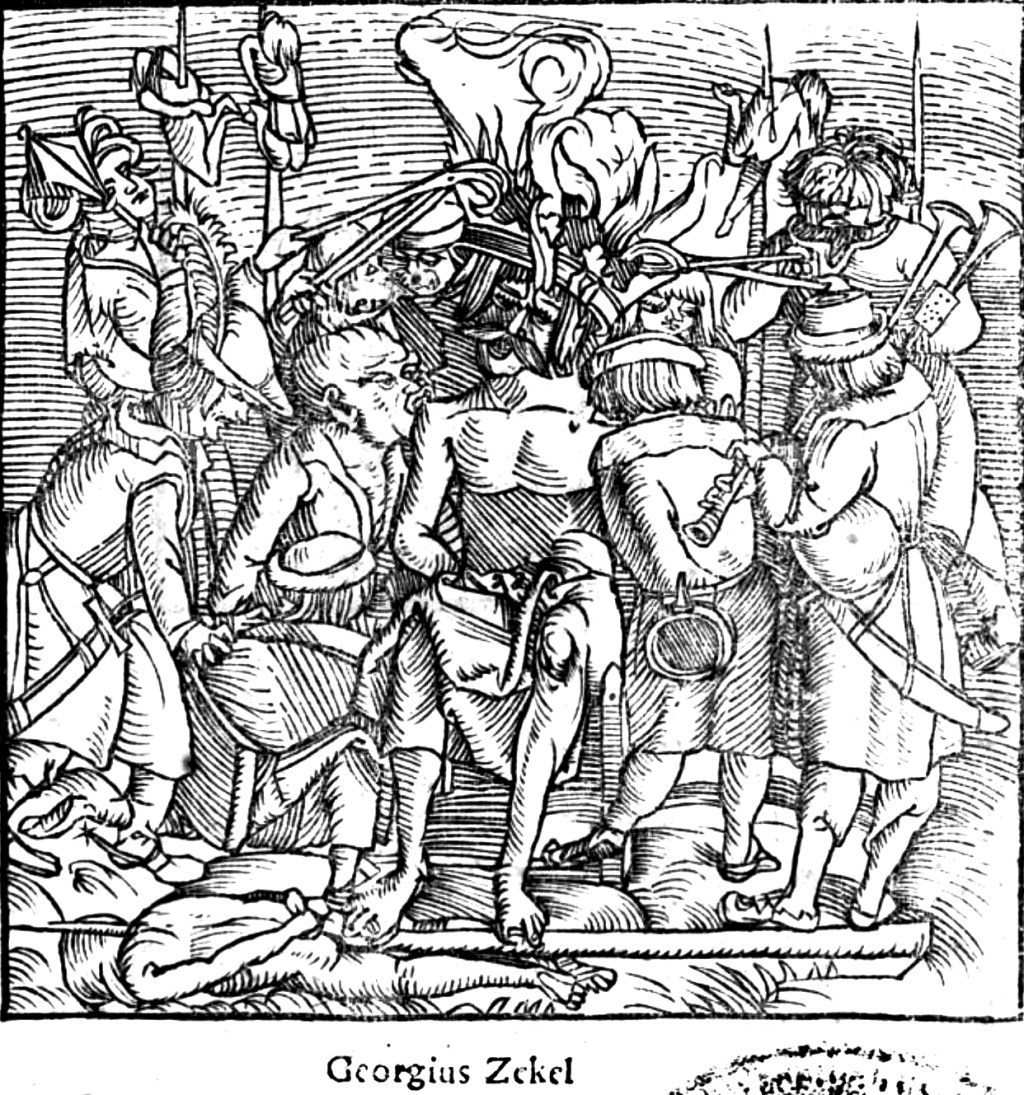
    With all that said, according to the account György was brought before a small crowd of notables. As a group of monks sang holy hymns, he was forced to set on a metal throne, which according to some versions of the story had been heated. Then a crown of red-hot iron was placed on his head. Nine prisoners were brought before the mock king. One of them was his brother Gergeley, whom György had been begging the authorities to spare. Gergeley had not even wanted to really join the crusade in the first place, until György convinced him. Instead of being given a pardon, Gergeley was cut down before him. The executions then took red-hot pincers and began ripping out parts of György’s flesh. The surviving prisoners were ordered to bite into his body; those who refused were killed on the spot. One account claims that grown men who watched this fainted at the site, others simply left. Another said that the moment György died one could see an apparition of the Virgin Mary herself, escorting György’s soul to Heaven. As for the execution itself, there was a sacred and symbolic logic there on top of the brutality. To quote Barabási, “The country is a body, organic and alive, as the king had often emphasized. György must die the way he disfigured his homeland—by biting into its live body.”

    The ones who agreed to cannibalize György so were spared from any further punishment and released. Apparently, the authorities were content with the punishment inflicted on him. In fact, a surprising number of the peasants involved in the crusades were given clemency. Someone needed to work the fields in time for the harvest, after all.

    The revolt did not quite end there. Several leaders including Lőrinc escaped or eluded capture and carried on the fight in parts of Transylvania. Fights and massacres erupted all over the country. In the end, though, order was restored.

    Still, György’s revolt unnerved those in power. That same year, by 1514 a proposed law code, the Tripartitum, was put together and presented to the Diet of Hungary. It would never be formally enacted, but nonetheless it would become a widely used source for Hungarian courts in the centuries to come. One source said the Tripartitum was “written in the blood of serfs.” To be fair, the Tripartitum codified a number of rights for both landholding and dependent peasants, but in other ways it also whittled away at their traditional rights. The rights of peasants to inherit and own land or to migrate were restricted. One day of service per week to the lords was now mandated and taxes and church tithes were set at fixed and high rates. To cap it all off, the Diet officially declared that the peasantry were now placed in a state of perpetual servitude in order to “remind you what a crime it is to rise up against your master.”

    Admittedly this didn’t happen entirely as a crackdown following the revolts. Some historians have argued that eastern Europe experienced a period of neo-feudalism or “Second Feudalism”, something I already touched on in my episode about Hans Bohm. But to go into more detail, from the late fifteenth century and well into the sixteenth century, Bohemia, Poland, Austria, Livonia, and parts of northeastern Germany enacted laws that also prevented peasants from moving freely and restricted their rights over their own lands, after feudalism had been in long decline in most of the rest of western and central Europe. Historians have proposed numerous explanations. One is the political threat of the Ottoman Empire, another points to the fact that Western Europe was more urbanized than the East. A more elaborate theory considers that the economies of western Europe were rapidly changing due mainly to the beginnings of colonial expansion into the Americas. The theory goes that colonization led to an infusion of wealth and raw materials into western Europe, which in turn fueled an explosion in manufacturing. This boosted trade between western and eastern Europe, with western Europe trading manufactured goods and eastern Europe trading agricultural produce in turn. With the growth in trade came a growth in demand, and landowners had the incentive to keep their peasants stuck on their farmlands as much as possible.

    Whatever the truth of the matter, and of course other historians have questioned the entire Second Feudalism thesis, the peasant crusade may have been fighting against forces that were already coalescing. At the very least, György’s revolution became an excuse to do what the powers that be wanted to do anyway.

    Then there’s the what-if questions the crusade leaves behind. King “Yes, Alright” died, but before his death he managed to get the nobility to accept as king his ten-year-old son, who was named King Lajos II. By this point the nobility had such a tight grip over royal finances that Lajos and his household had to pawn several of their personal possessions at several points to afford necessities. The army faired no better, with entire border fortresses left in need of repairs or understaffed. In 1526, Sultan Suleiman of the Ottoman Empire marched to go to war against Hungary, the type of scenario King Mathias had tried to prepare for. At the Battle of Mohács, most of Hungary’s high nobility, the very nobles who had been running the state for the past couple of decades, was cut down, and the then twenty-year-old King Lajos died when he fell off his horse and died in a stream because he couldn’t get up due to the weight of his armor. Hungary itself literally shattered: there was Royal Hungary, which was claimed by the Hapsburgs of Austria in the name of Lajos’ sister Anna who had married into the family; the Ottoman province of Hungary; and the Principality of Transylvania, whose leaders first claimed to be the rightful kings of Hungary and maintained a precarious independence by playing the Ottomans and the Hapsburgs off against each other.

    Would this have happened if Pope Leo had never tried rising a people’s crusade or if the clergy of Hungary had taken a different, better approach? Or if György’s revolt had been averted or if it had succeeded at least to the point that it provoked some beneficial reforms? Possibly; after all Hungary’s once formidable war machine had been breaking down from decades of neglect and underfunding while the Ottoman Empire was at what would prove in hindsight to be its peak. Still, it could very well have been decisive that the memories of the revolt were still so raw that peasants and burghers walked away from the call for recruits and some nobles and officials were extremely reluctant to try arming groups of peasants.

     If nothing else, I would say it’s a cautionary tale about how the powerful’s attempts to protect their self-interest at the expense of everyone else can, sooner or even much later, backfire spectacularly.

  • The Queen Who Became a Professional Writer

    The Queen Who Became a Professional Writer

    Marguerite de Navarre is the sister and wife of kings. While coping with being an agent of her brother and navigating the religious turmoil, she still found the time to become a bestselling author and perhaps the “first modern woman.”

    Sources

    Cholakian, Patricia F. and Rouben C. Marguerite de Navarre: Mother of the Renaissance (Columbia University Press, 2006).

    Gristwood, Sarah. “I Wrote a Book About Renaissance Queens. Today’s Stories of Sex Assault Sound Like Something Out of the 16th Century.” History News Network. 3 December 2017. Last Accessed: 7/9/2026.

    Knecht, Robert J. Renaissance Warrior and Patron: The Reign of Francis I (Cambridge University Press, 1994).

    Transcript

    Sometime in the year 1544 in England, a precocious eleven-year-old girl came up with a special gift for her stepmother Catherine. She translated a poem from French into English herself and bound it in a manuscript, titled The Miroir or Glass of the Sinful Soul. The girl may have also embroidered the book cover herself with silk threads in flower and Celtic knot patterns, although we don’t know for sure. The stepmother, who always treated the girl like the biological daughter she never had, cherished the gift. It was among her personal  possessions when she died, and it still rests today in the University of Oxford’s Bodlean Library.

    If any of you are Tudor history buffs, you probably already knew or at least guessed that the stepmother was King Henry VIII’s sixth and final wife Catherine Parr and the girl was the future Queen Elizabeth I of England. It’s a small moment, but it’s one that is in a way rare and profound. In this window of time, three generations of women were connected across time: Catherine Parr, Elizabeth Tudor, and the poem’s original author, Marguerite de Valois or to go by the title she held by the end of her life, Marguerite Queen of Navarre. They were all women born into the halls of power, yet they did experience hardships and were at various points at the mercy of men. Despite such obstacles, all three also left their own marks on history.

    Of course, none left as large a mark as the eleven-year-old Elizabeth would, even though at the time she was still the third in line for the English throne with an older brother no one had reason to assume wouldn’t live and one day have heirs of his own. Not only that, but many inside and outside of England believed she was technically born out of wedlock; long story. But even in the shadow of Elizabeth’s own unlikely and eventually perilous rise to the top, the other two women also made their own stands. Catherine Parr defended and sponsored church reformers and early Protestants, even though at one point it nearly got her sentenced to death by her own husband. Marguerite of Navarre was also a friend and protector of the church reform movement and even some of the early representatives of the Protestant Reformation. She constantly had to navigate between the demands of her king and brother and her own religious sympathies. Also she was not only a patron of the arts, but a writer herself, one of the first women who made her voice heard across Europe through the printing press. Finally while she was not the first, she was an early case of a woman who used her wealth and social position to host gatherings of intellectuals and writers, a particular French phenomenon known as the salon.

    This is a story of how one woman was a princess and a queen, but through her own efforts she also became something rather modern, a literary celebrity and a public intellectual.

    This is Turning Modern.

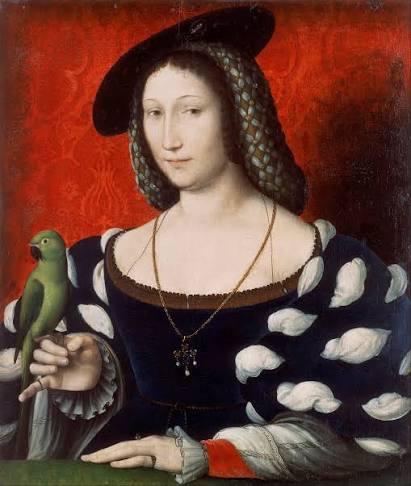
    Marguerite de Valois, future queen of Navarre, came from a poor, low-profile branch of her family. That family was the French royal family, so it wasn’t like she lived in squalor and obscurity, although the family was poor enough they chose not to hold celebrations over her birth, not least because she was just a daughter. Her prospects were thin or at least they would have been if not for France’s Salic Law, which had come into full force by her lifetime and which barred women and men descended from royal women from inheriting the French throne. The reigning king Louis XII was a distant cousin, but the Salic Law meant that Louis XII’s heir happened to be her younger brother, Francois.

    Theirs was a small and close-knit family. The marriage of Marguerite and Francois’ mother, Louise of Savoy, to their father Charles Count of Angoulême had been an arranged one, yet Louise and Charles genuinely loved each other…despite Charles having two mistresses. Forget it Jake, it’s France. Anyway, when Charles died in 1496, Louise was devastated and devoted her life to her only son Francois. Marguerite followed suit. Of course this is the sort of thing you would expect from a patriarchal society, but Francois did embody life-changing prospects for both his mother and his sister. It certainly helped that even as a teenager Francois struck the model of the ideal Renaissance prince – handsome (if a little big-nosed), well-built, charming, naturally chivalrous, and with a genuine passion for art, literature and fashion. He definitely cut a more attractive figure next to the elderly and miserly King Louis XII. Louise of Savoy affectionately called Francois “her Ceaser”, and for the most part Marguerite and Francois remained close for the rest of their lives, so much so that their relationship would inspire malicious rumors of incest.

    After the death of his wife Anne of Brittany, Louis XII acquired a new queen, Mary Tudor, the beautiful and vivacious young sister of the new king of England, Henry VIII. She was over three decades younger than her new husband. Louis XII died just a few months after the marriage, causing people to joke that sex with an attractive young bride was what  killed the old king. Students at the Sorbonne even put together a satirical play that showed the king being given a philly that carried him off to Hell.

    Marguerite herself was nearly married to the English prince who would become Henry VIII and even to Mary and Henry’s father, King Henry VII, when he was still alive. One account says that when Marguerite was approached by representatives of King Louis, she told  them off, saying, “When my brother becomes king, I will marry a man who is young, rich, and noble— without having to cross the [English] Channel!” Perhaps because her mother opposed the match as well, Louis XII actually dropped the plan.  

    Louise of Savoy had fretted that Mary Tudor would finally give Louis XII a male heir. Instead, her son Francois was now king. Marguerite ascended along with her brother. In fact, she rose far more than a French king’s sister should have, to the point you can see where the rumors of incest began. In the early years of Francois’ reign it was actually Marguerite who was for all intents and purposes the queen of France, and not Francois’ actual wife, the old king Louis XII’s daughter Claude. It was Marguerite who made the usual public appearances reserved for the queen of France, while Claude went to church, played cards with her ladies, and did the important work of being pregnant and giving birth. It was even Marguerite who went to Francois’ royal coronation while Claude stayed home, heavily pregnant.   Despite Marguerite’s defiant prophecy, she was already married to a man she would have almost certainly not chosen on her own: Duke Charles of Alencon, another distant relation of the royal family who stood in the line of succession. His family’s fiefdom happened to be a rich slice of territory, so the marriage was just a way of keeping a wealthy far-off relation close. He was sickly, not particularly intelligent, and while like many young prominent noblemen he was a commander in the armed forces he wasn’t a terribly competent soldier. Marguerite’s feelings about Charles would soften later in life, but in a poem she wrote after his death, The Prisons, she described him this way: “having neither read nor studied, / he would never have been taken for an orator.” For a girl who adored her athletic and intellectual brother, this husband must have been a disappointment, but this time she apparently had no say. Either she spent whatever leverage she had rejecting the betrothal to Henry VII or it was much easier for her to escape a marriage to an old foreign king than to a young man close to home.

    Complicating the matter is the chance that Marguerite was possibly attracted to a man who better matched her dreams, the dashing and witty Guillaume Gouffier, Lord of Bonnivet. We can only mostly reconstruct Marguerite’s history with Bonnivet from a trail of hints left across her writings, especially her short story collection The Heptameron. Perhaps in her mother and brother’s mind, Marguerite had to be married off precisely because she was an attractive girl with an extroverted personality who was already attracting men while being drawn to them. If some of the stories in The Heptameron had any basis in reality, one man went so far as to “accidentally” fall of his horse into some mud so he would have an excuse to be naked in Marguerite’s presence. As for Bonnivet himself, I have to admit this is speculation on my part. It is perhaps important context for the far darker turn their relationship would take.

    Marguerite of Navarre’s modern biographers, Patricia Francis and Rouben Cholakian, believe something traumatic happened to Marguerite, perhaps in 1520. While her husband was elsewhere, she and her brother were staying at the main estate of Bonnivet, who was a close confidant of the king. After Marguerite fell asleep, Bonnivet snuck into her room through a trap door and assaulted her. Marguerite tried to push him off and scratch him while screaming for help. Her attendants ran into the room and in the darkness Bonnivet was able to make his escape. Furious, Marguerite swore she would tell her brother and see Bonnivet put to death. However, an older woman among her attendants advised her to keep quiet despite herself. Marguerite had done nothing wrong, but people knew she had enjoyed Bonnivet’s company at one time or another. They might even say, she warned, that she had seduced Bonnivet and contrived his death. Marguerite was convinced. She got up the next day and joined her brother and Bonnivet for breakfast as if nothing had happened. Marguerite may have also been heeding the words of Anne de Beaujeu, another woman from the royal family who had been the regent of France for a time. Anne had written a sort of self-help book for aristocratic women, in which she wrote, ““Whatever your age, guard against being deceived . . . you can be blamed even for something very slight.” There is no man of worth, however noble he may be, who does not use treachery, nor to whom it does not seem good sport to deceive or trick women of rank.” Sadly the advice shared by Marguerite’s attendant and Anne de Beaujeu is still sadly a part of women’s experience even centuries later.

    Of course, we don’t know for sure that such a thing happened. However, the story I just described is in the short story collection Marguerite wrote, The Heptameron, only instead of Marguerite and Francois they are a nameless Flemish noblewoman, her brother, and a family friend. However, in his gossipy chronicles the abbot of Brantome declared that the story was true and that the assailant was Bonnivet. If anyone would have known it would have been Brantome, whose grandmother and mother would have been ladies-in-waiting to Marguerite at the time. And as the Cholakians point out, throughout the stories of The Heptameron, “rape and seduction are prominent themes.”

    While we may know of Marguerite’s traumatic past, we don’t know much about how she saw her marriage. They had no children, and Marguerite spent much of her time away in Paris at the royal court. At the same time, she turned more to religion, spending time in religious meditations and writing devout poetry. Her guide was Guillaume Brisonnet, bishop of Meaux, who was famous and in some circles notorious for being an advocate for church reform. In this time, Marguerite began to establish a reputation as a church reformer who in some eyes skirted around outright heresy. Yet, she never became a Protestant. Instead, she belonged to a group one might call moderate reformers, who agreed with Martin Luther and his crew that the Church was in need of drastic change but they still strongly accepted papal authority and the hierarchy of the Catholic Church. The hardline stance of the Council of Trent forced the moderate reformers to get in line or to abandon the Church and drew a sharper line between Catholics and Protestants, but that would not happen until after Marguerite’s death. For the time being, there was still a space in which one could be sympathetic to some Protestant ideas and still more or less be a good Catholic, although it was a difficult and even dangerous space to be in.

    At the Battle of Pavia in 1525, fought between France and the forces of Emperor Charles V of the Holy Roman Empire, King Francois was taken prisoner. Bonnivet was killed in the fighting. Marguerite’s husband Alencon also survived. He was one of the few high-profile nobles at the battle who lived and escaped capture, but this was at best a mixed blessing. One account claimed he simply misjudged the situation and mistakenly ordered his regiment to retreat in the chaos; another said he deliberately left the scene of the battle when it seemed like the French cause was doomed. In any case, as Alencon returned home, a crowd would gather wherever he stopped to rest or spend the night and jeer at him as a coward and pelt him with insults and stones. Louise of Savoy blamed him for the imprisonment of her son and retaliated by keeping him and Marguerite apart. The stress of his humiliation worsened his already poor health, to the point that it became clear he was dying. Marguerite defied her own mother’s orders to stay with her husband in his final moments and he died in her arms.

    While Louise of Savoy during her son’s imprisonment became the ruler of France, Francois explicitly asked that Marguerite handle the negotiations for his release. Although negotiations stalled at first, she did succeed, although she also advised her brother to break the terms of the treaty she herself negotiated as soon as he crossed over France’s borders. Like her mother, Marguerite was pragmatic when she needed to be.

    Marguerite was too valuable a commodity in dynastic terms to be left unmarried. Her next marriage was politically useful, but she probably did have more of a choice this time. Her groom was King Henri II of Navarre, a small kingdom in the Pyrenees that had been made even smaller after the southern half of the kingdom was invaded by Spain but Henri had also inherited some lands in southwestern France. Henri was ten years younger than Marguerite and was many things Alencon was not: a valiant soldier, a natural speaker, and a wit with an interest in literature. Tellingly, Marguerite spent less time at Paris and more time at her husband’s estate at Nerac in southwest France. Henri did have his mistresses, but there are hints that he and Marguerite were attracted to each other. And they did have two children, a daughter named Jeanne, who would become the mother of the future King Henri IV of France, and Jean, a baby who died soon after birth. This loss devastated Marguerite, and afterward for the rest of her life she would dress in a widow’s black.

    At Nerac, Marguerite of Navarre truly came into her own. With the encouragement of a Protestant publisher, Simon du Bois, she published “The Mirror of the Sinful Soul”, the very poem that the future Queen Elizabeth of England would translate for her stepmother Catherine Parr. Almost certainly inspired by the death of her son, Marguerite wrote the poem about triumphing over her own weaknesses and even death itself through faith. The poem was, in sixteenth century terms, a bestseller. It was translated into Latin for international release and republished no less than eleven times in her lifetime.

    It was also at Nerac where Marguerite established her own salon, where writers, theologians, and artists who sought her patronage or protection would visit. She also patroned and commissioned works from her own favored stable of writers and scholars. One such man was the physician Francois Rabelais, the author of the satirical French prose epic Gargantua and Pantagruel. It was Marguerite who also commissioned the first translation of Boccaccio’s short story collection The Decameron into French and had it published. When the religious firebrand Jean Calvin was on the run from authorities, it was Nerac where he sought sanctuary until the heat died down. Marguerite did not hesitate to step in to protect other moderate reformers and even outright Protestants, even from her own brother.

    The day came when she had to back down, though. In 1534, pro-Protestant pamphlets were seen around Paris and its environs. On the so-called Day of the Placards, when pamphlets were found even in the king’s private apartments, he was terrified and enraged. The crackdown on the French Protestants or Huguenots truly began then. Marguerite tried to convince her brother that the pamphlets must have instead been distributed by the Huguenots’ enemies to discredit them, but this time she pushed too hard. She left Nerac for Navarre and for over two months neither she nor Francois wrote to each other, an unprecedented gap in their correspondence, suggesting either that one of them was giving the other the silent treatment or the letters were discreetly destroyed. Despite all that, few doubted that she was a good Catholic. It’s telling that both the Pope Paul III and the staunchly Protestant city council of the Swiss city of Berne both warmly wrote to her and asked her for favors.

    While she fulfilled her traditional role as the sister and wife of kings, dispensing favors and securing her own network of clients, she also embarked on a career as an author. She continued publishing her poetry. She may have also intended to publish her own short story collection The Heptameron, which was clearly inspired by The Decameron, but sadly it was unfinished by the time of her death.

    While she clearly took a personal pride in publishing her own writing, criticisms by the French clergy over “The Mirror of the Sinful Soul”, especially in the wake of the Day of the Placards, stung her enough that she rarely published anything after 1533. Over a decade later, she lost her beloved brother Francois. Their relationship had become somewhat strained, both by Francois reneging on his promise to work on restoring the stolen half of her husband’s kingdom and on the growing persecutions of the Huguenots and other so-called heretics that alarmed Marguerite. Still, when he died she wrote a poem lamenting his absence. It reads, “My life was filled with sugar and honey / when it was sustained by his, / but now it is nothing but absence and bitterness.” Perhaps it was the loss of the rest of her small family – Louise of Savoy had died in 1531 – that caused Marguerite to turn to the more mystical sides of Christianity. This alienated a few of her Protestant friends, including Jean Calvin, but Marguerite was never one to let others define her own understanding of God.

    One day in 1549, Marguerite may have watched as Haley’s Comet passed the Earth. If she did, she may have wondered if it was predicting her own death. Not long after she would have seen the comet, she did become sick with pneumonia so severe that she lost the ability to speak for several days. She died on December 1 that year at the age of 57.

    One of the women who knew her well was her lady-in-waiting, a young English noblewoman named Anne Boleyn. Anne would share both Marguerite’s reformist sympathies and her independent streak, although the latter played a role in getting her executed at the orders of her own husband, Henry VIII. Anne Boleyn’s daughter Elizabeth would be very same future queen of England who would translate Marguerite’s own words as a present. Of course, such connections are easily explained by the frankly incestuous world of European high nobility and royalty. And yet, there is something in how closely connected these women were, like members of an intimate spiritual lineage.

    Marguerite seemed herself to stand astride both the old world and the new. Some of her religious sentiments like her fixation on arcane mysticism had a sense of the medieval, but she also showed an open-mindedness and a constant spiritual reevaluation and experimentation that made both Catholics and Protestants uncomfortable and revealed something of the modern. She served as a patron, a protector, and a political agent like any good queen since ancient times, but at the same time she had something of a career as a writer, whose works were so successful they set early sales records for the nascent print industry. I honestly think one can go so far as agree with the translator Samuel Putnam, who referred to Marguerite of Navarre as the “first modern woman.”

    Thank you for listening.

  • The Actual First Bible Translated into English (And The Man Who Died For It)

    The Actual First Bible Translated into English (And The Man Who Died For It)

    An Oxford grad and private tutor has a dream of making the first English Bible translated directly from Hebrew and Greek. Unfortunately, his ambition becomes a matter of life and death once his scholarly endeavors become just another front in the war to decide Europe’s religious future.

    Sources

    Daniell, David. The Bible in English: Its History and Influence (Yale University Press, 2003).

    Foxe, John. Foxe’s Book of Martyrs: Selected Narratives, ed. John N. King (Oxford University Press, 2009).

    ___________.  William Tyndale: A Biography (Yale University Press, 1994).

    Moynahan, Brian. William Tyndale: If God Spare My Life (Abacus, 2002).

    Transcript

    The scholar from England prayed aloud as he was bound to the stake. The path of his destiny brought him from the halls of Oxford to London and finally to the old duchy of Burgundy, where his fate was discussed in the halls of power. Diplomats and ministers all either tried in vain to save him or signed off on his condemnation.  

    He had time to cry out to the watching crowd, “Lord, open the king of England’s eyes!” before his very breath was cut off. The executioner strangled him with a rope before his body was to be burned as punishment for heresy. This was the only mercy that God or humanity granted him. But still, he must have thought, at least it was preferable to the flames.

    His body was burned, any bits of bone were smashed into powder, and the ashes were scattered, all to present anyone from claiming his remains as relics of martyrdom. It was too late though. Already his name had become a rallying cry, a watchword for resistance and defiance.

    What crime or revolutionary act did this man do? He translated a book.

    This is Turning Modern.

    One of the annoying things about us historians is that you can ask us a simple question and the odds aren’t bad that we’ll just answer, “Well, it depends on what you mean.” Case in point: what was the first English translation of the Bible? Well, it depends on what you mean by “English” and by “the Bible.” If you count Old English and any of the Books of the Bible, then it would be the monk Bede’s translation of the Gospel of John in the eighth century. According to legend, a century later King Alfred himself translated parts of Exodus and the Book of Psalms. There were other Old English translations of other parts of the Bible, including all four Gospels. There were also Middle English translations, but of just parts of the Old and New Testaments.

    Now if you mean the complete Bible in English, then that honor would go to the Bible translation made by John Wyclife in the fourteenth century. His translation was based on the version of the Bible used by the clergy of the Catholic Church for centuries, the Vulgate of St. Jerome, so named because it was written in the popularly spoken or vulgar version of the Latin.

    It wasn’t so much that the Catholic Church totally rejected all other versions of the Bible. They authorized translations for missionary purposes, like the invention of the Cyrillic alphabet in the ninth century to allow passages of the Bible to be written for Slavic readers. While that particular project had the backing of the Pope himself, though, there was still some opposition among the clergy, anxious that the Bible could be transmitted in a new and unfamiliar form.

    This fear grew more acute as Latin became a dead language – or more like an undead language that still shambled on as the language of the Church and diplomacy and scholarship, just not a language average people actually spoke – and vernacular languages becoming not just spoken but written as well. The thing is, the Catholic Church was right to be anxious over vernacular translations of the Bible. The first complete translation of the New Testament in a Western European vernacular language we know about was made in the twelfth century by the Waldensians, a heretical sect hounded by the Church. After all, translation is an art, not a science, and the act of interpretation itself can be inflammatory.

    Still, the Catholic Church itself never technically banned translations of the Bible. Like the punishment and execution of heretics, that was left to states, what the Church referred to as the “secular arm.” In the High Middle Ages, as literature written in vernacular languages became more common and as the Church reached the height of its power, laws against unauthorized biblical translations spread. In England, the so-called heretical movement sparked by John Wycliffe, the very same Wycliffe who produced the first English Bible translation, became the object of persecution. Wycliffe’s desire to make the Bible more accessible went hand in hand with his criticisms of the Catholic Church, especially papal authority. At the end of the fourteenth century, King Henry IV came to the throne by overthrowing his cousin Richard, so to secure his reign he felt obliged to get the Church on his side. Persecutions and executions for heresy in England had been rare until in 1400 Henry IV got the Parliament of England to pass a law cracking down on heretics, namely John Wycliffe’s followers, called the Lollards. The text of the law reads, “It is a dangerous thing, as witnesseth blessed St Jerome to translate the text of the holy Scripture out of one tongue into another, for in the translation the same sense is not always easily kept… We therefore decree and ordain, that no man, hereafter, by his own authority translate any text of the Scripture into English or any other tongue, by way of a book, libel or treatise; and that no man can read any such book, libel or treatise, now lately set forth in the time of John Wycliffe, or since, or hereafter to be set forth, in part or in whole, privily or apertly, upon pain of greater excommunication.”

    But even under the threat of being burned alive, the Lollards persisted, even if they did have to go underground. And it was perhaps inevitable, especially as the Middle English of John Wycliffe became increasingly incomprehensible to future generations, that someone else would take up the challenge of producing an English Bible. That man came from an unassuming gentry family in Gloucestershire in southwest England, William Tyndale. We don’t know much about his family and even the year of his birth, 1494, is just a guestimate. But his family must have been well-off as his brothers were a government official and a successful merchant based in London.    

    Tyndale doesn’t truly appear on the historical record until he became an undergraduate student at Oxford. He aspired to become a priest, but even at the university with England’s premier faculty of theology, according to his own writings Tyndale was quickly disillusioned at how the professors and his fellow students were much more interested in logical propositions derived from Aristotle’s philosophy than they were in the Bible itself. There were other reasons why Tyndale would have been disgruntled with the Catholic Church in general. He had to have known that the bishops of Worcester, who oversaw the pastoral care of Tyndale’s home community, were just absentee bishops. Three consecutive bishops of Worcester from 1512 on were Italians in Rome, who lived off the income that came from the office but never set foot on English soil, much less in their own diocese. Tyndale’s youth also coincided with the rise of the English church prelate Cardinal Wolsey, who essentially became the prime minister under the young King Henry VIII. Wolsey made so much money off the church and his worldly career he built a palace for himself more extravagant than any owned by the king. Later in life, Tyndale wrote scathingly about Wolsey, calling him “Wolfsee” and saying “this wily wolf, I say, and raging sea, and shipwreck of all England.”

    After Tyndale finished his Bachelors degree and spent the required year after graduation as a lecturer at Oxford, Tyndale chose not to continue his graduate studies there. Instead, he went to Cambridge, which at the time had a reputation as what we might call today Oxford’s safety school. For Tyndale, though, while Oxford was a stronghold for stale orthodoxy, Cambridge had a reputation for Lollard sympathies lurking just under the surface.

    It was an exciting but also frightening time for those like Tyndale who had serious doubts over the status quo. The Dutch humanist Erasmus, who had even taught at Cambridge for several years, published through the new printing press the first bilingual editions of the books of the New Testament, which had passages from St. Jerome’s Latin Vulgate alongside the original Greek the New Testament was written in along with detailed scholarly annotations. Then a rebellious monk named Martin Luther made a stir with his highly publicized dispute with the Catholic Church itself. By 1522, Luther and his sympathizers translated the entire canonical Bible, also with annotations, into German from the original Hebrew and Greek. Tyndale had his inspiration.

    After completing his Masters at Cambridge, Tyndale took a job as a private tutor for a family of Welsh landowners back in Gloucestershire. His life was comfortable and he was well-liked, but the desire to become a preacher and possibly even more never left Tyndale. According to John Foxe’s Book of Martyrs, which is the only source for several details about Tyndale’s life, Tyndale cut his teeth on preaching at an open space in the nearby city of Bristol, a spot today called College Green.

    Eventually Tyndale left for London with just some savings, a letter of recommendation from his former employers, and a hope that he would find a patron who would help him fulfill his dream of writing an English translation of the entire Bible. I don’t think I’m going out on a limb when I say that a fair number of intellectuals at least tend to be not very skillful at dealing with people or politics. Tyndale was one such scholar. His first major contact in London was the bishop of London himself. He genuinely hoped that the bishop would sponsor him and use his authority to suspend the heresy law to allow the translation to be published. The bishop politely but firmly refused. Tyndale turned instead to a group of merchants who sympathized with Luther. They raised enough money for Tyndale to support himself and leave for Germany, where he could solicit support from the Lutherans themselves and work without fear of persecution. Either right away or eventually he set himself up in the city of Hamburg, where he began work on what you could call the first real English bible, since it was the first one translated into English directly from the original Hebrew and Greek. While he likely learned Greek from Cambridge, we don’t actually know where he learned Hebrew, which was still a difficult language to learn outside Europe’s Jewish communities. What we do know for sure is that Tyndale also taught himself German just so he could use Martin Luther’s German Bible as a resource along with Erasmus’ New Testament. What Tyndale did not use as a source was Wycliffe’s English translation. Tyndale wanted his work to be wholly original.

    Indeed it was. Perhaps only Shakespeare played a larger role in shaping modern English than Tyndale and his biblical translations. In fact, he created new words by combining existing ones and devised phrases still used today, so much so that some words and phrases are mistakenly attributed to him when they are older. It was Tyndale who combined two English words to come up with Passover as a name for the Jewish holiday of Pasech. In his bible Wycliffe had erroneously termed the holiday “Easter.”  He did the same to invent the word “scapegoat.” His translation also gave us the phrases “eat, drink, and be merry,” “the powers that be”, “sign of the times”, and “it came to pass”, among others.

    It was the originality of Tyndale’s translation that made it dangerous, so much so it vindicated the authorities’ concerns about new and unauthorized translations of scripture. The controversy was inflamed by Tyndale’s interpretations of two particular Greek words. He interpreted the Greek word ecclesia as “congregation” instead of “church.” This was a total rewriting of the verse Matthew 16:18, in which Jesus declared to the apostle Peter, “Upon this rock I will build my church.” The Catholic Church’s entire claim to special authority rested on this verse, since the Popes were held to be the successors of Peter. Take “church” out of the verse and arguably you take away the entire foundation stone for the papacy’s legitimacy.

    The other word was presbuteros. Traditionally it was seen as a Greek word for “priest.” Tyndale instead rendered it in English as “senior” or “elder.” This one simple word choice was also explosive. The implication was that the presbuteros referred to in the Bible was not meant to be a special elite but simply an experienced leader of their congregation. Of course, Tyndale’s translations were not made in a vacuum. His choices were informed by the Lollard and Lutheran ideas he harbored most of his life. Even so, through translation, he was making these choices historically and theologically defensible, presenting them as not just a difference of scholarly opinion but a much more authentic understanding of the original text.

    Tyndale started publishing his Bible as separate books, beginning with the New Testament in 1526 and then Genesis in 1530 with Tyndale also continuously producing revised editions. Like the Waldensian bibles, these were published in slim volumes that people could easily carry with them – and easily hide from hostile eyes if necessary. Of course, Tyndale couldn’t just have his volumes of the Bible printed in England. Instead, he went to the northern German city of Cologne, which had already become a major center for the burgeoning book industry. The city was ruled by an archbishop and any book published there needed his permission to be legally printed, but since it was a publication by a foreign author in a foreign language, it was not difficult to get around the law. Tyndale turned to other publishers, soon relocating to the city of Antwerp, He hoped to eventually provide a translation of the entire Bible, the first directly translated into English.

    His books were contraband and copies were publicly burned, with authorities having to rather awkwardly explain that they weren’t burning true copies of the books of the Bible, just deliberate heretical mistranslation. Already in 1526 when Tyndale’s New Testament just started appearing in England the bishop of London, the same one Tyndale tried approaching, issued a proclamation banning copies of Tyndale’s translation, declaring, “Many children of iniquity, maintainers of Luther’s sect, blinded through extreme wickedness and wandering from the way of truth and the catholic faith, craftily have translated the New Testament into our English tongue, intermeddling therewith many heretical articles and erroneous opinions …”

    Tyndale’s most ferocious enemy was Thomas More, who had taken the place of Cardinal Wolsey as King Henry VIII’s Lord Chancellor after Wolsey fell spectacularly from grace when he failed to secure papal support for the annulment of Henry’s marriage to his queen Catherine of Aragon over her not producing a male heir. More had a personal revulsion for Lollards and Lutherans, and he used his position to escalate persecutions and executions of heretics. He singled out Tyndale and his bibles, snarkily declaring that finding errors in Tyndale’s translations was like finding water in the sea.

    However valid or biased More’s criticisms were, it wasn’t really Tyndale’s academic cred that was at issue. In his biography of Tyndale, Brian Moynahan explains the big deal this way: “The real horror of Tyndale’s Testament to the Church was not so much the words in themselves, however, but that they were English words. As heretical polemic moved out of Latin and into the vernacular, the whole of English society was open to the infection; and one book, passed from hand to hand, read out aloud by a literate to a company of illiterates, and spread by them in turn, could infect a multitude.” One conservative opponent of Tyndale put it this way, remarking on the impact Tyndale’s translations were already having: “Even silly little women want to pass judgment on the Bible as they might on their needle and thread.”

    Henry VIII was no friend of the reformers. He wanted the annulment of his marriage to Catherine of Aragon and his marriage to his mistress Anne Boleyn to be recognized in and outside of England. And, into the bargain, he wanted to be the sole head of the Church of England and break away from papal authority, but he still had no tolerance for the theological claims of men like Tyndale or Luther. So More’s efforts to have Tyndale brought back to England or persecuted on the continent had the king’s full support. Then there was Emperor Charles V, whose realms included Germany and the Netherlands. Charles V also wanted to root out Lutheranism and his aunt happened to be Henry VIII’s ex Catherine of Aragon. But still as an English national Tyndale had support among some of Henry VIII’s officials and among the English merchant community in Brussels, Tyndale was a huge diplomatic snafu in the making for Charles V.

    For the time being, though, Tyndale was safe. He hid out in the so-called English House in Antwerp, which city officials had given to the English merchant community. Essentially, the English House functioned as an embassy, and nobody wanted the legal and diplomatic headaches that would come from trying to force someone out. Unfortunately, for all his work with the Bible, Tyndale did not recognize a Judas when he saw one. This Judas went by the name of Henry Philipps. Like Tyndale himself, Henry Philipps was an Oxford graduate who came from a respectable and well-off family. His father was a landowner, a customs official, and a Member of Parliament prominent enough to have been invited to the wedding of Henry VIII and Anne Boleyn. Unlike Tyndale, for whatever reason Philipps’ life fell apart after he graduated. He lived off any scraps he could beg off or steal from his relatives and friends. Then, suddenly, he came into some money from an unknown source. He arrived at Brussels and enrolled in the University of Louvain, which was known to be a hotbed of reactionary Catholic sentiment. Philipps himself was a devout Catholic, hostile toward Luther and Henry VIII as well. One day, Philipps convinced Tyndale to leave the English House to go to dinner at a restaurant. While they were walking down a narrow ally, Tyndale was ambushed and taken into custody.

    Obviously someone paid Henry Philipps, who disappears from the historical record after this point. But who? Brian Moynahan argues that it was likely Thomas More, but the evidence is circumstantial. If More was behind it, then ironically at almost the same time More himself was sitting in a jail cell, imprisoned for refusing to recognize King Henry VIII as the Head of the Church of England. He would be beheaded, becoming a martyr for Catholics just as Tyndale would become a martyr for Protestants.

    For over a year, Tyndale was kept in prison at the castile of Vilvoorde not far outside of Brussels. Henry VIII’s new right-hand man, Thomas Cromwell, make some effort to secure Tyndale’s release, but complicating matters was that Tyndale was not only a heretic, but was also critical of Henry VIII’s marriage annulment and marriage to Anne Boleyn. Charles V and his officials also dithered, afraid that the ever unpredictable Henry VIII would end up siding with Charles’ archenemy King Francois of France. In the end, though, Tyndale would die.

    Of course Tyndale himself would have probably preferred to live, but I suspect he would also be sorely disappointed to learn that he never got to finish the entire Bible and that the King James Bible would overtake his translation in fame. Still, a modern study found that the majority of words used in the King James Bible were still taken from Tyndale’s translations, with some major exceptions. For example, the King James Bible went back to translating ecclesia as “church”, since the new Church of England had its own legitimacy that had to be traced back to the Apostles of Jesus.

    At the very least, though, I think a language nerd like Tyndale was would be delighted to learn that it’s impossible to avoid his fingerprints in the language English-speakers talk today.

  • The Drop-Out Who Destroyed a Society

    The Drop-Out Who Destroyed a Society

    In 1519, Europeans made their first diplomatic contact with an urbanized empire in the Americas—and, within a few years, that empire will no longer exist, in no small part because of a failed law student from Spain.

    Sources

    Cortés, Hernán. Letters from Mexico, trans. A.R. Pagden  (Orion Books, 1971).

    Florentine Codex, vol. 9, trans. Arthur J.O. Anderson and Charles E. Dibble, rev. ed.  (School of American Research, 1973).

    Gómara, Francisco López de. Cortés: The Life of the Conqueror by His Secretary, trans. Lesley Byrd Simpson (University of California Press, 1964),

    Restall, Matthew. Seven Myths of the Spanish Conquest (Oxford University Press, 2003).

    Townsend, Richard F. The Aztecs, rev. ed.  (Thames & Hudson, 2000).

    Transcript

    Today the Basilica of Our Lady of Guadalupe watches over the Plaza of the Americas in Mexico City. Countless pilgrims come there to see the centerpiece, an image of the Virgin Mary, as it has done since 1531. Although a newer building was constructed next to the old church in 1976 and claimed the Virgin Mary’s holy icon for itself, the older basilica not only still stands but remains open to visitors. However, the entire church hides something of a secret. It was built at the site a temple sacred to the goddess Tonantzin, the “Honored Grandmother” who presided over fertility. This is far from the only case of Christianity placing a thin veneer over older religious practice, but it is perhaps more appropriate than most. More than a place for Catholics to prove their devotion to the mother of Jesus Christ, the Basilica of Our Lady of Guadalupe remains a patriotic symbol for Mexico.

    The very name of the country of Mexico refers to the society that once worshipped Tonatzin, the Aztecs. The story of how the Aztecs’ empire ended was not a simple one of enemy armies swooping into their land. Instead it was the preposterous story of how circumstance and the decisions of one man, who was acting against the orders of his superiors the entire time, devastated an entire civilization.

    This is Turning Modern.

    Contrary to his reputation as a conqueror, Hernán Cortez was born a chronically ill child, who seemed destined to become a  clerk or a member of the church. In truth, he was too unmanageable to be made into a decent student, although he did learn quite a bit about law from the years he spent working as a notary. Cortez came back home as arguably the sixteenth-century Spanish equivalent of a college dropout. Yet while he wasn’t going to become a secretary for some prominent nobleman or a magistrate working for the monarchy, Cortez still had ambitions that were inflamed by the stories coming about a sailor named Christopher Columbus and lands unknown to both the Bible and the ancients.

    Using his family connections, Cortez seized on the first opportunity to go to the New World. Eventually he got a job as a notary and secretary for the governor of Cuba, Diego Velazquez. Cortez went far enough to secure his position in the new colony that he married Velazquez’s sister-in-law. However, being a man on the rise in a new colony was not enough for Cortez, although he may have also been motivated to leave Cuba because relations with Velasquez were starting to go south. In any case, Cortez worked hard to get appointed the commander of an expedition into Mexico, especially since he was interested in the rumors that there were vast hordes of gold and silver to be found there.

    The risks were incalculable. Just two years ago, members of one Spanish expedition into the Yucatan ended with the expedition’s members getting massacred. However, the possible rewards were enough that Cortez easily found a crew of around one hundred men. Along with religious missionaries, their ranks included professional mercenaries, younger sons of noblemen shouldered out of their inheritance by older brothers, and less distinguished men who were simply desperate or greedy for wealth and land.

    Velasquez signed off on the mission at first, but Cores had gone too far. Velasquez attempted to recall the expedition, but Cortez shrugged off the order, even though it made him guilty of mutiny. Instead, Cortez used his knowledge of the law to start building a case that he was acting directly under the authority of the Holy Roman Emperor and King of Spain, Charles V, and not a mere colonial governor.

    From this point on the true story is buried under layers of myth, legend, and outright propaganda. One persistent claim would have it that the natives that Cortez came across were overawed by the strange men from across the sea who seemed connected to blindingly fast beasts with four legs, so much so they thought the god Quetzalcoatl had returned to reclaim his kingdom. This is nonsense; the Aztecs could easily understand that the Spanish were simply a people they had never encountered before. Now it does seem to be true that the Aztecs were frightened by horses and were at a disadvantage because of the Aztecs’ steel armor and guns.

    Cortez had help, though. The first was the greatest ally of Cortez and all would-be conquerors of the Americas from Europe, the disease of smallpox, which preyed on the American populations that had no natural defense against it. Some modern estimates hold that smallpox claimed as much as 90 percent of the indigenous population of the Americas. A possible eyewitness account of the outbreak of the plague from an Aztec perspective might have been preserved in the Florentine Codex, which was written by a Franciscan friar decades after Cortez arrived in the Americas but was drawing on the testimonies of indigenous converts to Christianity. It reads, “But before the Spaniards had risen against us, first there was prevalent a great sickness, a plague. […] No longer could they walk; they only lay in their abodes, in their beds. […] There was death from hunger; there was no one to take care of another; there was no one to attend to another.”

    Fate also put essential allies on Cortez’ path. Cortez came across a friar named Geronimo de Aguilar. Stranded by a shipwreck, he was captured by some Mayans and escaped, but not before he learned the local Mayan language. Then a local Aztec leader gave Cortez twenty enslaved women. One of them as Malintzin, who became remembered with notoriety as La Malinche, who spoke both the Mayan Chontal language and the Aztec language of Nahuatl. With her help as a translator, Cortez was able to negotiate and strike deals with local leaders.

    This made Cortez especially dangerous. The Aztecs’ authority was built on the obedience, grudging or otherwise, of regional chieftains. Some were only kept in line by the threat of force. This was probably why the emperor of the Aztecs, Moctezuma II, made the move he did. In a decision still debated by historians, Moctezuma didn’t send an army to crush Cortez and his band, but instead a formal delegation to invite them to come to the Aztec capital of Tenochtitlan. This was his way of containing the threat, especially as it was undeniable that the presence of the Spanish was already sending ripples through the Aztecs’ delicate system of alliances and vassals. His greed inflamed by the extravagant gifts offered by the delegates, Cortez agreed to go, leaving some of his men behind to guard the territory they occupied in modern-day Veracruz.

    In his letters back to Spain, Cortez expressed astonishment over Tenochtitlan, a vast, well-populated city built over a lake, its streets and buildings interlaced with canals and connected with countless bridges. He writers, “The city is so big and so remarkable that, although is much I could say of it which I shall omit, the little I will say is, I think, almost unbelievable, for the city is much larger than Granada and very much stronger, with as good buildings and many more people than Granada had when it was taken.”

    Less positive was their impression of the Aztec priests who staffed the temples. A memoir written by one of Cortez’ comrades, Bernal Diaz, writes this: “They wore black cloaks like cassocks and long gowns reaching to their feet. Some had hoods like those worn by canons, and others had smaller hoods like those of Dominicans, and they wore their hair very long, right down to their waist, and some had it even reaching down to the ankles. Their hair was covered with blood, and so matted together that it could not be separated, and their ears were cut to pieces by way of penance. They stank like sulfur and they had another bad smell like carrion.”

    There’s no doubt this account was biased, but it does raise an issue worth addressing given the way people have been, let’s say, using history in recent years: the Aztec practice of human sacrifice. I don’t want to argue the point, so let me just have an interlude with a hypothetical of sorts. Let’s say there’s a parallel world where the Aztecs colonized Europe or at least they colonized Portugal and Spain. In other words, it’s a world where the Sunset Conquest took place; people who are fans of Crusader Kings will know what I’m talking about. In their version of the 21st century, the descendants of the Aztecs gave up human sacrifice centuries ago, and their political commentators and scholars are having their own debates over how the Aztec colonization of Europe should be viewed. Some still hold the traditionalist view that the Aztecs brought civilization to Iberia. After all, their descendants may have sacrificed humans to the gods, but these Spanish and Portuguese, they had crowds watch while people were burned alive just because they were accused of secretly worshipping their god the wrong way or they loved people of the same sex.

    That’s just something to keep in perspective if one is tempted to think a society was better off experiencing a Hernán Cortez.

    Anyway, let’s get back to Cortez himself, who is about to have his first meeting with Moctezuma. The first meeting is recounted in Cortez’ letters: “And they were all dressed alike except that Moctezuma wore sandals whereas the others went barefoot; and they held his arm on either side. When we met I dismounted and stepped forward to embrace him, but the two lords who were with him stopped me with their hands so that I should not touch him; and they likewise all performed the ceremony of kissing the earth.”

    For two weeks Cortez through his interpreters negotiated with Moctezuma, trying to get him to acknowledge Charles V as his God-given sovereign. Matters came to a head when he heard reports of a violent clash between his men in Veracruz and some locals, which made him believe that Moctezuma was trying to cut Cortez off from the rest of his forces, or so he would later claim. Whatever the exact truth, Cortez tricked Moctezuma into giving him a private audience in his chambers, giving his men the opportunity to take Moctezuma hostage. After several tense days, Moctezuma gave in. He would allow Christian worship to take place in the Great Pyramid of Tenochtitlan and would acknowledge Charles V as his overlord. With a hint of genuine sympathy, Cortez’s secretary, Francisco Lopez da Gomara, described the speech Moctezuma gave to an assembly of the Aztec elite:

    “You will please me by giving yourselves to this captain as vassals of the Emperor and King of Spain, our sovereign lord, to whom I have already submitted as his servant and friend. And I implore you to obey him henceforth, as you have obeyed me, and give and render him the tributes, taxes, and services that you have rendered me, for you cannot give me greater pleasure.” Moctezuma could say no more, because of his tears and sobs, and all the people wept so bitterly that for a good while they could not even answer him. They sighed and groaned so heavily that they even moved the hearts of our men; but in the end they said they would do as he commanded.”

    Moments like this is why in some historical narratives Moctezuma is seen as a cowardly dupe, cowed and outmaneuvered at every turn by the Spanish. Rather, I think this was a deliberate move to get the Spanish to press their luck too far. He might have also been aware that Cortez had got disturbing news. Velasquez sent a small army to capture Cortez and bring him back to Cuba to be tried for insubordination and treason. Reluctantly, Cortez again split his forces, leading some of his men to confront Velasquez’s squad while leaving one of his lieutenants, Pedro de Alvarado, in charge in Tenochtitlan.

    For reasons lost in the chaos – either Alvarado had been acting out of fear and hatred or he had been tricked by one of the Aztecs’ native enemies – he ordered a massacre of the Aztec people during a religious festival. The Florentine Codex, again likely using the words of an Aztec eyewitness, says, “And the blood of the brave warriors ran like water; it was as if it lay slippery. [. . .] And the Spaniards went everywhere as they searched in the. . . [buildings]. Everywhere they went making thrusts as they searched, in case someone had taken refuge.”

    The manhandling of their monarch was bad enough; the massacre of most of the empire’s nobles in the middle of one of the holiest festivals on the calendar was too much. The inhabitants of Tenochtitlan came out in force, pelting any of the Spanish they saw with stones and darts. Cortez had beaten Velasquez’s squad, only to return to a city that had slipped into chaos. At his urging, Moctezuma stood above the mob on a palace parapet, wearing the turquoise crown, begging for calm from his people. His subjects responded with furious shouts and with stones, one of which dealt a fatal blow to his head. Falling back, Moctezuma’s Spanish jailers hurried him to his bed where he would linger in agony for three days. Cortez and his priests tried to convince him to convert to Christianity, but Moctezuma died a believer in the gods of his ancestors. In his imagining of Moctezuma’s final moments, the writer Arthur Miller, in his play The Golden Years, has Moctezuma turn on his deathbed to a remorseful Cortez who hopes to atone for his crimes by saving the emperor’s soul and quip, “Your god is bloodier than mine.”

    Not long after Moctezuma breathed his last, the Spanish were driven out of Tenochtitlan by its people. This might have marked the moment when destiny finally turned against Cortez, but unfortunately, he was saved by his most precious ally, smallpox. The potential leaders of the empire who were not slain in Alvarado’s massacre, including Moctezuma’s brother and successor, were mostly killed by the plague. Soon enough, Tenochtitlan and the entire Aztec Empire would be claimed and remade by the Spanish.

    Was all this inevitable? How much of a part did one man, a failed law student named Hernán Cortez, play in the downfall of not just an empire but a society? If you go by scholars who are of the persuasion that geography and environment shape history, it was indeed inevitable. Any meeting of the peoples of the Old World and the New would have ended in violence, which the Old World was geared by circumstance to win. I don’t agree. Not just because I find such understandings of history to be callous and simply wrong, but because I just don’t believe in inevitabilities in history. What if someone other than Cortez had made first contact with the Aztecs, leading not to conquest but to agreements, albeit rather unequal agreements, similar to those reached between the Congolese and the Portuguese? I could be wrong. Even before the discovery of the Americas, Charles V already had pretenses of becoming the world emperor worthy of biblical prophecy, and the brutality of the European colonization of the Canary Islands and the Caribbean had already set the tone for what was to come.

    But that’s the thing about counterfactuals. You can never be completely sure; don’t trust anyone who says history ran a predictable course. After all, who can say we actually do live in the best of all possible worlds?  

  • Martin Luther on Trial

    Martin Luther on Trial

    Martin Luther braves persecution by the Church to come to the city of Worms to have his case heard by Emperor Charles V. In this contest between a reviled monk who is the son of a mine owner and a monarch whose empire spans an ocean, the victor is perhaps not the person one would normally expect…

    Sources

    Gregory, Brad S. The Unintended Reformation: How a Religious Revolution Secularized Society (Harvard University Press, 2012).

    Luther, Martin. Works: Letters I, vol. 48, ed. and trans. Gottfried G. Krodel (Fortress Press, 1963).

    Parker, Geoffrey. Emperor: A New Life of Charles V (Yale University Press, 2019).

    Roper, Lyndal. Martin Luther: Renegade and Prophet (Penguin Random House, 2016).

    Transcript

    On a spring day in 1521, a crowd of over 2,000 clogged the streets of the German city of Worms. Many of them were locals, but some had travelled from other towns and regions, just to catch a glimpse of the man who would be arriving.

    A wagon slowly weaved around the hordes of people. Suddenly, it stopped. The man who stepped out of it before the curious and admiring gazes of dozens of people was no king or general or bishop, but a monk and professor of theology whose father owned some copper mines. Even so, people across Europe from peasants to nobles now knew his name: Martin Luther. Once Luther had left the carriage, another monk emerged from the mob and embraced him like an old friend. He also touched his robes three times, like a petitioner hoping for a blessing from a saint.

    Someone who may have glimpsed Martin Luther’s arrival without knowing who he was or why he was there might have guessed that it was a joyous occasion. Instead, Luther was there to be judged before the most powerful man in Europe, Emperor Charles V. If Luther felt any genuine terror in that moment, no one knew but him. As far as his confidents knew, Luther would dive into the lion’s den without hesitation. In fact, he was even prepared to become a martyr.

    This is Turning Modern.

    According to Martin Luther himself, it was a thunderstorm that put him on the path to becoming one of the chief architects of the modern world. When he was a law student and traveling home to visit his family, he was caught in a severe summer thunderstorm near the village of Stotternheim. Likely because his father Hans owned several copper mines, Luther cried out to Saint Anna, the patron saint of miners, and swore that he would become a monk if he survived the storm. And that is exactly what Martin Luther did. In a sign of the defiance he would show throughout his life, he became a monk against the wishes of his stern father, who wanted him to become a lawyer who could represent their family’s interests. It should be said, though, that Martin did everything he could to avoid seeing his father for months after he went to a monastery. As Martin Luther’s modern biographer Lyndal Roper remarks, Luther’s “first step was the rebellion against his father.”

    While his decision to become a monk was likely also motivated by Luther’s lifelong struggles with depression and the recent death of a close friend, there really isn’t much of a reason to doubt Luther’s sincerity here, especially because that part of Germany was known for its violent thunderstorms in the summer. As he settled into the monastic life and rose through the ranks to become a professor of theology, Luther continued to be haunted by depression and the sense that he was awash with sin, much to the chagrin of his confessor, who had to endure Martin Luther’s hours-long, guilt-soaked confessions.

    Eventually Luther’s critical eye turned away from himself and toward the church, especially because of the practice of selling documents promising the remission of sins, called indulgences. Historians now tend to agree that Luther didn’t actually nail his famous Ninety-Five Theses criticizing the Church to the door of the cathedral in Wittenberg. Still, the Ninety-Five Theses were written with the purpose to start scholarly debates, and when they were disseminated through the newfangled technology of the printing press, they immediately provoked the ire of the Church. Luther himself seems to have genuinely had no idea how much controversy he was stirring up.

    Further writings published by Luther added fuel to the fire, both by giving his enemies in the Church ammunition and by making him famous across Germany. As we saw in the previous episode about Hans Behem and the peasant revolt that almost was, Germany had long been simmering with widespread resentment against the Church. For centuries the Church had clashed with Germany’s rulers, the Holy Roman Emperors. Also Germans were well aware that the tithes they paid to the Church more often than not went to funding the papacy’s construction projects in Rome or wars between the Papal States and their Italian rivals. The fact members of the upper ranks of the clergy and independent monasteries were also secular princes, more so in Germany than anywhere else in Europe, made the clergy a particularly unwelcome and burdensome presence in many Germans’ lives, from the members of city councils to the peasantry. One might say that it wasn’t so shocking that Martin Luther became such an overnight sensation, but that a Martin Luther didn’t come along sooner even without help from the printing press.

    In any case, Luther’s story might have turned out very differently if he didn’t have a powerful protector, one of the leading princes of Germany, Elector Frederick III of Saxony. When Pope Leo X excommunicated Luther and Luther kept publishing works critical of the Church, it was Frederick III who kept Luther from being packed off to Rome. Frederick arranged to have Luther’s case put before not the Pope, but the Holy Roman Emperor, Charles V. Charles V was the most powerful monarch the world had ever seen, at least on paper. Through lucky accidents of marriage and birth and political maneuvering, his family had gone from being upstarts on the brink of political extinction to one of the great powerplayers in Europe, claiming not just the office of Holy Roman Emperor but Austria, Naples, Sicily, the modern-day Netherlands and Belgium, Spain, and Spain’s colonies in South and Central America. Unfortunately, this meant Charles was stuck with the unenviable task of running a flimsy patchwork empire, comprised of peoples who all had their own languages, laws, and political institutions and traditions. Making it worse for him was the fact that Charles V was, in the words of Dirk Hoffman-Becking, host of the excellent History of the Germans podcast, “just an average man.”

    Even when the exact magnitude of what Luther would create was far from clear, the disgraced monk already posed a challenge to Charles V’s already overtaxed mind. The papal representative was already calling on Charles V to condemn Luther was a heretic, and alienating the papacy was dangerous since the Pope could side with Charles V’s most powerful rival, King Francois I of France. But on the other hand, the office of Holy Roman Emperor was an elective one, and to help ensure his own recent election Charles V had made a number of concessions to the German princes. One of these was promising that no subject of theirs would be put on trial before a foreign court, and that included the papal court in Rome. Besides that, Charles V was well-aware that Luther was already a celebrity in Germany. Having him killed risked a massive revolt, and since Charles V was already dealing with violent resistance in his dominions in Spain, he could ill-afford to fight rebellions on two separate fronts. Charles V’s advisors also saw in Luther a potential weapon that could be used to bring the Pope to heel, if need be.

    So, when Frederick III asked Charles V to allow Luther to be heard at a planned meeting of the German princes at Worms and to give him a safe conduct, Charles V agreed. It was a decision supported by most of his advisors, but the papal ambassador Girolamo Aleandro was, of course, outraged. During an argument with one of Charles V’s advisors, he prophetically warned, “You will soon see such a fire that all the water in your North Sea will not extinguish it.”

    When Luther heard that the emperor had granted him an opportunity to plead his case at Worms, he told his correspondents that he would not go if the emperor was just going to browbeat him into repenting. If ,on the other hand, he was going to be condemned and executed, he was willing to become a martyr. This was not a remote possibility. Everyone knew very well the case of Jan Hus, a Czech priest also accused of heresy by the Church and who was also promised a safe conduct so he could appear before the Holy Roman Emperor, only to be arrested and burned at the stake.

    Once Luther arrived for his hearing, he was brusquely told by the imperial marshal to answer as briefly as possible, an order that Luther would characteristically ignore. Then he was brought into a large, packed meeting hall. There were up to a thousand people present, not just foreign ambassadors, members of the clergy, German princes or their representatives, and members of the imperial family and court, but also locals from the city and average people who could afford to make the trip. Charles V himself sat on a raised dais, directly facing where Luther spoke. The theologian Johann Eck, who had been a friend of Martin Luther but in recent years had turned into one of his harshest critics, was there, representing the emperor. He pointed toward a pile of books on a bench, all written by Luther since the Church condemned the Ninety-Five Theses, and asked in Latin and then German if Luther had written these books. A theology professor who was acting as a defense attorney of sorts for Luther shouted that the titles of the books should be read for everyone assembled. With that, Eck read out the titles and a brief summary of each one. When he was done Luther cracked a joke: “You haven’t mentioned all my books!”

    Ignoring the jibe, Eck asked again in both Latin and German if he would admit to writing these books, and if he did write them, if he would recant of what they said. Observers remarked that Luther appeared anxious. He responded at first by swearing loyalty to the emperor. Then he admitted that he wrote the books, but as for the second question, he asked the emperor to grant him another day so he could consider his answer because “this is a question of faith and the salvation of souls, and because it concerns the divine Word, which we are all bound to reverence, for there is nothing greater in heaven or on earth.”  Charles withdrew from the court to consult with Eck and his advisors. Returning after some time, he granted Luther’s request.

    It was a delaying tactic. Luther had actually been informed beforehand what he would be asked. In fact, he was annoyed at the lack of a real debate. In one letter, Luther complained that he expected that an army of theologians would face him in a rhetorical battle. Instead, he was, in his own words, just asked, “Are these your books? Yes. Do you want to renounce them or not? No. Then go away!” Anxious and disgruntled as he was, at least Luther enjoyed accommodations near where the Diet was held that were worthy of a nobleman. In fact, it was the same building several distinguished knights were also staying in. Meanwhile the papal delegate Aleandro was stuck in a shabby, poorly heated room. It was a subtle but clear sign of where many people’s sympathies really laid.

    The next day, Luther was not called into the Diet until the late afternoon. When he arrived, he was brought to an even larger hall lit only by several torches and that was so crowded with spectators that even some of the German princes had to stand. Even then, he had to wait for two hours while delegates debated on the topic of administrative reforms. Finally, though, the audience got to see the main event. Luther was again asked if he wrote these books and if he recanted what he wrote. Speaking in Latin and then repeating himself in German, Luther began by apologizing to the emperor for being a man not used to the imperial court, but only life in a monastery. Then he moved on to his actual answer. He admitted he wrote the books, but he quickly added that the books were all written with different purposes in mind. Some he wrote just to explain God’s word in plain language, some to criticize what he saw as abuses in the Church and the papacy, and some he had written to argue against defenders of the papacy. He could not recant what he wrote in the first category of books since they were just reflecting biblical teachings, remarking “even my enemies themselves are compelled to admit that these are useful, harmless, and clearly worthy to be read by Christians.” As for his writings about papal tyranny, well, if he was compelled to recant of those writings, it would only vindicate his own criticisms of said papal tyranny. With his usual acidic wit, Luther added that he just did not want to “add strength” to allegations of papal tyranny, “especially if it should be reported that this evil deed had been done by me by virtue of the authority of your most serene majesty and of the whole Roman Empire”. When Luther declared that the “whole German Nation was vexed and oppressed in Rome”, Charles V, who had been silent up until now, became irritated and ordered Luther to move on.

    This time, Luther complied. As for the third kind of book, Luther could not repent of those either, because he hadn’t written anything in those that went against Scripture. Sure, he admitted that he might have been more vicious in his writing than was appropriate for a Christian, but, Luther added, “I do not set myself up as a saint.” If anyone there could prove that he had erred against the Word of God, Luther would be the first to throw his books into the flames. Otherwise, “he would not retract a single word he had written.” Then Luther addressed the emperor directly, pleading with him to allow his works to continue to be published.  

    It was now Eck’s turn to speak. He countered by saying “that everything that [Luther] admitted writing in his books. …was heresy that had long since been condemned by [church] councils” and ‘for that reason there was no point in discussing something that had already been discussed, declared to be evil, reproved and condemned by the Church, which had issued holy decrees and very good decisions on the matter:. Rather than just being defensible interpretations of Scripture, Luther’s writings instead claimed, according to Eck, that “we must believe that our predecessors for the past thousand years were heretics and were not saved; and it would be reckless and a great error to think that one man, with little authority, wanted to condemn so many good Christians.”  At this, Luther fired back with one of the most famous speeches in history: “Unless I am convinced by the testimony of the Scriptures or by clear reason (for I do not trust either in the Pope or in councils alone, since it is well known that they have often erred and contradicted themselves), I am bound by the Scriptures I have quoted and my conscience is captive to the Word of God. I cannot and will not retract anything, since it is neither safe nor right to go against conscience.” An account published by his supporters added these famous words that were not included in the original transcripts of the Diet of Worms: “I cannot do otherwise, here I stand, may God help me. Amen.’ Whatever Luther actually said in that moment, it caused the emperor to interrupt the proceedings again. Charles V had been raised in Burgundy with French as his main language and his German and Latin were both not up to par. Nonetheless, Charles V understood all he needed to. He stood up and declared, “That is enough: I do not wish to hear any more from someone who denied the authority of the councils!”

    Luther’s appeal to his conscience has often been seen as a pivotal moment in history, and rightfully so. Still, Lyndel Roper warns us that we shouldn’t interpret what Luther was talking about in a modern sense. Luther was not talking about a moral and strongly felt but still technically subjective stance, like what we might mean by “conscience.” He saw himself not as presenting a new interpretation of Christianity, but as fighting for the true understanding of the Christian Gospels.  This is what Roper means when she writes, “When Luther said his conscience was ‘captive to the Word of God’ he meant that it could not be moved or altered; he ‘knew’ with his whole being — mind and emotion — what God’s Word was, and could not deny it.” In his writings, Luther explicitly condemned the notion of an individual interpretation of Scripture. For him, there was only the truth of God’s Word and corruptions of it. I don’t doubt Luther would be horrified to learn about the present-day situation in my country of the United States, where even in a small-ish city you might find all within walking distance churches belonging to four or five different denominations, at least. Even so, in Luther’s own lifetime other would-be reformers were publishing their own challenges to his doctrine. If enough people claim that they know the truth but their truths all look different from one another, then the distinction between what’s truth and what’s individual opinion really just doesn’t matter anymore. Further, it’s a thin line between the kind of conscientious stand Luther made and one made for a secular cause, like democratic freedom or a particular understanding of human rights. Regardless of what Luther meant, it’s really not unreasonable to draw a straight line between Luther’s defiant declaration of conscience and modern ideas of the individual and subjectivity.

    The significance of what happened in that moment does not seem to have been lost on Luther and his supporters and enemies. The Elector Frederick later said that Luther “spoke well”, but added that “he is too bold for me.” After Charles V stormed out of the hall and the German princes began leaving the chamber themselves, the imperial court’s Spanish attendants tried blocking the doors, shouting, “Burn him! Burn him!” However, Luther’s German supporters swarmed around him and carried him out of the hall on their shoulders. As he was carried out of the building, Luther made to the crowds the same gesture German knights typically made when they won a joust. His allies also remarked that Luther’s anxieties and fears seem to have dissipated and he was unusually cheerful after the day’s events. Still, Luther didn’t press his luck. He quickly left Worms before there was any chance his safe conduct might expire or be revoked. In the middle of Luther’s travels, Frederick III had his agents kidnap Luther after a faked highway robbery. Luther was secretly set up in Wartburg Castle, isolated in the mountains of Thuringia. There Luther would remain for almost a year. Before then, Luther did write a letter addressed to Charles V, assuring him that he would have recanted if someone had just convinced him that his interpretation of Scripture was wrong. He concluded with a plea: “I beg Your Sacred Majesty once more for Christ’s sake not to allow me to be crushed by my enemies, to suffer violence and be condemned since I have so often made myself available, as is becoming to a Christian and obedient man.” Charles V never saw the letter because no one dared give it to him.

    Charles V himself was so disturbed by Luther’s defiance that he spent that night writing a response. In it, he argued that he had a sacred obligation to defend the Church because he was descended from several royal houses that were all famous for defending the true faith. He then wrote, “I am entirely determined to dedicate my kingdoms and lordships, my friends, my body, my blood, my life and my soul” to battling heresy. He continued that to permit “heresy or a diminution of the Christian religion to rest in the hearts of men through our own negligence would bring permanent dishonour on us and our successors. Having heard the perverse reply that Luther gave yesterday in the presence of all of us, I tell you now that I regret having delayed so long before proceeding against him and his false doctrine, and I have decided to hear no more from him.” After that, Charles V signed the Edict of Worms, which made Luther an outlaw, forbade anyone to give him a place to stay or to eat with him, and outlawed publications of his writings. By the time copies of the Edict were distributed, though, Luther was already safe in Wartburg Castle.  

    Both the Church and the emperor had now declared war on Luther, so his supporters were surprised that he remained cheerful in the following weeks. Perhaps Luther knew that he had already won, despite all the forces arrayed against him. If so, Luther wouldn’t have been the only one who glimpsed this. One of Charles’ Spanish secretaries, Ifonso de Valdes, said as much when he wrote after the issuing of the Edict of Worms, “Some imagine that this marks the end of the tragedy, but I believe it is not the end but the beginning. I see that the minds of the Germans are very agitated against the pope; and I also see that they do not attach much weight to the emperor’s edicts, because as soon as Luther’s books see the light of day, they are sold constantly and with impunity in every street and square. You can easily conjecture what will happen as soon as the emperor departs.”

    Thank you for listening.

  • The “Journalist” Who Covered the Ottoman Invasion of Egypt

    The “Journalist” Who Covered the Ottoman Invasion of Egypt

    Writing in the years of 1516 and 1517, an inhabitant of Cairo likely witnessed firsthand a new era as Egypt lost its independence and was forcibly annexed by the Ottoman Empire. However, he not only observed the collapse of the old regime, but also the toll it took on the people.

    Sources:

    Finkel, Caroline. Osman’s Dream: A History of the Ottoman Empire (Basic Books, 2005).

    Ibn Iyas. An Account of the Ottoman Conquest of Egypt, trans. W.H. Salmon (Royal Asiatic Society, 1921).

    Ibn Iyas. Journal d’un Bourgeois du Caire, ed. and trans. Gaston Wiet (Libraire Armand Colin, 1945).

    Lord Kinross. The Ottoman Centuries: The Rise and Fall of the Turkish Empire (HarperCollins, 1979).

    Petry, Carl F. The Mamluk Sultanate: A History (Cambridge University Press, 2022).

    Transcript

    Ibn Iyas’ friends and relatives told him he should leave Cairo and join them in fleeing to the countryside. However, he refused. After all, he was a historian, and he had an obligation to posterity if nothing else. He knew that he was living through the beginning of a new age for Egypt.

    The looting had not been as horrific as he feared. Even so, he was afraid to leave his home. He carefully made sure that he did not wear anything that might cause him to be mistaken for a member of the old ruling class, the Circassians. Regardless, when he realized that their new ruler was going to be passing by his kinsman’s house, he braved the crowds and the guards and made his way to the roof, where the house’s residents slept under the stars on hot days. From there, he could see the new Sultan, a barrel-chested man with a thick and well-combed moustache, riding his horse in front of cheering crowds and surrounded by guards keeping an eye out for possible assassins sympathetic to the old regime.

    As the world changed around him, Ibn Iyas took out some parchment and began to write his notes.

    This is Turning Modern.

    Mamluk Egypt had one of the stranger governments in history, so much so that I’m reluctant to try to even describe it as someone who isn’t an expert just in the political history of medieval Egypt. The name given to it by modern historians comes from the Mamluks, regiments of elite Turkish soldiers recruited from among slaves by the rulers of the Islamic Caliphate. As the Caliphate crumbled into smaller nations, some of these rulers recruited their own Mamluk regiments. That was the case of the Ayyubids of Egypt, but then, in the thirteenth century, the dynasty was overthrown by the Mamluks, who went on to impose their authority over the Levant, Syria, and the holy cities of Mecca and Medina, making them the preeminent Islamic state.

    Historian Carl F. Petry describes the state the Mamluks created as a kind of military oligarchy. The officers of different regiments vied for control over the state. There was still a Sultan and he wielded a great deal of power, but he was elected by the officers of whatever regiment was in the ascendency at the time. Still, the Mamluks never really had any kind of formal system of succession, nor did they denounce the principle of hereditary rule. In fact, occasionally the sons of the previous Sultan would be selected to succeed him, although in such cases it was usually because the military oligarchy found it prudent to choose the son of a popular Sultan to be nothing more than  their mouthpiece. At the same time, it was true that many of the Mamluk Sultans were at least distantly related to each other, and there was one hereditary dynasty, the Qalawuni, who held power almost continuously through the late thirteenth and early fourteenth centuries. With different factions in the army scheming and maneuvering against each other, it’s just that any potential dynasty-makers just didn’t last long. So one could probably compare Mamluk Egypt to the Roman and Byzantine Empires, where the turnover in rulers and would-be dynasties were so high it arguably might as well have been an elected office. Sensitive to their reputation as usurpers who had destroyed a famous dynasty, the Mamluks gained legitimacy in the eyes of the rest of the Islamic world by welcoming the Abbasids, the old dynasty that once ruled over the entire Islamic Caliphate. After losing their capital of Baghdad to Mongolian invaders, the Abbasids came to Egypt, where they would still have the title of Caliph but they would only enjoy a purely ceremonial and religious role while the Mamluk Sultans and officers did all the actual ruling.  

    Starting with Sultan Barquq in 1382, the Mamluks began to look to a particular people for their leaders. Barquq had started out as a slave from Circassia, a region in the northern Caucasus. Circassians were a predominantly Christian people with blue eyes, auburn or reddish hair, and pale skin. The women had a reputation of being exceptionally beautiful and particularly strong-willed, while the men were thought to be handsome, strong, and to make excellent soldiers. While these were positive stereotypes, unfortunately for the Circassians they meant that Circassia was a frequent target for Italian and Turkish slave raiders. Among the Mamluks, it became common for Circassian slaves to be forced into the army or into service at the royal court, freed after a term of service, and then rise through the military and the political ranks. One such Circassian man was Barquq, who was chosen as Sultan in 1382. He started out life as the son of a Christian Circassian and then became the first of many Circassian Sultans who would rule over Egypt. Almost every Sultan after Barquq would also be Circassian. Essentially, the Mamluk regime became one that enslaved and trafficked people into slavery, but it also made its enslaved men, ones who came from a Christian ethnic minority no less, into its own monarchs.

    Of course, Mamluk Egypt was not just a giant military barrack. With Baghdad conquered and razed by the Mongols, its capital of Cairo became the new thriving intellectual center of the Islamic West. For whatever reason, scholars in Egypt, Syria, and the Levant under the Mamluks were especially prolific when it came to writing history. Over the course of the Mamluk era, hundreds of different kinds of histories would be written, from multivolume narrative histories to yearly chronicles to biographical dictionaries. Many were written with literary flair and it became fashionable to include poems with one’s historical narrative. One German scholar has even argued that these historians eventually broke away from traditional narratives about kings, wars, and religion and began writing about the everyday.

    That brings us to Ibn Iyas or, to use his full name, Zayn al-Din Abu’l-Barakat Muhammad ibn Ahmad al-Nasiri al-Jarkasi al-Hanafi, author of a monthly historical chronicle titled “Marvels Blossoming Among Incidents of the Epochs.” Not much is known about him except he came from a wealthy family but one that could still be described as “bourgeois.” He was educated at home by two distinguished scholars, a privilege usually just reserved for the nobility. Ibn Iyas has been described as being like a journalist, and I have to agree. In some ways his book reads more like modern journalism than history. It even has a ring of a TV newscaster about it. Mostly the book lists events month by month with little commentary from the author, although he does occasionally insert his own commentary or moral judgment on events. Sometimes he’ll even jot down a poem, a popular practice among Egyptian historians of the era

    Despite the promise of marvels, a good portion of the book involves detailing political appointments made by the Sultan, battles fought on the empire’s frontiers, the downfall of various ministers and courtiers, reports of when the Nile River floods, and so on. But that said, Ibn Iyas also gives interesting glimpses into everyday life in Egypt. Here’s some examples: he describes a woman and five men getting arrested because they were eating salted fish and getting drunk on wine in broad daylight in a public park in Cairo during Ramadan. Somehow –  unfortunately he doesn’t say or didn’t know how – the woman escaped while all five men were caught and put in a jail for a while. In another case of true crime, he mentions that a servant murdered a milkman because he refused to sell him a pot of milk. There’s also a description of the Sultan personally presiding over the opening of a series of polo matches at the old Roman Hippodrome in Alexandria.

    The most dramatic moment, though, was one I suspect Ibn Iyas wishes he didn’t live through: the conquest of Egypt by the Ottoman Empire and the end of its independence until the 19th century. Both the Mamluks and the Ottomans belonged to the Sunni branch of Islam, but tensions began to fester when the Ottomans conquered Constantinople, making the Ottomans the Mamluks’ chief rivals for control over trade from Asia and the Silk Road. When the Persian Empire was revived under the Safavid dynasty, who belonged to the rival Shia sect, the Mamluks infuriated the Ottomans by staying neutral instead of supporting them in their conflicts against the Safavids. In fact, the Mamluks and the Ottomans fought a war against each other before from 1485 to 1491, although it ended in a stalemate.

    As with so many catastrophic defeats and pivotal assassinations recorded by historians, Ibn Iyas claims that in the year 1516 there were ominous portends of the Mamluks’ downfall. “It was said that a woman gave birth to a boy with two heads, four arms, and four legs ; the Sultan was amazed when he saw it. It was said that a similar portent had appeared in the time of the Imam ‘Ali”, Imam ‘Ali being the fourth Caliph whose assassination led to the Sunni/Shi’a split. Ibn Iyas writes that the same day as the birth there was three days straight of rain and lightning, accompanied by eerily yellow sunsets.

    The Ottoman Sultan of the time was Selim, a physically imposing man who was notorious for having officials who enraged him or were strongly suspected of corruption executed on the spot. On the Mamluk side was Qansuh al-Ghuri, an aged Circassian who was known to be both a talented writer of poetry and an avid polo player. Unfortunately Ibn Iyas paints al-Ghuri as a spendthrift tyrant, whose taxes and levies were unsufferable, although given that the last war with the Ottomans left the Mamluk treasury bare this might have been unavoidable. Selim’s ambassadors approached al-Ghuri with the offer of an alliance against the Safavids, but al-Ghuri refused to give up Mamluk neutrality.   

    After scoring a major victory against the Safavids, Selim marched toward Iran to press the advantage. At least, that’s the official story. Historians have debated whether that was Selim’s original plan or if it was a ruse to trick the Mamluks into letting their guard down. In any case, the governor of the city of Aleppo in northern Syria had decided to betray the Mamluks and secretly aligned with the Ottoman cause. What exactly went down isn’t entirely clear, just that the governor of Aleppo sent a fabricated report to al-Ghari that instead the Safavids had managed to drive the Ottomans back. Suspecting that there might be a threat from the Safavids, al-Ghuri ordered a military build-up at Aleppo. This massing of troops near his border was just the pretext Selim needed. Selim turned his army around toward Syria while the Ottoman propaganda machine declared that the Mamluks had joined forces with the heretical Safavids and had been caught preparing to stab the Ottomans in the back while they were out fighting against the Safavid threat. The fact that the Safavids had in the past reached out to the Mamluks for an alliance made it look like there was smoke coming from this non-existent fire, but in fact the Mamluks maintained their neutrality with the Safavids and the Ottomans alike.

    The Ottomans had superior firepower, having adopted gunpowder technology much faster than the Mamluks could. However, the Mamluks could still raise an army as large if not larger than any force the Ottomans could muster, but it would take time. At least according to Ibn Iyas, Selim was well-aware of this and attempted delaying tactics. He sent representatives to discuss peace with Mamluk leaders at Aleppo, but Ibn Iyas says “this was mere bluff and trickery to prevent the Sultan’s going to war, and to shake his determination which was borne out by subsequent events.” Despite Selim trying to buy himself time through diplomacy, al-Ghuri raised an army himself and went to Aleppo.

    On August 24, 1516, al-Ghuri’s army and the Ottoman forces faced each other on a field near the Syrian village of Dabik. Knowing that the Ottoman army was superior in numbers, al-Ghuri tried the tactic of making a mad dash to the center. This actually worked at first, startling the Ottoman soldiers and scattering them. Ibn Iyas, who likely talked to at least one person who was at the battle, describes what happened next, “Selim thought seriously of a retreat or a surrender, as over 10,000 of his men had been killed. At first the army of Egypt was victorious; would that it had continued so ! But a report reached the Karanisah Memlooks that the Sultan had ordered the important Memlooks not to go into action at all, but to let the Karanisah Memlooks fight alone, which dampened their ardour. Meanwhile Atabek Sudun had fallen, also Malik al-‘Umara Si Bai, governor of Damascus, and a great number of the right flank turned defeated. This was followed by the flight of Khair Bey, governor of Aleppo, and the defeat of the left flank, Amir Kansuh Ibn Sultan Chirkess being taken prisoner, some said killed. Moreover, Khair Bey was said to be secretly in league with Selim against al-Ghuri, a report which was confirmed later. He was, moreover, the first to fly before all the troops, and proclaimed defeat. But this loss was inflicted on the Egyptian troops by the will of Providence in fulfilment of His decrees….It was a time to turn an infant’s hair white, and to melt iron in its fury. The field of Dabek was strewn with corpses and headless bodies, and faces covered with dust and grown hideous. Dead horses lay everywhere, saddles were scattered about, also swords inlaid with gold, steel sets of horse-armour, helmets, armour, and bundles of clothing.”

    The battle would prove to be not just a tactical defeat. Ibn Iyas’ account continues, “Now as the confusion and terror increased Amir Tamr al-Zardkash feared for the safety of the Sultan’s standard, so he lowered it, folded it up, and concealed it. Then he approached the Sultan and said to him : ;Our King and Master, the troops of Selim are upon us, save yourself and go back to Aleppo.” When the Sultan understood this a kind of paralysis fell upon him, which affected one side, and caused his jaw to drop. He asked for water, and they brought him some in a golden cup, from which he drank a little. Then intending flight, he turned his horse round, moved on a few paces, fell off his horse, stood for a moment, and died from the shock of his defeat. His body was not found amongst the dead, nor was it ever known what became of it ; it was as if the earth had swallowed it up there and then. Therein is a lesson to him who considers.” Ibn Iyas leaves al-Ghuri a brief poem as a cold epitaph: “Look with wonder at al-Ashraf al-Ghuri, Who, after his tyranny had reached its height in Cairo, Lost his kingdom in an hour, Lost this world and the world to come.”

    The Mamluks were not popular in Aleppo, which might explain why the governor of the region was so ready to stab al-Ghuri in the back. It certainly explains why Selim was able to take the city easily. He even rubbed it in. Ibn Iyas writes about how Selim “sent off a man who walked with a limp and was beardless, with a wooden club in his hand, who went up to the citadel, entered it without opposition, affixed seals to the stores therein, and took possession of money, arms, and other articles of value. Selim did this that it might be said that he took the citadel of Aleppo by means of a limping man with a wooden club, and the weakest man in his army.”

    The Ottomans were also able to take the Syrian capital of Damascus practically unopposed. Meanwhile the Mamluk officials in Cairo scrambled to find a new Sultan. They unanimously chose al-Ghuri’s chancellor and another Circassian who began as a slave working in the palace, who was crowned as Tuman Bay II. Tuman Bay, rather understandably, tried to refuse, but the officials, according to Ibn Iyas, “replied that there was no one else but him, and that there was no way out of it, whether he wished it or not.”

    Unfortunately, one of Tuman Bay’s first acts was hearing an official letter sent by Selim himself. ‘It has been revealed to me that I shall become the possessor of the east and west, like Alexander the Great. You are a Memlook, who is bought and sold, you are not fit to govern. I am a king, descended through twenty generations of kings, and have taken possession of the country by agreement with the Caliph and the judges…If you wish to escape violent treatment let an issue of coinage be struck in our name in Egypt, and let the public sermons be delivered also in our name ; and become our governor from Gaza to Egypt, while we will rule from Syria to the Euphrates. But if you do not obey us, then I will enter Egypt, and kill all the Circassians there, ripping open those with child and destroying the unborn.’ When this letter was read to the Sultan he wept and was terrified.”

    To try to win God’s favor before the inevitable confrontation, Tuman Bay banned Christian and Jewish merchants throughout the empire from selling any beer, wine, or hashish. However, Ibn Iyas notes, “But no one paid any attention to this order, and things went on just as before.” Not far from Cairo, Tuman Bay’s army built a series of barricades, in preparation for the arrival of the Ottoman forces. The battle took place on January 22, 1517. This time, the Mamluks were prepared, and Ibn Iyas notes that “countless numbers of the Turks were killed.” Like with the battle of Dabek, though, the Turks were able to rally after their initial failures. Nor did the Mamluks have an effective way to deal with the Ottomans’ firepower advantage. According to Ibn Iyas, “The noise of their musketry was deafening, and their attack furious.” Some of the officers and Turin Bay managed to escape, but the war had been won. Cairo belonged to the Ottomans. After only two battles, the Ottoman Empire had more than doubled its territory and had taken complete control of the holy cities of Jerusalem, Mecca, and Medina. Selim also took the Abbasid caliph, al-Mutawakkil III, from Cairo to Constantinople and soon began using the title of caliph himself.

    Without only a couple of months, Tuman Bay was captured. Selim was actually inclined to spare him, but his advisors convinced him that he would always remain a threat. So Tuman Bay was hung and his corpse displayed on the city gates of Cairo. Nor were the people of Cairo entirely safe. Al-Ghuri writes, no doubt from personal experience, that, “Many Turks entered the mills and took away the mules and worn-out horses and a number of camels belonging to the water-carriers. They plundered, in fact, everything that came in their way, whether dry goods or anything else. The pillaging went on all that day until after sunset. Then they went to the granaries in Cairo and plundered the grain which was public property. No one had thought that they would do this, but such was the decree of Fate.” The new bosses targeted Circassians, killing them on the spot for weeks after the invasion. This led to another case of how grand historical events brought about suffering for the people on the ground, at least as Ibn Iyas claims. “The Turks would arrest people in the streets, telling them they were Circassians; and when they declared that they were not, they would tell them to ransom themselves from death, and extort whatever sums of money they chose so that the people really became their prisoners.” Ibn Iyes also claims local criminals pretended to be Turkish soldiers in order to cover up their crimes while wealthy people around Cairo paid Turkish soldiers to stand guard at their houses so other Turks would not loot them.

    We don’t know for sure, but Ibn Iyas may have been there when the new Sultan Selim made his first appearance in Cairo. “He formed a cavalcade and entered Cairo by the Bab al-Nasr gate, and went through the city, preceded by an immense number of led horses and a large force of infantry and cavalry, which occupied the whole of the streets ; the procession went through the Zawllah Gate under the Rab‘, and on to Bulak, to the camp under the embankment. As the Sultan passed through the city he was cheered by all the populace.”

    Of course, Ibn Iyas was not the first historian or chronicler to be an eyewitness to major historical events. Still, though, while it may not be unprecedented there is something modern or at least something that rides the line between journalism and history in how he weaves the everyday with major events. We don’t know what happened to him except he did survive the Ottoman occupation of Cairo, continuing to write until 1521. As for Selim, the man who brought an end to the Mamluks’ strange experiment in government, he died from cancer only two years later after greeting cheering crowds in Cairo. In his final years, under the not terribly original penname Selimi, he wrote a poem commemorating his conquest of Egypt among his other victories:

    Sunken deep in blood of shame I made the Golden Heads [i.e. the Kızılbaş] to lie.

    Glad the Slave [i.e. the Mamluks], my resolution, lord of Egypt’s realm became:

    Thus I raised my royal banner e’en as the Nine Heavens high.

    From the kingdom fair of Iraq to Hijaz these tidings sped,

    When I played the harp of Heavenly Aid at feast of victory.

    Through my sabre Transoxiana drowned was in a sea of blood;

    Emptied I of kuhl of Isfahan the adversary’s eye.

    Flowed down a River Amu [i.e. the Oxus] from each foeman’s every hair –

    Rolled the sweat of terror’s fever – if I happed him to espy.

    Bishop-mated was the King of India by my Queenly troops,

    When I played the Chess of empire on the Board of sov’reignty.

    O SELIMI, in thy name was struck the coinage of the world,

    When in crucible of Love Divine, like gold, that melted I.

    Thank you for listening.

  • The Erotic Publication That Scandalized Renaissance Europe

    The Erotic Publication That Scandalized Renaissance Europe

    The apprentice of a legendary artist, the first publisher in history to be sued over copyright, and a famous satirist team up to create a provocative work of erotica that enraged the Pope himself.

    Sources:

    Romano, Giulio; Raimondi, Marcantonio; Aretino, Pietro; and Waldeck, Count Jean-Frederic-Maximilien. I Modi: The Sixteen Pleasures, An Erotic Album of the Italian Renaissance, trans. and ed. Lynne Lawner (Northwestern University Press, 1988).

    Talvacchia, Bette. Taking Positions: On the Erotic in Renaissance Culture (Princeton University Press, 1999).

    Vasari, Giorgi. Vasari’s Lives of the Most Eminent Painters, Sculptors, and Architects, vol. III, trans. Mrs. Jonathan Foster (London: George Bell & Sons, 1894).

    Transcript

    In the year 1520, the great artist Raphael passed away. His apprentices Giulio Romano and Gianfrancesco Penni were tasked with finishing the projects Raphael’s workshop in Rome had yet to complete. There was an invigorating creative freedom in the prospect of finally becoming a master, Giulio had to admit despite his grief. But it was also frightening. Penni was already a master with a workshop of his own. Giulio on the other hand would have to strike out on his own and find his own patrons, without Raphael behind him.   

    Raphael had loved him like he was his own son, and Giulio saw Raphael as more than a mentor in turn. So while Raphael had a tendency to keep his apprentices on a tight leash and to keep their own ideas on the shelf, he did help Giulio develop his own project, even as he was suffering from the illness that would kill him.

    It was this last collaboration with his master that might prove his financial salvation. On his own time Giulio enjoyed making sketches of real people in the nude and in the act of making love. He would gift or sell these to his friends and to Raphael’s patrons. Through Raphael he knew an engraver and printer who could and likely would print copies of those images and sell them en masse. There were always prudes, of course, but Giuliano knew from experience that there was no shortage of clients who would pay well for such art. He even knew men of the cloth and one cardinal who had accumulated quite the collection.

    It had to be a sure thing.

    This is Turning Modern.  

    I’ve heard it said that, almost as soon as humans invent a new medium, they use it for porn. In 1839, when Louis Daguerre invented the first technology that could develop photographs that do not fade over time, within a year’s time brand-new photographic studios were producing erotic nudes. The first explicitly erotic film, depending on how you define “erotic film”, was made within months of the first publicly shown motion picture, “Workers Leaving the Lumiere Factory.” It was called “Bedtime for the Bride” and it showed a woman giving a striptease. Even in the 1980s, years before America Online made the Internet accessible to a broad swathe of the general public, people on Usenet forums were sharing pornographic images scanned from magazines and slash fiction.

    So…what about the printing press? We know less about the earliest works that were printed that were erotic. The issue gets murkier if you judge what would be taboo by the standards of the time. Giovanni Battista Palumba was an early printmaker who specialized in artistic scenes depicting nude male and female figures who were sometimes in suggestive scenes, but these all portrayed scenes from ancient Greek and Roman mythology, which made them mostly if not completely uncontroversial. If that sounds strange, well, today you could probably get away with showing Michelangelo’s David or the Venus de Milo to a middle school class….maybe, it’s hard to tell in my country the United States, especially nowadays.

    Guilio Romano’s project would be different from Giovanni Battista Palumba’s prints. His were not figures from myth, but contemporary figures in explicitly erotic poses. And some if not all of his figures would be based on real people, including well-known Roman courtesans. At some point, he named it I modi, which in Italian means “The Ways” or maybe more accurately “The Positions.” It wasn’t completely new, of course. Erotic drawings existed even in the pious Middle Ages; some were even drawn on prayer books. Most people who could afford manuscripts at all could only afford one or two books, so it was necessary to be economical. Explicitly sexual art was painted in private villas or exchanged among groups of connoisseurs. But few pieces that showed naked bodies in sexual acts without the respectability of classical or biblical themes were shown in public, and as far as we known none were to be published through the printing press.

    For his plan, Giulio Romano turned to one of Raphael’s collaborators, a printmaker named Marcantonio Raimondi from Bologna. Marcantonio had already made his mark on history, albeit in a rather scandalous way. In 1510, Marcantonio was privileged to see a series of engravings on the Life of the Virgin Mary by the German artist Albrecht Durer. Marcantonio was enthralled by the images, so much so he published them as his own while making only small modifications. Even though he changed some of the images, Marcantonio didn’t notice or he didn’t bother to remove Durer’s signature monogram, “A.D.”, which appeared on the foreground in all the images. Not seeing imitation as the highest form of flattery, Durer sued Marcantonio through the courts of the Republic of Venice, the first lawsuit for copyright infringement in history. The court would only order Marcantonio to stop including Durer’s monogram, however.

    We don’t know exactly when, but Giulio and Marcantonio reached an agreement. Giulio made twenty drawings of heterosexual copies, each in a different sexual position, and Marcantonio made engravings based on the drawings that would be the basis for printed copies. The prolific biographer of Renaissance artists, Giorgio Vasari, records what happened next:

    Giulio Romano next employed Marcantonio to engrave twenty plates of figures, the character of which was highly offensive ; and what was still worse, Messer Pietro Aretino wrote a most indecent sonnet for each, insomuch that I do not know which was the most revolting, the spectacle presented to the eye by the designs of Giulio, or the affront offered to the ear by the words of the Aretine. This work was highly displeasing to Pope Clement, who censured it severely, and if it had not happened that when it was published Giulio had already left Rome for Mantua, he would certainly have been very heavily punished by the Pontiff. Many of these designs were meanwhile discovered in places where they ought least of all to have been expected, and the work was not only prohibited, but Marcantonio, being arrested for his share in the same, was cast into prison, and would have fared very hardly if the Cardinal Ippolito de’ Medici and Baccio Bandinelli, who was then at Rome and in the service of the Pope, had not interfered to procure his release. And certain it is that the endowments which God has conferred on men of ability ought not to be abused, as they too frequently are, to the offence of the whole world, and to the promotion of ends which are disapproved by all men.

    Vasari, who wrote many years after the fact, did get one detail wrong. The first print runs of I modi were made without Pietro Aretino’s involvement, but the images alone were enough to provoke Pope Clement’s wrath. Why, though, if such images were constantly passed around privately without the Church getting involved? In her book Taking Positions: On the Erotic in Renaissance Culture, Bette Talvacchia argues the reason is quite simple. It was one thing for people to have such images in the privacy of their homes; it was quite another to publish them, where anyone with the money could buy them from a bookseller or street vendor.

    Pope Clement ordered the prints as well as the copper plates used for the printing to be confiscated and destroyed. The order must have been fairly successful. Only nine images survive from these early runs and are now in the British Museum, with the…intimate parts of each person’s bodies carefully removed. As Vasari notes, Marcantonio was thrown into a Roman prison. By luck or deliberately, Giulio Romano was already out of town once Pope Clement unleashed the authorities. He had found a patron, Duke Frederico Gonzaga of Mantua. We don’t know if the duke found out about Giulio’s work through I modi, but he shared Giulio’s interest in risque subject manner. One of Giulio’s projects for the duke was a series of frescos on the myth of Cupid and Psyche, painted in a banquet hall in the Palazzo della Te in Mantua.  Despite the Pope’s efforts, though, I modi was not destined to be forgotten by history, all because of the intervention of one man, Pietro Aretino.

    Aretino is a fascinating figure in his own right. Lynne Lawner hails him as ““the first journalist and publicist of the modern world.” He was known for writing and placing in public satirical verses about the politics of the papal court in Rome. In 1525, he even wrote a play, titled “The Courtesan”, that scathingly mocked the papal court and Roman authorities for their corruption and hypocrisy. Even so, Aretino welcomed controversy in his own life, declaring in one of his own poems, “I am a sodomite.” While Pope Clement seems to have been surprisingly willing to let Aretino have his say, Aretino did have one high-ranking enemy at the papal court: Gian Matteo Giberti, the bishop of Verona and one of the Pope’s advisors. Aretino would not only work to convince the Pope to release Marcantonio from prison; he would write his own poems to accompany each of the I modi. Again, we’re not exactly sure of the chronology, but by 1527 Marcantonio began publishing I modi again, this time with the poems published alongside the images that inspired them. It was in this form that we have the most complete surviving version of I modi  and which apparently became a sensation across Europe, so much so that in England the name Aretino became synonymous with lewdness.  

    Here’s Lynne Lawner’s translation of Sonnet 15. I kept her use of the original Italian to describe specific acts, but I’m sure you’ll still be able to understand the meaning:

     “Come view this, you who like to fottere,
    Without being disturbed in that sweet enterprise:
    This man here simply goes about his business
    Carrying her off, fottendo wherever he wants to.
    You don’t need to go to school
    To learn in detail how to do that thing.
    Study this image: there’s no charge.
    Anyone who loves and cares can fottere.
    Look how he’s lifted her in his arms,
    Her legs up high on either side of him
    She looks as though she’d faint away from pleasure.
    IT doesn’t bother them that they’re exhausted.
    Indeed, it seems like they like the game very much
    They long to swoon in the very act;
    Yet they stay upright and solid,
    United, panting, focused on such great pleasure
    They cannot but be happy while it lasts.”

    What made this work so shocking to men like Giorgio Visari years later wasn’t just the description of the sex act. One of the core teachings of the Church was that, even in a lawful marriage, sex was sinful if it was done without the purpose of procreation. Aretino has the lovers in I modi revel in having sex in ways that cannot result in conception. As Aretino has a man exclaim in another sonnet, “May my lineage die out with me.”

    But there’s even more to it than that. As just images I modi was provocative but not entirely outside the norm of erotica for the time. With Aretino’s verses, however, I modi is transformed into a joyful celebration of hedonism, a declaration that physical pleasure may not be sinful after all. As Lynne Lawner puts it,  “I modi proposes an alternative world to the decorous life of the courts: a world outrageous, sinful, heretical, profane, and blasphemous yet humanistic in its heritage. Here natural forces are seen as divine, and man, as he takes on the guise and spirit of these forces, becomes immortal.”

    As for the collaborators, Giulio Romano stayed in Mantua, where he established a workshop that later became a school of art, until his death in 1546. Marcantonio, unfortunately, did not get to enjoy such a peaceful life. The same year that I modi was likely published alongside Aretino’s poems, Marcantonio happened to be in Rome when the city was brutally pillaged by the Spanish and German soldiers of the Holy Roman Emperor Charles V. Marcantonio was wounded during the looting and held hostage. While his friends and family were able to pay his ransom, he died shortly thereafter from his wounds. As for Aretino, he somehow continued to enjoy great success despite being known as the “scourge of princes.” Still, he was hardly safe. By 1526, he was no longer welcome in Rome and relocated to Mantua. There he struck up a friendship with Duke Frederico, but given that Aretino could not help but step on the toes of the powerful that friendship did not last long. Frederico even asked Pope Clement if he wanted him to have Aretino killed. Needless to say, Aretino eventually left Mantua too. In the end, he died from a heart attack in Venice at the age of 64, although I prefer to believe an old legend that says he actually died because he laughed too hard.

    Their legacy, I modi, would set the pace for erotica throughout the early modern era. In a time when the Catholic Church found itself embattled by Protestants and when people were increasingly looking to pre-Christian eras for new ways to understand the world and achieve happiness, erotica like I modi wasn’t just about titillation or even shock value; it could carry political and philosophical statements as well. And, believe it or not, it would continue to do so through the Reformation until the French Revolution.

  • The German Peasant Who (Almost) Started a Revolution

    The German Peasant Who (Almost) Started a Revolution

    A young German herdsman draws crowds while preaching about the evils of the nobility and the clergy and a new world where goods and land are shared. In hindsight, he is offering the elites of the Holy Roman Empire a warning about the near future, but will they listen?

    Sources:

    The German Peasants’ War: A History in Documents, eds. Tom Scott and Bob Scribner (Humanities Press International, Inc., 1991).

    Peters, Margaret E. “Government Finance and Imposition of Serfdom After the Black Death.” European Review of Economic History 27.2 (2023): 149-173.

    Roper, Lyndal. Summer of Fire and Blood: The German Peasants’ War (Basic Books, 2025).

    Wazer, Caroline. “Medieval Peasants Only Worked 150 Days Due to ‘Frequent, Mandatory’ Holidays?” Snopes.com (August 31, 2024). Last accessed: 3/28/2026.

    Wunderli, Richard. Peasant Fires: The Drummer of Niklashausen (Indiana University Press, 1992).

    Support this project: ⁠turningmodern.com/support⁠

    Transcript

    In the spring of 1476, peasants from all around southern and central Germany began to converge at the village of Niklashausen in a valley just outside Bavaria. Pilgrimages by groups of peasants to sacred sites weren’t unusual, but there was nothing of note at or near Niklashausen, just a small shrine to the Virgin Mary.

    What was especially odd was that some of the peasants left abruptly, sometimes leaving their tools behind in the fields. They were also singing songs. These weren’t well-known hymns or folk songs either, these were new. And if any of the reports were to be believed, the songs alone were proof that this was not a normal pilgrimage. In fact, there was very good reason for the clergy to be alarmed.

    They were joyfully singing about killing priests.

    This is Turning Modern.

    First, a couple of housekeeping notes. The next episode is going to be the last one I’m going to post to the Medici Podcast channel, so if you’re enjoying the new show, please subscribe to Turning Modern on whichever podcast platform you prefer.

    And second, I just want to thank my friend Andy Stelling for giving me the idea for this episode.

    Finally, if you like the show and want to support it, go to turningmodern.com for ways you can help me keep the lights on or tell a history lover in your life about us.  

    So with that, let’s get started.

    Somewhere online you might have stumbled across a meme claiming that peasants only worked 150 days a year because there were so many church holidays. At least in England, it may actually be more or less true based on the records. But it’s not because of holidays, just the fact that an average of 150 days was possibly all peasants wanted and needed to work. Even then, it’s likely that at least some peasants might have still been working the medieval equivalent of gig jobs on their so-called days off. At the very least, though, it is safe to say that peasants had more control over their time than your typical retail or office worker.

    Still, I don’t think most people today would trade their life in for a peasant’s. Aside from the lack of toilets, you still had to work hard during the harvest and pay for the privilege of existence through not just taxes but fees and dues to your lord and tithes to the church. And no matter how much you gave to the authorities you were still one or two bad harvests away from starvation.

    In the fourteenth century, though, things had gotten better because of the Black Death of all things. In the plague’s aftermath, so many people had died that peasants suddenly found that their labor was in high demand. For the first time within anyone’s living memory they had some choice in where to live and who to work for. Wages went up while the prices of common goods and the cost of rents went down. There were attempts by those in power to try to turn the clock back to before the plague, which ignited a number of violent revolts like the Peasants’ Revolt in England, the Jacquerie revolts in France, and the Ciompi Rebellion in Florence, which was perhaps the first proletarian revolt in history. Check out Episode 9 of the Medici Podcast for a description of that. Some laws restricting peasants’ newfound freedom did get put into place in different areas, but for the most part in western Europe serfdom ended up being one of the casualties of the Black Death. Yet in parts of central Europe and much of eastern Europe, the opposite eventually happened with serfdom either becoming more entrenched or even made stricter than it was before. The economic historian Margaret Peters argues that the stark difference was because western Europe was much more urbanized than much of eastern Europe. This meant that monarchs in eastern Europe had to depend much more on landowning magnates for both tax money and soldiers for their armies, so to keep them happy the serfs had to be kept down. I think another reason, but a related one, was that eastern Europe was facing more existential threats right at their doorstep than western Europe. For Poland, Hungary, and their Christian neighbors, it was the Ottoman Empire, while the Russian principalities were still threatened by the vestiges of the Mongol Empire.

    In the case of the west, since governments had more of a tax base in the cities, kings and queens there could sit back and watch serfdom collapse and have the satisfaction of knowing that all of those annoying nobles with their own private fortresses and armies were losing their captive workforce. But none of this means that peasants had an easy time in Germany or the Holy Roman Empire if you want to refer to the polity that encompassed modern-day Germany.  While serfdom did die out in most of Germany, peasants still had to live with numerous fees, restrictions, and injustices, and by the late fifteenth century, it was getting worse. Europe’s population had not only recovered by then, it was beginning to reach heights not seen since the heyday of the Roman Empire. This meant jobs and opportunities to relocate to a better area or to a town were drying up, rents were going up again, and inflation was kicking in. The landlords took advantage of this by trying to reintroduce some of the old feudal obligations and dues. Peasants weren’t forced back into being serfs, but they did find themselves having to provide more services and pay additional dues to their lords.

    Laws and customs varied from region to region, even village to village, but some things that peasants had to deal with come up over and over again in the documents we have. There were forests, streams, and lakes that peasants couldn’t fish or hunt in because they exclusively belonged to the lord. They couldn’t even gather wood from such places. If a deer was eating their crops or a fox was threatening their livestock, they would be punished if they killed the animal on the lord’s land. There’s even one case on the record where peasants complained about having to keep the lord’s hunting dogs, even though the dogs kept killing their chickens. A woman had to pay a fee if she married a peasant who lived on another lord’s land, the reasoning being that she had to compensate the lord for depriving him of her children’s future labor. There was even a fee that had to be paid by the family when a peasant died. On top of the usual dues and tithes, peasants had to give up a share of every harvest to the lord. There were certain days – the number varied wildly from place to place – when peasants were obliged to do services for their lord, such as repairing buildings or weaving hemp or building dams, and that was even if such dams caused their own land to get flooded. On these days they could also be ordered to transport food and supplies. In those cases, they had to provide their own horses or oxen. They also often had to provide their own food and drink while doing whatever chores for the lord. If you’re thinking, “I wouldn’t put up with any of that”, I bet at least some of you had to work a job where you had to pay for a permit to park your car at your own place of work or pay for your own uniform or you prepared food but had to pay full price if you wanted to eat any of the food you’d been making.

    To be fair, though, not everyone put up with it. That finally brings us to the protagonist of our story today, Hans Behem or Bohm, depending on what spelling in the records you go with. A young man in his late teens or early twenties, he lived in the countryside near the village of Niklashausen and worked herding either sheep or cows. One source claims he herded pigs, but given how hostile said source is, it was probably just a flourish to make Hans look even more disreputable. He would come from the fields to Nilkashausen wearing a drum around his neck and carrying a flute to perform folk songs. One day, though, Hans returned to Niklashausen claiming that at night he had a vision where the Virgin Mary spoke to him. At her urging he gave up his worldly goods by burning his drum and flute in a ‘bonfire of the vanities.’ We don’t really know what Hans believed she said, but we can make an educated guess based on later records: God was angry at the world because the princes and nobles and priests had  been exploiting the people for too long and a new world was coming where everything would be shared in common between the people.

    This was a time when medieval veneration of the Virgin Mary hit its peak. In fact, one could argue that by this point she had become the unofficial fourth member of the Christian Trinity. The idea that Mary had been born free of sin became commonly accepted in the Church even if it wasn’t official dogma yet, and some even claimed that Mary didn’t truly die but was carried to Heaven. Unlike other Christian saints who were limited to specific roles, groups, or countries, the Virgin Mary was the intercessor between God and all of humanity. Still, though, from back in the time when she was just one prominent saint among many, she was still said to favor two particular groups most of all: shepherds and herd animals, because shepherds and their flocks were the first to witness and honor her and Jesus.

    Hans preached to the astonished villagers that the Virgin Mary was calling on people to take a pilgrimage to the humble village shrine. The word spread, and thousands from around the region were convinced to come hear the strange young man that some were already calling the Holy Youth or the Prophet. On July 2, 1476, which happened to be the Feast of the Visitation of Mary, Hans preached to crowds between 10,000 to 30,000 people. Whatever the exact number, the crowds were so large that Hans had to speak from a window that overlooked the village square. Even then how he was able to preach to such a massive number of people is something of a mystery; perhaps there were people standing around further back who repeated his words. Among the people present were informants sent by Rudolph von Sherenberg, the prince-bishop of Wurzburg, whose jurisdiction encompassed the countryside where Hans lived. The secular lords were not yet panicking; in fact, Count Johann III of Wertheim, whose own jurisdiction was over Niklashausen itself, was pleased to have so many peasants coming to spend money on his road tolls and buying food and supplies from his merchants. Bishop Rudolph was frightened, though, and he planned to use the reports written by his informants as proof of what he already suspected was heresy.

    Although a document survives based on the informants’ reports, it doesn’t record what the sermon said. Instead it’s mostly a series of heretical claims listed from the sermon written in the third person, so Hans’ own actual words are all but lost. Still, scraps survive here and there. He is reported to have said, “Ach we, ir armen tubel”, which means “Oh dear, you poor stubborn fools”, with “poor” likely having the same double meaning of pitiful and impoverished as in modern English. Our only other possible direct quotation is “The priests say that I am a heretic and they will burn me. If they knew what a heretic was then they would know that they are heretics and I am not. As they burn me, so they burn you.”

    Hans’ one sermon gave Bishop Rudolph more than enough ammunition. Hans claimed or at least allegedly claimed that the Virgin had given him special powers, including the power to save souls from Hell. He called for all forests and bodies of water to be held in common with no one allowed to claim them as their exclusive property. He claimed the Virgin Mary demanded that the nobles stop collecting payments from the people. He said there was no such thing as Purgatory. He accused the emperor of being an evil man who let the nobles of Germany exploit the people and the Pope of having no real interest in reforming the Church. Most damning of all, he called for priests to be killed. Hans’ followers even had a catchy little ditty:

    “Oh God in Heaven, on you we call, Kyrie Eleison, Help us seize our priests and kill them all, Kyrie Eleison.”

    A fair question to ask is, why do they want to kill the priests but not the nobles? Shouldn’t they have more reason to hate the nobles than the priests? Well, to understand their mindset you have to remember that there’s a contradiction that’s haunted Christianity since it became the state religion of the Roman Empire in the fourth century. In the Gospels, Jesus is pretty explicit about the topic of wealth. Matthew 19:24 reads, “Again I tell you, it is easier for a camel to go through the eye of a needle than for someone who is rich to enter the kingdom of God.” Three of the four gospels share versions of the same quote where Jesus tells people or specifically a rich young man to sell their possessions and give the money to the poor. Besides that, people at the time knew very well it was a little odd that a religion that started with a group of men sharing everything in common and wandering around the Levant in poverty ended up with leaders living in palaces and dining on the finest meals. Officially the Church would address the dissonance with verses like Genesis 3:19, “By the sweat of your brow you will eat your food”. For them such verses were proof that the hard work of peasants was atonement for the sins of humanity. In the later Middle Ages, as societies in western Europe became more urban and richer, the issue of whether or not Christians or at least the clergy were called upon to forsake wealth became a major and more pressing controversy, with new religious movements forming in order to imitate the holy poverty practiced by Jesus and the Apostles. The debate even caused the Franciscan order to split between those who wanted to return to the humble ideals of their founder Saint Francis and those who argued it was necessary for Franciscan monasteries to support themselves by owning land and having tenants. Defenders of the status quo would claim that the biblical verses cited by their opponents were not meant to be taken literally while the verses that backed their own position were clear-cut. Or they would say that the point being expressed in the Gospels is that Jesus will redeem even the rich; it’s the sins of those other people – you know the ones, them – that are really the problem.

    The more things change, the more they stay the same indeed.

    The issue was especially galling for German peasants. Centuries ago Germany had been the fault line between Christianity and paganism. So bishops had been granted land, castles, and even vassals to support their missionary efforts and protect themselves. Later on, the emperors found it expedient to grant more land and special political powers to clergy and monasteries, so they could lighten the administrative burden. They were a more attractive alternative to lay persons because besides being educated, clergy were also celibate, meaning they wouldn’t start some pesky dynasty that would gain more land through marriages and inheritances and eventually pose a threat to the emperor’s power. Soon enough, these bishops and abbeys were controlling practically independent states within the empire. Called prince-bishops, prince-archbishops, and princely abbeys because they were literally both clergy and secular lord, the elite clergy of the Holy Roman Empire had more political power right in their hands than any European clergy outside Italy. Three prince-archbishops – those of Cologne, Mainz, and Trier – were even formally involved in the election of new emperors. Of course not all clergy were worldly and corrupt, but people did not easily forget when these princely clergy flaunted their wealth and abused and exploited the peasants on their estates. Hans was said to have even explicitly called out one notorious practice common in the Holy Roman Empire, where a high-ranking member of the clergy would claim various church offices in order to access the incomes funding those offices, but they would never set foot in those dioceses, much less give sermons or talk with the parish priests there.

    While we don’t know Hans’ own words, we do have an eyewitness testimony in the form of a letter written on July 21 1476 letter written by a priest to his superiors. The priest’s name is unknown; we just know that he was at the nearby town of Eichstatt:

    “I tell you the truth that people were hurrying to Niklashausen as if they were frantic and fleeing from an attacking enemy during a war. They said simply that no one could stop them, and that they were compelled to hurry along. Wives left their husbands, children quit their homes, and farmers abandoned their fields. Frequently as many as eight thousand people came to Niklashausen during one day, sometimes ten or fifteen or even sixteen thousand. Among the great multitudes, one could find always ten boys for every adult male. Thus, the Youth, that is, the aforesaid peasant began to preach, asserting that his authority was from God, and that he was able to lead souls from hell. He spoke openly against the pope and the authority of the church, not fearing excommunication, and he even said with impunity that the priests ought to be killed. The hearts of the laity rejoiced at such words, and they even joked about it. I can describe to you the articles that were prepared by certain notaries public all tend toward the same thing: that all the goods of the entire world ought to be held in common and divided equally among all, and that all authority of superiors is worthless. From these ideas the pilgrims composed a song which they sang when returning to their homes carrying their banners before them: o God in Heaven, on you we call Help us seize our priests and kill them all. And so forth. Thus, they entered Eichstatt, marching through the middle of the streets in troops; then entering the church, they sang their pernicious song in loud voices. This all began so suddenly, and the lord bishop [of Eichstatt] was not here, but in the town of Herriden.  I had encouraged the vicar and the preacher of the cathedral to resist and oppose such evil behavior-one of whom answered in an impious manner that he would do nothing, so ignorant were they of the justice of God. At these words, of course, I was aggravated, but remained silent, and only with difficulty stopped myself from reproaching them. One day, however, about a hundred or more pilgrims entered the cathedral singing their hateful song. They even circled the high altar while singing and calling upon God to help them kill all priests. I then entered the church, snatched up a staff, and drove them all from the church. They all fled, with the exception of one of them, who was stretched out on the ground near the church door. No one resisted me except a cook from this city of Eichstatt, who had joined them and invited them to eat at his place. He made an effort to incite them to defend themselves against me, but he could not persuade anybody, and he himself was driven from the church. Needless to say, a report of what took place immediately circulated, not only throughout the city, but also throughout the entire diocese, that I was in such a rage-as if possessed by a demon-that I was able only to be restrained with fetters, and then only with great difficulty by fourteen men.”

    The report drawn up by Bishop Rudolph’s informants was circulated to the princes of the Holy Roman Empire and it was enough to convince most of them to enact laws against peasants leaving their territories to join the pilgrimage. There were stories circulating that Hans was performing miracles, such as restoring sight to a blind child and bringing a child who had drowned back to life. Bishop Rudolph’s officials drafted and circulated a memorandum debunking the specific miracles. At one point a representative of the Church had to assure the town council of Wurzburg: “This affair did not come from God, and if all the miraculous signs took place that people say took place in Niklashausen, then they would amount to more miraculous signs than had ever taken place under our God and all his saints. They were all vain inventions and false roguery.” It seems some people in power needed some assurance that Hans Behem was not an agent of God after all.

    Aware that the wolves were circling, Hans urged his followers to arm themselves and leave their wives and children behind by July 13, which in that area was the feast day of Saint Margaret of Antioch, the patron saint of among other things peasants. Before that day, while Hans was asleep, 34 knights burst into the house he was staying in and abducted Hans. Hans and his followers were completely unprepared, so much so there was no resistence whatsoever. Hans was taken to the dungeons of Bishop Rudolph’s castle and would be tried for heresy.

    With Hans gone, a miller stood apart from the crowd waving a sword and tried to claim that he too had visions of the Virgin Mary. But somewhat ironically it was a local nobleman, Conrad von Thulman, and his son who became the new leaders of the pilgrimage. They led the pilgrims to the gates of the bishop’s castle and cried up to the walls, “Return the Youth to us, return the holy and innocent man, or else we will destroy the fortress and the city.” The bishop’s marshal came out to speak with them, calmly pointing out that without canons or catapults they had no chance of taking the castle. That was enough to cause many of the pilgrims to walk away, though a sizable mob remained at the gates. The bishop ordered the castle’s canons be aimed over the crowd’s heads to try to scare them off. Unfortunately, the pilgrims assumed that the canons had been aimed directly at them and God had protected them. When they still refused to leave, now the canons were fired on the crowd, killing several people and wounding many more. The castle gates then opened and a retinue of knights rode out of the castle, rounding up some of the pilgrims and the Thulmans and chasing the others away. Hans’ pilgrimage was truly over, but the bishop had no way of knowing that Hans actually was a prophet in a way. His short life and career were a warning that within fifty years’ time Germany would be ground zero for an unstoppable religious schism that would remake Christianity for countless people and, after that, Germany would also be rocked by the Peasants’ War, the most violent outbreak of popular rage until the French Revolution.

    The pilgrims held by the bishop were eventually freed with no further punishments. The Thulmans were forced to agree to become direct vassals of the prince-bishop. Hans was to die, however, along with two other men. One was a religious hermit who lived in a cave near Niklashausen whose name was not preserved. Possibly he had influenced and even encouraged Hans, but we know nothing of their exact relationship, if there even was one. The miller who claimed to share in Hans’ visions was to be executed as well. Hans was convicted of heresy, but, since trial records did not survive, we don’t know what the other two men were charged with. Possibly it was treason. Even though Hans was condemned, for a conviction of heresy Bishop Rudolph still needed a confession. To get it, Hans was tortured by the strappado, a common torture method. Hans’ hands were tied behind his back and attached to a rope thrown around a beam in the ceiling. Hans was pulled up with the rope, violently twisting his arms and dislocating his shoulders. No doubt physically and mentally broken, Hans confessed that he had lied about his visions and that he had been coached by an unnamed friar who had escaped. The friar’s identity or if he existed at all is a mystery. Most likely there was some confusion and the friar was actually the hermit already in custody. Even so, it was important for the authorities to blame the entire affair on a member of clergy gone rogue. It was unthinkable that an uneducated peasant could preach so persuasively and effectively.

    As a heretic, Hans was to be burned at the stake, while the miller and the hermit were to be beheaded. Unfortunately, our only source for the execution is an account written years later by Abbott Johann Trithemius, who wrote about Hans with undisguised contempt. Nonetheless, the details of his account have a depressingly authentic feel. Hans was forced to watch as the hermit and the miller were beheaded. Either because he was genuinely ignorant of what was happening or because he was in a state of shock, he asked the official overseeing the execution, “Are you going to hurt me?” The official answered, “No, but someone has prepared a bath for you.” As the executioner tied Hans’ hands to the stake, Hans started singing a song about the Virgin Mary. He seems to have composed the song himself, but the lyrics, like so many of Hans’ words, are lost to time. A crowd watched all the proceedings but they stood back as far as they could. Some believed it was better to be cautious in case Hans was a prophet after all and there would be a deadly display of divine wrath, others thought Hans truly was a heretic and when he died the demons that possessed him would come roaring out to find a new host to possess. Hans kept singing as the flames were lit, but he stopped once the fire began to singe his flesh. He screamed three times before he died. Abbot Johann notes simply that “No miracles happened.”