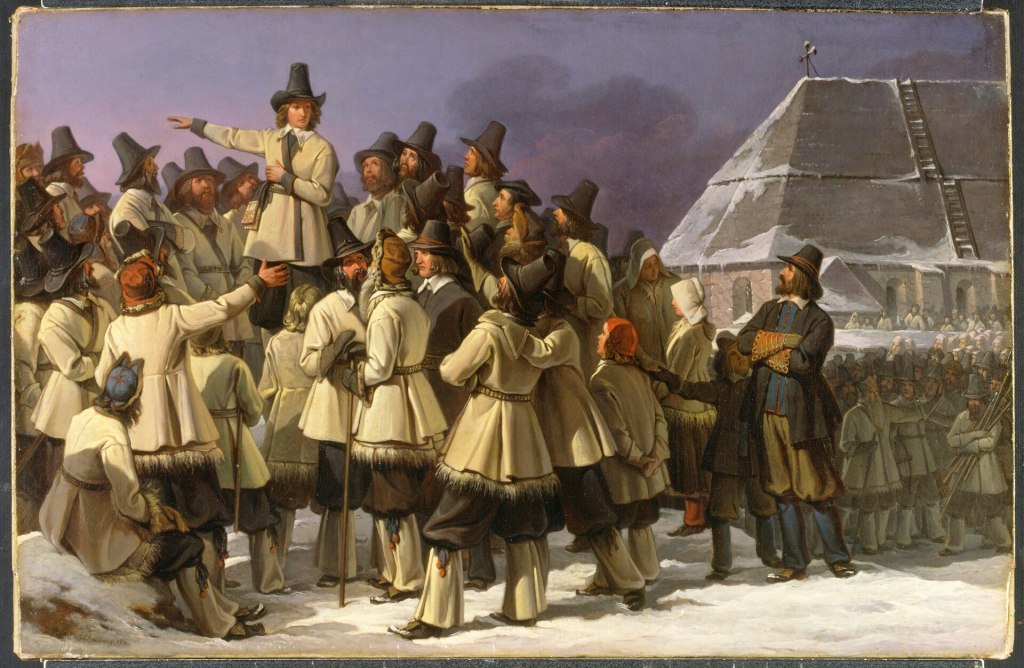
A rebel leader and future king makes a dramatic escape across the Swedish countryside in the dead of December. This is the story of how this adventure inspired a famous competition centuries later.
Sources
Gustafsson, Harald. “A State That Failed?: On the Union of Kalmar, Especially Its Dissolution.” Scandinavian Journal of History 31:3-4 (2006): 205-220.
“Gustav Vasa Couldn’t Ski?” Nordstjernan. Last accessed: 8/22/2026.
Kent, Neil. A Concise History of Sweden (Cambridge University Press, 2008).
Nordstrom, Byron J. The History of Sweden (Greenwood Press, 2002).
“Pre-history.” Vasaloppet.se. vasaloppet.se/en/about-us/history/pre-history. Last accessed: 8/22/2026.
Sundmark, Björn. “Snowy State: The Children’s History of Sweden” in Nordic Utopias and Dystopias: From Aniara to Allatta!, eds. Maria Ahlbäck, Jouni Teittinen, and Maria Lassén-Seger (John Benjamins Publishing Company, 2022).
Swart, Peder. Gustaf Is Krönika (G.E. Klemming, 1870).
Transcript
Every year on the first Sunday of March in Sweden, there is a national ski race, the Vasaloppet, that in recent years has drawn an average of 15,000 participants. The race starts in Sälen near the Norwegian border, a region famous for its ski resorts, and ends almost 60 miles to the east at the town of Mora. The race has taken place annually since 1922 except for the years between 1942 and 1945 for reasons that hopefully don’t need an explanation
However, its origins reach even further back by a number of centuries. The course of the race is a reversal of a legendary trek undertaken by Sweden’s first king of the modern age, Gustav Vasa, who according to legend skied the distance from Mora to Sälen before he was king and when he was still just a fugitive fleeing from a foreign tyrant.
This is far more than just a legend that’s inspired a legacy of athleticism. It’s a story wrapped up in Swedish nationalism and the origins of modern Sweden, specifically the country’s War of Liberation that aimed for independence from Danish rule.
This is Turning Modern.
On June 17, 1397, at the city of Kalmar in southeast Sweden, Queen Margaret of Denmark signed a treaty that formally unified the kingdoms of Denmark, Norway, and Sweden under one crowned head. She was the hereditary queen of Denmark herself. Meanwhile her husband Haakon had been the king of Norway and Sweden. After the death of their only son and heir Olaf and then Haakon’s own death, Margaret was proclaimed queen of Sweden and Norway in her own right. Remembered by history as the Union of Kalmar, the treaty Margaret signed was a compromise of sorts. Technically, all the Scandinavian kingdoms would remain mostly independent. Each of the three kingdoms would retain their own representative assemblies and their own laws, but they would share one monarch, one trade policy, and one foreign policy.
The Kalmar Union wasn’t just the product of a dynastic accident. It was the result of months of heated negotiations between representatives of the three kingdoms. It was also seen as a necessity. Much like how parts of eastern and central Europe united under the Hapsburgs in response to the threat of the Ottoman Empire, the kingdoms of Scandinavia also had a common foe, the Hanseatic League, a confederation of northern German towns. The Hanseatic League vied with Scandinavia for control over the lucrative trade network between the North and Baltic Seas. The rivalry reached a crescendo when Denmark suffered a crippling defeat after clashing with the Hanseatic League. By the time Queen Margaret made her bid to become queen of all three kingdoms, bitter memories of the Hanseatic League and how they forced Denmark and by extension all of Scandinavia to accept a policy of quote-unquote “free trade” were still very fresh.
While the Kalmar Union wasn’t entirely an accident of births, deaths, and marriages, credit should also go to Queen Margaret, who was from all accounts a fierce negotiator and a brilliant administrator in her own right. Unfortunately, she was also the only one who could keep the Kalmar Union running smoothly. The union started showing cracks as soon as she died in 1412. Her son Olaf was the only one besides her who would have had any legitimacy in all three kingdoms, and he was long dead. She tried to solve the problem by setting up her great-nephew Erik of Pomerania as a co-monarch and adopting him as both her son and heir, even though her hand remained firmly on the wheel until her death. Unfortunately, as a king Erik was as appetizing as sour milk. It’s telling that he’d always be remembered in Scandiavian historiography as “Erik of Pomerania”, stressing the fact that he came from northern Germany and was not a proper Scandinavian. Major revolts broke out in both Sweden and Norway, and eventually Erik was deposed and fled back across the Baltic.
The Kalmar Union never recovered, but it remained in place…more or less. Even though at least in theory the Kalmar Union was meant to be a federation of equals, Denmark kept asserting itself as the dom. And while the Kalmar Union stayed in place on paper, at times Norway and Sweden elected their own kings over the Union no matter what Denmark had to say, and war did break out between the three kingdoms although without formally and permanently overturning the Union. Still, starting in the second half of the fifteenth century, Sweden was ruled by a series of regents who were arguably all but kings in name and picked by the Swedish national council, even if they still paid lip service to Denmark.
In hindsight, the Kalmar Union was on course to crash headfirst into an iceberg. But I think it is possible it might still have worked indefinitely in one form or another; after all, Norway and Denmark would remain unified under one monarchy until the 19th century. Instead, we get King Christian II of Denmark, whose reign ended up being the stake in the Union’s heart. Depending on what source you read, Christian II was either a bloodsoaked tyrant or a reformer ahead of his time. Unsurprisingly, the most likely truth is that he was both. On the reformer side of the equation, he promoted humanist education, was said to sympathize with commoners and hate the aristocracy, and reformed laws in a way that benefited peasants by demolishing most of the last remnants of feudalism, including the ability of landlords to trade serfs like livestock. As for the tyrant side…well, we’ll get to that.
No doubt Christian II was aware of how the great dynasties of the rest of Europe – the Hapsburgs, the Tudors, and the Valois – were all consolidating and expanding their territories. He even married Isabella, the sister of Emperor Charles V. As he sought to bring the three kingdoms closer together, Sweden stood out as a problem child. For decades, almost all levels of Swedish society were increasingly unhappy about the partnership with Denmark. Miners and merchants alike grumbled over how their businesses was impacted by Denmark’s trade policies while the nobility resented Christian II’s reforms and how Denmark made an alliance with the state that would soon become Russia, the Grand Principality of Moscow, which was already threatening Sweden’s eastern borders. It didn’t help that this was also the time of the Reformation. So the fact that Christian II’s most powerful supporter on the Swedish council, Gustav Trolle, happened to be an archbishop gave the tensions a religious dimension. Christian II scored a decisive victory against the separatists in 1520 with a battle that saw the rebellious regent of Sweden, Sten Sture, fatally wounded. Striking what looked like a conciliatory and merciful tone, Christian II invited the elites of Sweden for his coronation as king of Sweden in Stockholm.
After the celebrations were over, though, Christian II did not sit down with them for negotiations as they expected. Instead, he had over a hundred noblemen, city council members, merchants, and even two bishops arrested. Archbishop Trolle declared that they were guilty of heresy, taking advantage of the spread of Lutheranism in Sweden at the time. However, everyone knew their real offenses were being involved in the separatist movement. One by one they were dragged out to the city square and beheaded, their bodies unceremoniously burned and the ashes scattered. He didn’t stop there; he had a number of influential women imprisoned as well and had the bodies of Sten Sture and his son torn out of their graves. A possibly accurate, possibly apocryphal account claims that Christian once said this to his correspondent, the scholar Erasmus: “Mild measures are of no use; the remedies that give the whole body a good shaking are the best and surest.” Clearly Christian had put his philosophy into practice.
It was not only a clearcut atrocity, but for Christian II himself it was an unforced error. Ever accepting Christian as their ruler was now a total non-starter for the Swedish. There’s no debate that the Kalmar Union was also a casualty of what would become known as the Stockholm Massacre. It didn’t help that once Christian II became aware of the magnitude of the backlash he blamed Archbishop Trolle, which only further enraged the Pope who was already furious that Christian had laid his hands on two bishops. Then he shifted the blame to his own officers, which of course only caused the men whose swords he relied on to grumble mutinously.
Three of the victims of the Stockholm Massacre were the father, uncle, and brother-in-law of a prestigious and well-liked nobleman named Gustav Vasa. All three had been prominent supporters of Sture. Luckily, Vasa had been outside of Stockholm at Gripsholm Castle. Since Gripsholm Castle was close enough to the city, Gustav fled westward toward Norway. It was of course still part of Christian II’s domains, but either it would have been easier to go underground than in his homeland or Gustav was hoping to catch a boat to England or Germany from there.
Vasa’s westward flight became the backdrop of many Swedish legends, some more plausible than others. My own favorite out of these stories has Gustav hiding out dressed as a peasant in the home of a commoner named Sven when some Danish soldiers burst in and demanded to know the identity of Sven’s guest. Thinking quickly, Sven’s wife struck Gustav on the back with a spade while yelling at him for being a lazy farm laborer. The soldiers reasoned that the mysterious peasant couldn’t have been Gustav Vasa because no commoner would dare strike a nobleman no matter the circumstances. Needless to say, this is generally considered one of the more implausible accounts.
But the most famous story from Gustav Vasa’s time as a fugitive is the very story that inspired the Vasaloppet. In the dead of December, Gustav traveled to Norway, trying to rally support wherever he went. When he attempted to get the townspeople of Mora to rebel against Christian II, they refused. The versions of the story I found claimed that the people of Mora didn’t want to become traitors and were tired of war from the last attempt to break away from Denmark, but I suspect if the story is true maybe they thought who cares if the king murdered a bunch of nobles and rich people in the big city. Whatever the reason, Gustav’s words met only blank stares. Since the Danes were closing in, he fled Mora not on horseback or snow shoes, but on skis. Not long after Gustav’s departure, the people of Mora heard rumors from other travelers who had been in the vicinity of Stockholm that Christian II wasn’t satisfied with all the blood he spilled and planned to carve a path of destruction across Sweden, rounding up anyone suspected of disloyalty and killing them on the spot. Either that or they had heard about the Stockholm Massacre for the first time; the accounts I could find diverge a bit on that part.
Whatever changed their minds, the town council of Mora agreed to send two men, Engelbrekt Jonsson and Lars Jakobsson, to catch up with Gustav Vasa and tell him that they would join any rebellion against Danish rule. The two men skied the entire way and delivered the message to Gustav Vasa, convincing him to abandon his plan to hide out in Norway and instead return to Mora where he could help organize a rebellion. Returning on their skis back to Mora, there Gustav Vasa received oaths of loyalty from the leaders there and organized the people into a fighting force that more volunteers from around the region flocked to join. With their help, Gustav marched south, seizing some of the tax revenues being collected and inspiring revolts in other parts of the country. The burgeoning rebellion also got support from Lübeck, the wealthy port city leading the Hanseatic League which had a vested interest in weakening Denmark and which had been annoyed by Christian II’s policy of raising tolls. The Swedish rebellion was even backed by Christian’s own uncle Frederick, who had been sharing with Christian power over the Duchy of Schleswig-Holstein on the Danish-German border. By the summer of 1523, the Swedish Council elected Gustav Vasa as king of Sweden.
As for Christian II, his luck just kept getting worse. At about the same time Gustav Vasa was declared king of Sweden, his own country also rebelled against him and he was replaced with his own disloyal uncle Frederick. Christian fled to the Netherlands, hoping his brother-in-law Charles V would intervene and put him back on his throne, but Christian only got empty promises. So by 1531, Christian took matters into his own hands and set sail for Oslo. Even before he became king of Norway, Christian had ruled over Norway as regent, and he had always been popular there, so he had high hopes of starting a revolt. However, the army he was hoping for didn’t materialize like it did for Gustav Vasa. Christian tried to return to the Netherlands and was granted safe conduct by his uncle, but it turned out Frederick was lying and at the first opportunity he had Christian imprisoned. In a sign that Christian’s reputation as a reformer wasn’t entirely fluff, there was a conspiracy to put him back on the throne after Frederick died, but ultimately Christian was sent back into his cushy imprisonment and instead Frederick’s son, confusingly also named Christian, became king of Denmark and Norway after defeating Christian II’s sympathizers. He was still in captivity when he died in 1559.
So the million-dollar question is, did the first modern king of Sweden really ski across the Swedish countryside to escape the Danes? I wish I could give you something conclusive, but…I don’t know. The main early source for the story is Peder Svart’s chronicle of Gustav Vasa’s life, which was dictated by the king himself, but Gustav Vasa was very much aware of the power of public relations and wouldn’t have been above embellishing or flat-out making up stories. Also I found an article claiming that a genealogist local to Mora has found correspondence written by Gustav Vasa suggesting he didn’t know about the existence of skiing. I’m a little skeptical of this claim, since skiing has been a Scandinavian pastime and means of transportation since literally the Stone Age and we know there were ski divisions in Swedish armies even back in the Middle Ages. But, to be completely honest, I couldn’t even find much about this outside the article itself, which you can find referenced in the show notes, much less the actual correspondence. Even so, it’s not the only source I found that’s at least a little skeptical of the claim that Gustav Vasa skied himself.
All that said, the fact that the story does give specific names of two men who would have been either still alive or known by people still alive in Mora does make me think the story was at least partially true. Maybe the messengers sent to him from Mora actually did make the round trip on skis but Gustav himself made the journey in a more conventional way. That might explain how the two skiers sent from Mora were able to catch up with him. So, if I had to guess, I would say Gustav Vasa didn’t make the trip in skis, but the two men who convinced him to return to Mora did. But I’ll leave it there, since I’m really brushing up against the limits of my research resources and I don’t want to get deluged with hundreds of emails and social media posts from Swedish people angry that I poked too hard at a beloved national legend.
Thank you for listening.


Leave a Reply