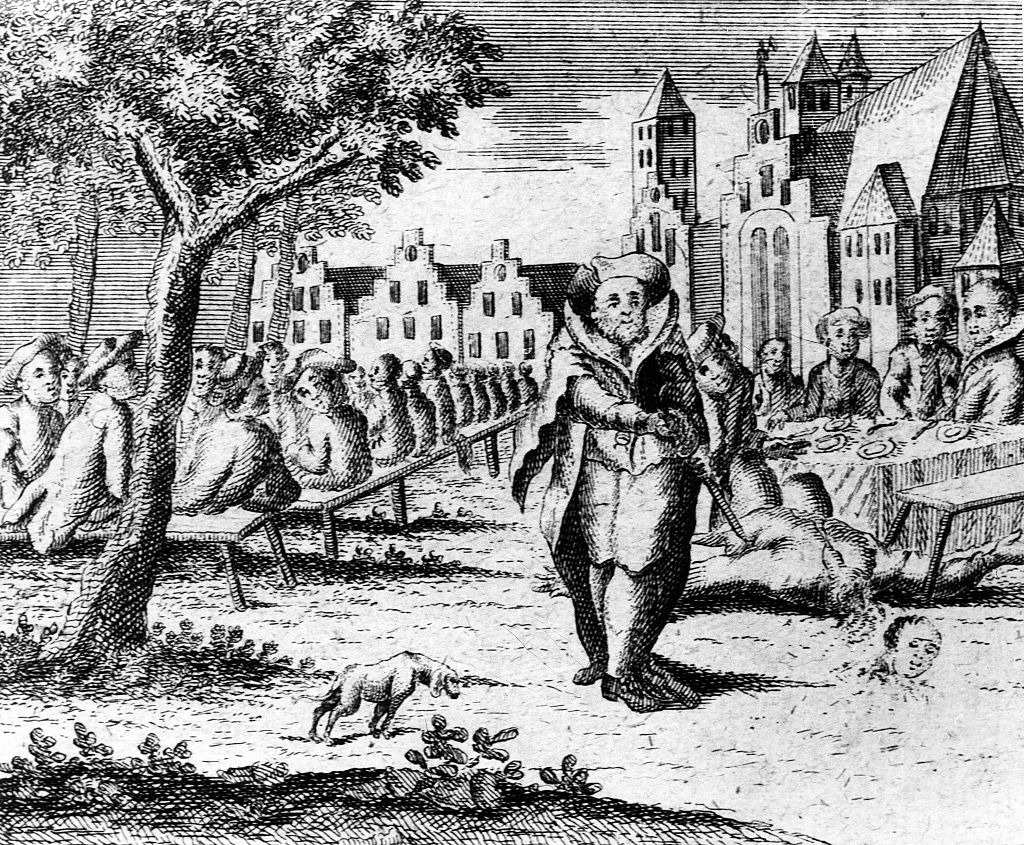
As the Protestant Reformation continues to spread, the city of Münster unexpectedly plays a special role. Not only does it become a refuge for a religious minority despised by even other religious minorities, but it can boast being the capital of the new King of the World.
Sources
Arthur, Anthony. The Rise and Fall of the Anabaptist Kingdom of Münster (St. Martin’s Griffin, 1999).
Ham, Paul. New Jerusalem: The Short Life and Terrible Death of Christendom’s Most Defiant Sect (Penguin Random House, 2018).
Kerssenbrock, Hermann von. Narrative of the Anabaptist Madness: The Overthrow of Münster, the Famous Metropolis of Westphalia, trans. and ed. Christopher S. Mackay (Brill, 2007).
MacCulloch, Diarmaid. The Reformation: A History (Viking, 2003).
Turning Modern is a one-person production, so support is always welcome. You can contribute through Patreon or Ko-Fi.
Transcript
On a summer day in 1534, a goldsmith named John Dusentchuer stood before a crowd in the city of Münster’s marketplace. Perhaps gesturing to a handsome, well-dressed young man sitting on an elevated platform, he began to speak like a preacher: “Most Christian brothers, the Father has revealed to me from heaven, and enjoined me to make known to you, that John Bockelson of Leiden, a man of God and a saintly prophet, will be king across the entire earth. He will be the lord of emperors, kings, princes and all the powers of the world. He will be over every ruler and no ruler will be over him. He will hold the scepter and throne of his father David until God the Father reclaims His Kingdom from him.”
Many people living in Münster believed or maybe claimed to believe that the young man was a prophet communicating directly with God. But once the weight of the goldsmith’s claims sunk in, a wave of restlessness came over the crowd. The murmurs and whispers only grew louder as Dusentchuer reached into his bag and pulled out a golden crown, gold rings for each of the young man’s fingers, and a gold chain emblazoned with the three emblems associated with royalty: the sword, the scepter, and the apple. The young man turned to the crowd and said he was afraid he was too young for such a burden, and yet he was being called to become king by the will of God. With that, he seemed to have lost the crowd, as their complaints became louder. Sternly, the young man spoke loudly over their protests: “Shame on you, for complaining against the ordinance of the Heavenly Father! Even if you all joined to oppose me, I will still rule, not only over this city but over the whole world, for the Heavenly Father has said it should be so. My kingdom which begins today shall never fall!” With that, the crowd’s mutterings of dissent gave way to cheers. And that was the day a former tailor’s apprentice was crowned as King of Earth in the marketplace of the German city of Münster.
This is Turning Modern.
***
The German Peasants’ War was a public relations disaster for the new Protestant movement. Catholics portrayed the revolt as the inevitable consequences of how Protestantism wasn’t an earnest religious reform movement at all but an invitation to anarchy. With his usual venom, Martin Luther tried to disassociate his ideas from the Peasant Revolt by writing and publishing a 1525 pamphlet with the rather unsubtle title, “Against the Murderous, Thieving Hordes of Peasants.”
In the aftermath of the German Peasants’ War and the denouncement of it, any movement that took Protestant ideas even further was bound to face a hurricane of fear and rage. If any movement no matter how marginal showed signs of going much further than even Luther in their theology or taking their challenge of orthodoxy outside the church and to social and political matters, then they would become everyone’s target, even the Protestants because such radicals in their mind discredited their movement and threatened to provoke a violent Catholic crackdown.
This was exactly what happened to the Anabaptists, even though they only numbered a few thousand by the time of our story. The movement was identified by their belief in the importance of adult baptisms as a freely chosen sign of faith in God and their opposition to infant baptisms. Their very name came from a prefix derived from the Greek word for “again”, ana. However, this was something of a slur at the time. The Anabaptists themselves called themselves “The Brethren of Christ” or “The Company of Christ.” Nor did they believe in actual “rebaptism”, but instead they emphasized a baptism that could be freely chosen by a fully grown adult. This stance on baptism was far from the only thing that made them so hated. They completely rejected the idea held by the Catholics and Lutherans that in the sacrament of the Eucharist the body and blood of Christ was present in some way, instead viewing the Eucharist as purely an allegory for the Christian community. Perhaps worst of all in some eyes, Anabaptists believed in communal ownership of property, rejected social distinctions, and opposed any kind of ecclesiastical authority, believing that all Christians were part of the priesthood and that no one should be compelled to become part of a church. Radical stuff for the early sixteenth century.
Anabaptists were persecuted by Catholic and Protestant authorities alike. Charles V ordered that any Anabaptist man or woman who was “of the age of reason” should be executed. A dozen Anabaptists were arrested and burned alive in England. Even in the few places in Germany and the Netherlands where they weren’t actively persecuted, they were strictly barred from preaching.
One unlikely convert to Anabaptism was Bernhardt Rothmann. Born the poor son of a blacksmith, his uncle was a priest who recognized his intelligence and paid for him to go to school to join the clergy. He became a priest stationed in Münster, but news of the German Peasants Revolt and how it had been ruthlessly crushed radicalized him. His superiors noted with disapproval and then alarm that his sermons started calling for the end of infant baptism and the communal sharing of property. He was prohibited from preaching in public. However, after some time he began to defy the order, writing to the local bishop that “my conscious is clear, I have no doubt that I can rely on God’s mercy.”
The matter became violent when the bishop pushed to have the Münster city council exile Rothmann from the city. A majority of the representatives in the city council sympathized with him. One of them was a wealthy merchant, Bernardt Knipperdolling, who protected him. At Knipperdolling’s encouragement Rothmann’s supporters took to the streets. The temperature rose quickly, and the rioters broke into churches, burning tapestries and paintings they deemed idolatrous. They also grabbed and burned books they apparently considered blasphemous, including Latin Bibles and writings by Boethius, Thomas Aquinas, and Chaucer.
This was no longer a problem for just the mayor and the city council. Münster was under the authority of a prince-bishop, Franz von Waldeck. He came from the local aristocracy, had more interest in secular politics than in prayer or theology, and owed his election as prince-bishop more to his family connections than his career in the church. There was even a woman who lived with him as if she were his wife and bore him eight children. In sum, he was exactly the kind of aristocratic careerist in the church would-be reformers like Rothmann blamed the corruption of the church on. And this was on top of generations of building resentment between the city government of Münster and the prince-bishops who taxed them to fund their own wealth and territorial ambitions.
Waldeck was reluctant to act. There was a risk in angering what was by far the richest part of his fiefdom, especially since Münster was part of the Hanseatic League and the other towns and cities in the League could intervene. More to the point, Waldeck like many princes of the empire didn’t have the funds to keep much of an armed force at his beck and call and instead relied on expensive mercenaries. Emboldened by the delay, Rothmann’s backers on the city council passed a number of laws that outlawed Catholic practices like the Mass, prayers for the dead, and the veneration of the Virgin Mary.
In the meantime Waldeck had written to Emperor Charles V, asking permission to use military force if necessary. Perhaps he hoped the emperor would feel obligated to support him if things went south. Charles practically ordered Waldeck to act. Since the majority of the city council still refused to punish or banish Rothmann, Waldeck put the city under a blockade by October of 1532.
This actually might have been the end of it. Münster was a major trading center, and neither side wanted to cut off the tap. A Protestant prince who ruled a neighboring territory, Landgrave Philip of Hesse, stepped in and helped negotiate a truce between the city council and the prince-bishop. Anyone who violated the blockade would be freed from prison, the anti-Catholic laws would be annulled, and while Rothmann would not be punished he would agree to stop preaching. On February of 1533, the truce officially went into effect.
Unfortunately, Münster happened to have become the home of hundreds of newcomers. Somehow during the blockade Rothmann had gotten out dozens of pamphlets that circulated around northern Europe, promising that Münster would become a refuge for Anabaptists. Just a month after the enactment of the truce, a special election for the town council was held. Their numbers bolstered by the newcomers, all Catholics and Protestant moderates were ejected from the city council. That was not all. Immediately new laws poured out of the council hall. The poor were given clothing and food and enlisted in paying jobs working on civic works projects and convents and monasteries were ordered to offer communal meals to the community. Along with these egalitarian measures were draconian rules that punished prostitution, blasphemous cursing, and even lying and appearing drunk in public with a stint in jail or public whippings. Supporters who saw Rothmann as a tool for loosening the prince-bishop’s grip on the city balked, finding the familiar tyranny of the prince-bishop preferable to the tyranny of these Anabaptist busybodies.
Still, some of the moderates were more afraid of Waldek. The moderate and the Anabaptist leaders reached their own agreement, that both sides would contribute to the common defense to Münster against the prince-bishop’s forces while everyone’s religious liberties would be respected. No one would know until much later that Waldek did send a messenger to offer terms to the city council, but the messenger sympathized with the Anabaptist radicals and had secretly destroyed the prince-bishop’s message.
Despite the promises of preserving religious freedom, a zealous fervor was overtaking Münster. Hundreds of locals were baptized within just one week. When a Lutheran minister tried to preach a sermon denouncing Rothmann in the main cathedral of Munster, St. Lambert’s Church, he was chased out by a mob of women. An elderly moderate in the city council, Jaspar Jodefield, got into a public argument with Knipperdolling, which climaxed with Jodefield trying to run the merchant through with a spear until someone restrained him. Not long afterward, Jodefield joined many other citizens who left the city, either out of disgust with the new regime or out of fear of the prince-bishop’s wrath or both. After this exodus, the Anabaptist leaders forced another election of the city council. This time, every member of the city council was among their number. The occasion was celebrated by a mob breaking into St. Lambert’s Church and destroying the tombs of the city’s bishops along with any religious art or icons that they could get their hands on.
Such holy passion could no longer be contained by the city council. A leader had emerged from among the ranks of the faithful, a former Dutch baker named Jan Matthys. He claimed to be a prophet, dressing in white robes while his wife Divara clothed herself entirely in black. In later years the Anabaptist preacher Obbe Philips would write that Matthys was in truth no prophet, but a despot. “He was so fierce and bloodthirsty,’ Philips wrote, ‘that he took many people’s lives and killed them – so fierce that even his enemies were frightened by him.” Philips would also bemoan that he and the other Anabaptists of Münster had been “shamefully and miserably deceived.”
Indeed, it does seem that under Matthys’ influence the righteous revolution in Münster took a dark turn. Now, anyone who wanted to leave Münster had to surrender all of their food and valuables, on the pretext that the city needed supplies when the prince-bishop struck. Even the growing migrations out of the city were not enough for Matthys. One day he preached for the total extermination of all the Catholics and Lutherans in the city, railing, “Everywhere we are surrounded by dogs and sorcerers and whores and killers and the godless and all who love lies and commit them!” This was at least a step too far for Knipperdolling, who somehow managed to convince Matthys to be satisfied with an order, issued in January of 1534, to force all the remaining non-believers out of the city. Matthys’ followers stormed into every house, forcing everyone who wasn’t known to be an Anabaptist out and seizing their possessions. Anyone who wished to stay had to participate in a mass baptism carried out in the winter air. Those who were physically unable to leave had no choice and were dragged out of their homes to be baptized no matter what. An eyewitness who would later write and publish his account, Herman Kerssenbruck, claims: “The women carried their naked nursing babies and begged in vain for rags to clothe them in. Other women, driven from their maternity beds, gave birth in the streets. Miserable children, barefoot in the snow, whimpered beside their fathers. Old people, bent by age, tottered along calling God’s vengeance down upon their persecutors.”
Prophet or no, Matthys knew it was a matter of time until the prince-bishop had cobbled together enough of an army and enough support from the other German princes to crush the resistance of Münster. In fact, he already had enough men to surround the city and begin a siege. His best hope was aid from Anabaptist sympathizers abroad. Unfortunately, the city received word that a motley army of Dutch Anabaptists that had been marching south for Münster were stopped and detained by the Spanish authorities then in control of much of the Netherlands. A hundred of them were executed, the rest were released but their swords and guns had been confiscated. Not long after the sobering news, Matthys declared that God had ordered him to don armor and challenge the prince-bishop himself to battle. In full battle armor, Matthys rode out, surrounded by a dozen retainers. They didn’t make it far outside the city walls until about 500 soldiers on horseback fell on them and cut them to pieces.
However, Matthys was just the John the Baptist to the true prophet, a dashing and witty man in his 20s, Jan of Leiden. Like Matthys he was Dutch, hailing from a village in South Holland. In his own account, he was the illegitimate son of a local mayor and took up work as a tailor’s apprentice. Dissatisfied with his lot in life, he tried to become a merchant, traveling as far as Portugal. Instead he ended up in England, where he started an inn that was less than successful. It was then that he met Matthys and converted to Anabaptism, becoming an apostle of sorts to Matthys, which was how he ended up in Münster and got the blessing to marry Knipperdolling’s daughter. If she or Knipperdolling knew that Leiden had previously married a woman in England with whom he had two children, a family that he had left behind in the Netherlands, there is no account.
Jan of Leiden declared that God had ordered Matthys to ride out alone. Instead, because he came out with help, God punished him for his lack of faith and had chosen Leiden to take his place. The modern historian Anthony Arthur compares Jan of Leiden to a modern cult leader, writing, “Of all the qualities that the preceding episode reveals about Jan van Leyden—ingenuity, imagination, timing—the one that stands out most is his intuitive mastery of what would later, in our own century, be called the technique of the big lie. Told with sincerity to a people anxious for reassurance, deriving from some source beyond and greater than its speaker, the big lie is so outrageously improbable that nobody could possibly make it up. Therefore, it must be true. As a tool for demagogues and charlatans to mislead the gullible, it has never been more effectively used than by young Jan van Leyden.”
And much like cult leaders, John of Leiden knew how far he could push the limits. Once he had the backing of the most prominent Anabaptists, Leiden declared that the office of mayor and the city council were both abolished. Instead, as Rothmann announced in a pivotal sermon, the government would now be handled by a council of twelve Elders. Knipperdolling was given the special title of Schwertführer, or “chief enforcer.” It was he who would carry out the executions of anyone guilty of the new laws passed down from the Elders. Trying to leave the city, homosexuality, acts of greed, any theft, idle conversation, starting a fight, displaying anger or envy, disobedience to the Elders, or a wife defying her husband were now all punishable by death. However, most cases ended with the culprit being pressured to confess and debase themselves before the Elders. Still, in his confession to the authorities, Knipperdolling would admit that he beheaded eleven or twelve people.
But Leiden and the Elders did not stop at trying to shape people’s morals; they had reshaped society itself. Leiden changed the names of the city gates and squares from the names of saints and historical figures to names with a practical or holy theme. For example, one city gate became the Water Gate, and the city’s market square became Mount Zion. Leiden also insisted on naming all the new babies in the city. For some reason, Leiden would give them names taken from the Old Testament or would give them names in alphabetical order.
Private property and even money itself had been abolished, with money only used for trade with outsiders. By law houses had to remain unlocked. All meals were now to be taken in common and in silence as the Elders read passages from the Bible. People dressed in drab, modest clothing and called each other “sister” or “brother.” An entire city was now enacting the Anabaptists’ own vision of what the early church had been like.
Then John of Leiden made his most audacious move yet. All existing marriages were to be considered null and void unless an Anabaptist preacher approved of them. In addition, all single women or the wives of men who had left Münster had to take a husband and men could take multiple wives. Jan himself put the new principle into practice when, in addition to the daughter of Knipperdolling he had married, he also took as his wife Divara, the wife of his predecessor as prophet Matthys. He didn’t stop there; he took more wives, all of them attractive and young. This new right was not extended to women. One woman, Katherine Kockenbeckin, was put to death when she had the audacity to take a second husband.
The outrage was enough to inspire a coup. An Anabaptist and the leader of the city’s blacksmith guild, Henry Mollenhack, led a group of men who seized Jan, Knipperdolling, and Rothman and locked them in the cellar of the City Hall. Other supporters were also captured, including according to one account a man who was caught in bed with his four wives. He was dragged to the stocks, where a group of women pelted him with stones and feces, shouting, “Do you have enough women now?” However, despite its smashing success the coup only lasted hours. Leiden’s supporters rallied and freed the triumvirate. The coup’s ringleaders were hung from a tree by metal collars, their hands tied behind them, and the people riddled them with arrows and bullets.
Whatever misgivings people were still having in the failed coup’s aftermath, something would happen proving that Jan of Leiden had God’s blessing. The prince-bishop’s men continued besieging the city, but a catastrophic assault started by some drunk soldiers led to hundreds of his men getting killed by the city’s defenders, with both men and women raining boiling pitch and quicklime down to the helpless troops and with virtually no casualties among the defenders. It was during the euphoria following this great victory that Jan decided he would be more than just a prophet.
To quote the modern historian Paul Ham, “In early September, basking in his second military triumph and at the height of his popularity, he seized his chance. Drawing deep on his gifts as a showman, he crafted a series of outbursts designed to mesmerize the people. He was ‘struck mute’ again. He lay down for hours in the shape of a cross. He fell into a trance. He spoke in strange tongues. He wrote unintelligible messages in chalk that were, he said, the Word of the Lord.” It was then that he was declared the new King David and crowned King of the World.
Even before that, Leiden and his top supporters weren’t required to go all in on the “all property must be shared” plan. They still lived privately in their homes and did not have to partake in the communal meals. Now, Leiden was a king with a royal court, and they all lived accordingly, dressing as extravagantly as they wished and enjoying lavish feasts in the privacy of a mansion next to the cathedral.
Even so, the siege continued, and by the autumn of 1535 the city’s supplies began to fail. In October, Leiden summoned 27 prominent Anabaptists and tasked them to go out into the wider world and recruit new converts and allies who could help save their kingdom. It was, as Anthony Arthur suggests, perhaps not a coincidence that all the 27 were potential political rivals. If that was the real reason, the plan worked perfectly. All 27 were caught and killed in the cities they traveled to, except one, a schoolmaster named Heinrich Gaes.
As the people suffered from starvation and disease spread, Leiden did seriously send out messages to the Protestant princes of Germany, pleading their cause. However, they had gone too far and had made Protestantism look like a gateway to social upheaval and polygamy. Philip of Hesse, who was probably the only ruler with any sympathy for Münster, wrote back that it was too late to form alliances with Protestant leaders. The best Leiden could do was offer a peaceful surrender in exchange for mercy.
Heinrich Gaes offered to again try to find support as a messenger. Days after he reportedly left, a pamphlet was found at the city gates. It read, “Dear fellow-citizens. God has opened my eyes so that I now see how what we have wrought in Münster is false and poisonous; He has commanded me to hold up for you the mirror of your wickedness, as He has held it up for me. I beg you to open your eyes—it is high time!—and to see that what you have done is against God and His divine command. All the prophets are only men like me. You poor, stupid fools have been deceived, betrayed, and misled. I know everything. You may still save your lives if you will turn from your path and leave this godless business behind. This is God’s command. So that you will be sure to believe that this letter comes from me, Henry Gaes, I have sealed it with my signet ring, which you all know.” Leiden failed to keep the pamphlet from becoming known to his people and could only weakly say that false prophets like Gaes always emerge in times of hardship.
Instead of surrender, the King of the World tried cracking down even further and awarding his most devoted courtiers. In a public ceremony and in his capacity as the true ruler of Germany, he granted titles to a number of courtiers. A tailor named Bernard Moer was made the Duke of Brunswick, the shoemaker Herman Redeker would take over Cleves, a shopkeeper Johann Denker became the Prince of Saxony, the coppersmith Leddanus was now the Archbishop of Cologne, and there were more. Hermann von Krassenbrok noted what happened next: “To make sure that the townsmen were left with no time to plot sedition against the king, the dukes employed them in constant labor, and to make sure that they did not become fierce, they gave them only bread seasoned with salt to eat. When the men were not engaged in necessary strengthening of the defenses, they were kept busy razing either churches or huts and humble structures that had been built long before in the open ground behind the walls.”
If true, in the end it turned out they didn’t have to worry about their own people, at least not the ones who were still in the city. Thanks to both the breakdown in discipline among the rank and file due to the famine and insider information given to the prince-bishop’s officers from defectors like Heinrich Gaes, the enemy was able to retake Münster without a fight late on a night in June. Those among Leiden’s court who were not slaughtered on the spot were the ones prominent enough to be taken alive under the prince-bishop’s orders. Leiden was among those captured. Rothmann was reportedly killed in a skirmish on the streets of Münster, but he was never found, dead or alive. Outside the elite most of the city’s Anabaptist men were unceremoniously slaughtered, while captured Anabaptist women who refused to repent and didn’t have wealthy families who could ransom them were likewise killed. Among the victims were Queen Divara, the wife of two prophets. In the aftermath, judging from reports only 19 men and 216 women composed the population of repentant Anabaptists still residing in Münster.
The King of the World was quickly reduced to an underfed prisoner in rags. It was in this condition that he finally met his nemesis, Franz von Waldeck, who looked at Leiden with contempt and asked, “Bist du ein Konig?” – “Are you a king?”. Tellingly he used the familiar German “du” pronoun, which was typically used when addressing not only friends and family but also children and one’s social inferiors. It is in his darkest moments that we glimpse the wit that must have helped make Leiden such a beloved leader, even as he marched his people toward suffering and disaster. He fired back at the bishop, “Und bist du ein Bischof?” – “And are you a bishop?” We get this rare glimpse of who Leiden was in another account that describes how, while he was being transferred between prisons, he was accosted by a crowd. One of the people in the crowd shouted, “Is this the king who took for himself so many wives?” Leiden replied with mock offense: “I beg your pardon. I took maidens and made them wives.”
Leiden tried to bargain with Waldeck and others. He proposed that if he were left alive, he could be placed in a cage and taken all around Germany, as an example of what happens when someone defies their rightful sovereign. They could even charge onlookers and possibly that way they could make up enough money to compensate for how much it cost to retake Münster. Even Leiden’s audacious charisma and ingenuity couldn’t save him now, however. He had to die. True to the era, though, the authorities were still keen on getting him to repent. This resulted in some odd theological arguments. When one priest tried to get Leiden to see the error in his legalization of polygamy, Leiden pointed to the passage 1 Timothy 3.2, which stated that a bishop could only be the husband of one wife. Leiden argued, “This implies that laymen must have had more than one; otherwise, why would the bishop be specifically limited? There you have your text.” Regardless, the night before his execution, at least according to the priest Johann von Siburg, Leiden broke down. “He admitted that he deserved the bitterest possible death ten times over, and=he renounced all his errors…Jan was thus comforted and consoled the whole night long by the priest.”
If Leiden wasn’t being sincere and he hoped confession would at least give him a kinder death, he was wrong. In front of St. Lambert’s Church, Leiden was brought before a mob. At his side were his father-in-law and chief supporter Knipperdolling and another prominent backer, Bernhardt Krechting, who like the missing Rothmann was a priest turned Anabaptist preacher. Before the scaffold, which was really just three wagons tied together, Leiden fell to his knees and repeated words attributed to Jesus Christ himself: “Father, into your hands I commend my spirit.” The three men were tied to a post with iron collars, which had spikes on the interior that pierced their necks. Over the course of an hour, their tongues were torn out and their bodies were torn apart with metal pinchers heated in a fire. If they fainted from the pain, the executioners revived them. Seeing what was happening to Leiden, Knipperdolling tried to kill himself by trying to make the spikes on the collar pierce deeply into his neck, but he was only tied more tightly to the stake. One observer Antonius Corvinus noted that Leiden only cried out in pain once. Quickly Corvinus added the pious note that “it is certain that Satan is able to lend strength and courage to those he catches in his web.” The three men were placed in iron cages that were raised high from a tower on St. Lambert’s Cathedral. Their remains would remain there for about fifty years. However, the cages would remain, just without their prisoners. You can still see them above the cathedral’s clockface.
As for the Anabaptist movement, Münster was a catastrophe. The movement was split between those who took inspiration from Leiden and preached the necessity of violent resistance and those who emphasized the principles of non-violence and religious tolerance that had been first articulated by the movement’s founders. The Anabaptists fractured into different groups, although they were far from the only group to quickly split apart after being founded during the Reformation.
While it was very short-lived, the Münster Rebellion is a fascinating piece of a much larger puzzle. There is something undeniably modern in the regime of King Jan of Leiden that resembles much later cults like Aum Shinrikyo, Jim Jones, the Rajneesh movement, and the like. A charismatic leader claiming extraordinary credentials, the way the community itself was enlisted to enforce petty and arbitrary rules on each other, the promise of an egalitarian utopia while drawing sharp lines between the leader’s inner circle and everyone else…I could go on. Even more interesting is the fact this was perhaps the first time since antiquity that a society in the West so radically reshaped itself in so short a time. True, the Anabaptist leaders of Münster did not believe they were embarking on a new social experiment. They thought the end of the world was at hand and that their king was simply taking control until the imminent return of Jesus Christ occurred. Also far from enacting anything new they believed they were simply reenacting the way the ancient Christians lived. Yet, I think it’s not unreasonable to see in what happened in Münster a prologue to times and places like Cromwell’s England, the French Revolution, and the Soviet Union. Society could be reformed, at first with just the blueprints thought to have been left by God, but eventually, people would try guided only by their own ideas.
Thank you for listening.


Leave a Reply