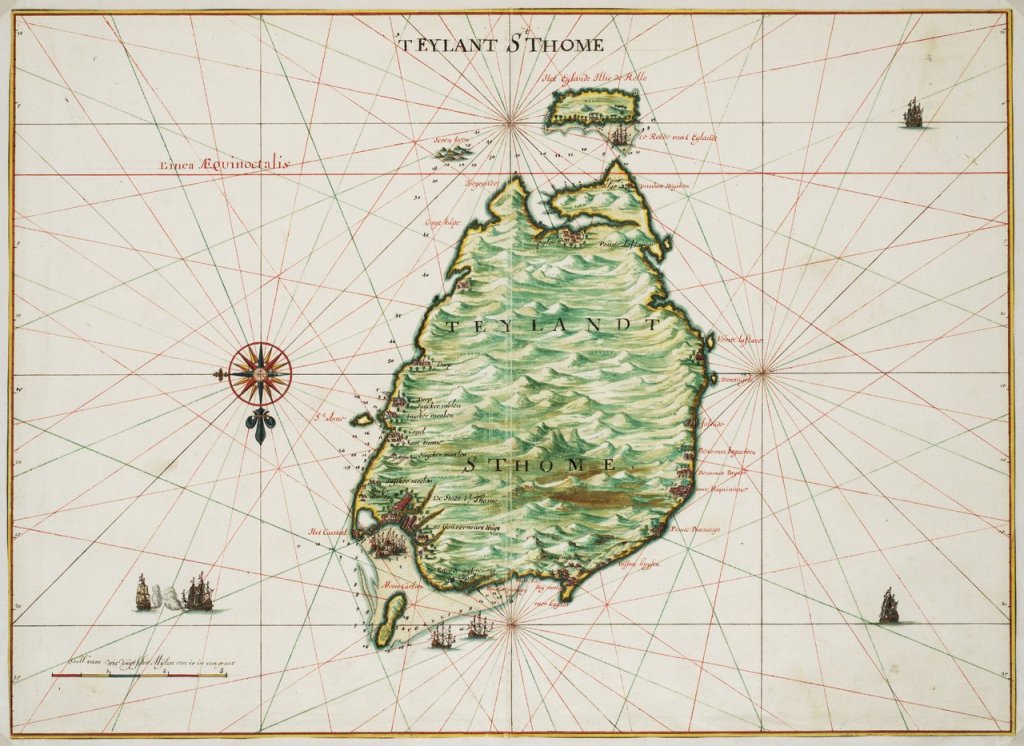
Hundreds of children were taken from their families and sent to a distant, previously uninhabited island. The reasons why this happened are a toxic mixture of deeply rooted intolerance and simple greed.
Sources
ha-Cohen, Joseph. The Vale of Tears (Emek Habacha), trans. Harry S. May (Martinus Nihoff, 1971).
Soyer, François. “King João II of Portugal ‘O Príncipe Perfeito’ and the Jews (1481-1495), Sefarad 69.1 (2009): 75-99.
_________. The Persecution of the Jews and Muslims of Portugal : King Manuel I and the End of Religious Tolerance (1496-7) (Brill, 2007).
Usque, Samuel. Samuel Usque’s Consolation for the Tribes of Israel, ed. and trans. Martin Cohen (Varda Books, 2002).
Transcript
Born in Spain, the Jewish scholar Solomon ben Verga was caught in the expulsion of the Jews ordered by Queen Isabel and King Fernando. After escaping to Portugal, he soon fled again to modern-day Turkey, where he put his own trauma to work in writing “The Scepter of Judah”, a record of persecutions carried out against the Jewish people. Of the stories, undoubtedly one of the worst involves a woman whose six children were taken from her by the order of the King of Portugal.
According to ben Verga’s account, the woman waited near the cathedral where King João II was hearing Mass. As the king got on his horse, she threw herself on the street, nearly being trampled. She pleaded not for the return of all her children, but just for the youngest one. Angrily the king shouted to his attendants, ordering them to take her out of his sight. Even as the men dragged her away from the king, she continued to scream out her pleas. The only mercy the king gave her is that he ordered his attendants to release her, shouting to them, “Let her be, for she is like a bitch whose pups have been taken away!”
The story is bleak and harrowing enough. Yet, this woman was not the only parent suffering. Possibly as few as 700, possibly as many as 2,000 Jewish children were ripped from their families and sent to a tropical island off the coast of West Africa, left to fend for themselves in an alien and hostile world. Even in the annals of anti-Jewish persecution, such bizarre and brazen cruelty stands out.
When faced with such atrocities, most people’s natural instinct is to ask “Why?” In this case, it’s a story of not only intolerance, but also cold, vicious political opportunism.
This is Turning Modern.
When King João II became king of Portugal in 1481, he had a mission to strengthen and enrich Portugal and its monarchy. His father Afonso V had wasted a great deal of energy and time trying to press his second wife/niece Juana’s hereditary claim to the Spanish kingdom of Castile and had let the nobility grab too much power in the interim. João addressed the problems he inherited from his father with the efficiency of a mob boss. If you’ve been following this podcast, then you might remember João as the king who ruled Portugal when the Portuguese made first contact with the Kingdom of Kongo. That was just one way in which João tried to expand Portugal’s exploration and colonization efforts while making sure the Portuguese crown had an air-tight monopoly over the new trade opportunities. João took a firm hand with the nobility – quite literally. When he was presented with evidence that his cousin and brother-in-law Duke Diogo de Viseu was leading an aristocratic conspiracy against him, João confronted Diogo in his own private chambers and stabbed him to death. Less violently but perhaps just as drastically, João stripped the nobility of its right to try judicial cases involving the inhabitants of their own lands, giving more power to judges appointed by the state.
So did King João’s ruthlessness extend to his Jewish subjects? Not in the beginning, or at least, no more than his predecessors. As in many other medieval kingdoms of western Europe, Jews were considered under royal protection, which meant they were protected from persecution and violence in exchange for the king getting a, let’s say, more than generous cut of whatever profits the community made. This had been the status quo in Portugal. In his letters, João even bluntly referred to the Jews as “his property.”
There were some regional anti-Semitic laws that passed under João’s watch, like a law against Jews being allowed to wear silk in public. However, the historian François Soyer points out that in these instances João had been forced to bend to the will of regional councils. Indeed, in one case when representatives confronted the king with demands that he ban Jewish tax collectors from being employed by the state, João sarcastically pointed out that he knew for a fact that Christian tax collectors usually demanded more and pocketed the difference than their Jewish counterparts.
Even so, events just across the border was going to the relationship between the monarchy and the Jews would change, despite João wanting to keep the Jewish community of Portugal as his personal checking account. The event that João’s father had tried so hard to avert, the unification of the kingdoms of Aragon and Castile, had happened through the marriage of Queen Isabel and King Fernando. In 1492, they issued a proclamation offering the Jews and Muslims of Spain a stark choice: convert to Christianity or leave the country. This ultimatum capped off decades of escalating hostility toward the non-Christian minorities of Spain, directed even toward the conversos, Muslims and Jews who converted to Christianity or their descendants. They were often accused of secretly practicing their or their ancestors’ religion and conspiring with still faithful Jews and Muslims to subvert the Church and the political order, fears that hit a fever pitch across both Spain and Portugal after 1485 when a group of conversos in the city of Saragossa assassinated the Inquisitor Pedro de Arbués in a desperate bid to prevent the Inquisition from being established in Aragon. The fact that Isabel and Ferdinand had just overseen the conquest of Granada, the last Muslim country left on the Iberian peninsula, also excited millenarian hopes that the arrival of the kingdom of Heaven was at hand and the process could be sped up by pressuring the unbelievers in their midst to embrace the faith.
The Spanish expulsion put King João in a bind. He could allow some of the Jews who refused to convert and faced expulsion to settle in Portugal, but it would be an unpopular decision among his people and would lead to frayed relations between João and the Spanish monarchs. For João, the prospect of adding to his so-called property was too much to resist. Jewish exiles from Castile could cross into Portugal, but only 600 families would be allowed to remain, and the 600 would prove to either be wealthy or skilled artisans. The rest could only stay in the country for eight months. After that, they would have to convert to Christianity or leave Portugal at their own expense.
An account by Rabbi Elijah Capsali recounts the welcome the exiles received from the king as they waited in refugee camps near the border: “King João, even before the [Castilian Jews] had entered Portugal, sent zealous agents, angels of destruction, to decimate them and deprive them of their ornaments. As they were emptying their bags, the messengers of the Gentiles appeared before them, insulting them; [the Crown’s agents] searched their tents seeking loot and seizing their gold and silver. In order to prevent any violation of his orders, the King appointed officials and governors whose task it was to stop anyone from entering [Portugal] until they had paid the royal treasury one golden beka. Neither men nor women were exempted.” One of the Castilian exiles who ended up in Portugal, Rabbi Abraham Zacuto, recounts just how the exiles were bled dry: “[The Jews] gave a tenth of all their wealth, plus one ducado for each soul, apart from three ducados for [the permission] to pass through the states, and they also gave a quarter of all their wealth that they brought in, and some nearly a third. And even one who had no wealth at all paid a ransom for his soul of eight ducados, and if not he would be imprisoned.” Other sources add that Jewish families had to pay a tax for each child they brought with them with only babies who were still breastfeeding exempt. When they left Portugal on officially licensed ships, usually for Morocco or to Italy, they also had to pay an exit tax.
Clearly whatever João thought of the Jews on a personal and religious level, his attitude to them was practical and exploitative. So why did he command such an atrocity, seizing children of the refugees who ranged from the ages of six to ten? No Christian source addresses the motive, but the majority of Jewish sources do agree that it was a vicious punishment for those Jewish families who failed to pay the taxes João imposed on them. Essentially, they were taken as collateral. When their parents still failed to pay, João decided the children would made unwilling colonists of the island of São Tomé, an island off the coast of West Africa and near the mouth of the Kongo River. Without their families and placed on boats alongside colonists and prisoners who were likewise exiled from Portugal, the children were sent to a completely unfamiliar, hostile island. Joseph ha-Cohen’s chronicle of Jewish persecution, The Vale of Tears, carries a vivid account: “There he sent the poor Jews, together with the criminals, and no one came to their aid. The mothers rose their voices with weeping when these barbarians tore the children from their laps, and the men tore out their beards because of their souls’ grief in this time of terror. Many prostrated themselves before the King, saying, ‘Please, let us go into exile with them,’ but, like a deaf viper, he refused to listen and ignored them completely. One woman, who clutched her child to her bosom, plunged into the sea because of her grief, and thus both found their death. See and witness, if such a thing has ever occurred before!”
The sources don’t agree how many children were sent to São Tomé. The numbers vary from 700 to 5,000. François Soyer argued that the most credible number comes from Valentim Fernandes, a German-Portuguese artist and scholar who visited São Tomé and wrote a travelogue about his experiences. In it, he mentioned that 2,000 children were sent there. Grimly, Fernandes added that many of the children quickly succumbed to disease and the snakes and crocodiles who lived on the island. Fernandes remarks that only almost 600 of the children survived. The survivors did grow up and have descendants who would become part of the makeup of São Tomé. Although a few scant references suggest that the descendants of the children, despite efforts to baptize and convert them before they even arrived on the island, continued to engage in some Jewish practices into the 18th century, but whatever Jewish beliefs and cultural memories they carried on did eventually fade.
Besides Fernandes, no contemporary Christian source even mentions the taking of the children. This suggests that, even in a time of increasing anti-Semitism, the treatment of the children of the Jewish refugees was scandalous at the time. As for João, his only son and heir Afonso died in a horseriding accident. With his son’s death, the next in line for the throne was João’s cousin and political rival Manuel, the brother of the very Duke of Viseu he personally killed. Desperately João tried to guarantee that the crown would pass to his illegitimate son Jorge, but here even João did not get his way. The Jewish chroniclers saw Afonso’s death and the succession of Manuel as divine judgment for João’s crimes. If it was cosmic justice, though, it backfired in a tragic way. About a year after succeeding to the throne, Manuel buckled under diplomatic pressure from Isabel and Fernando and also ordered the forced conversion and expulsion of all Jews and Muslims from Portugal.
I suspect for some it’s tempting to try to keep this story in the distant past. This is the sort of thing that happens only in the history books or at least not in the country I live in. If you are thinking that, I won’t stop you, but I would also suggest, depending on when and where you’re listening to this, you don’t check the news.
Thank you for listening.
 Turning Modern
Leave a comment