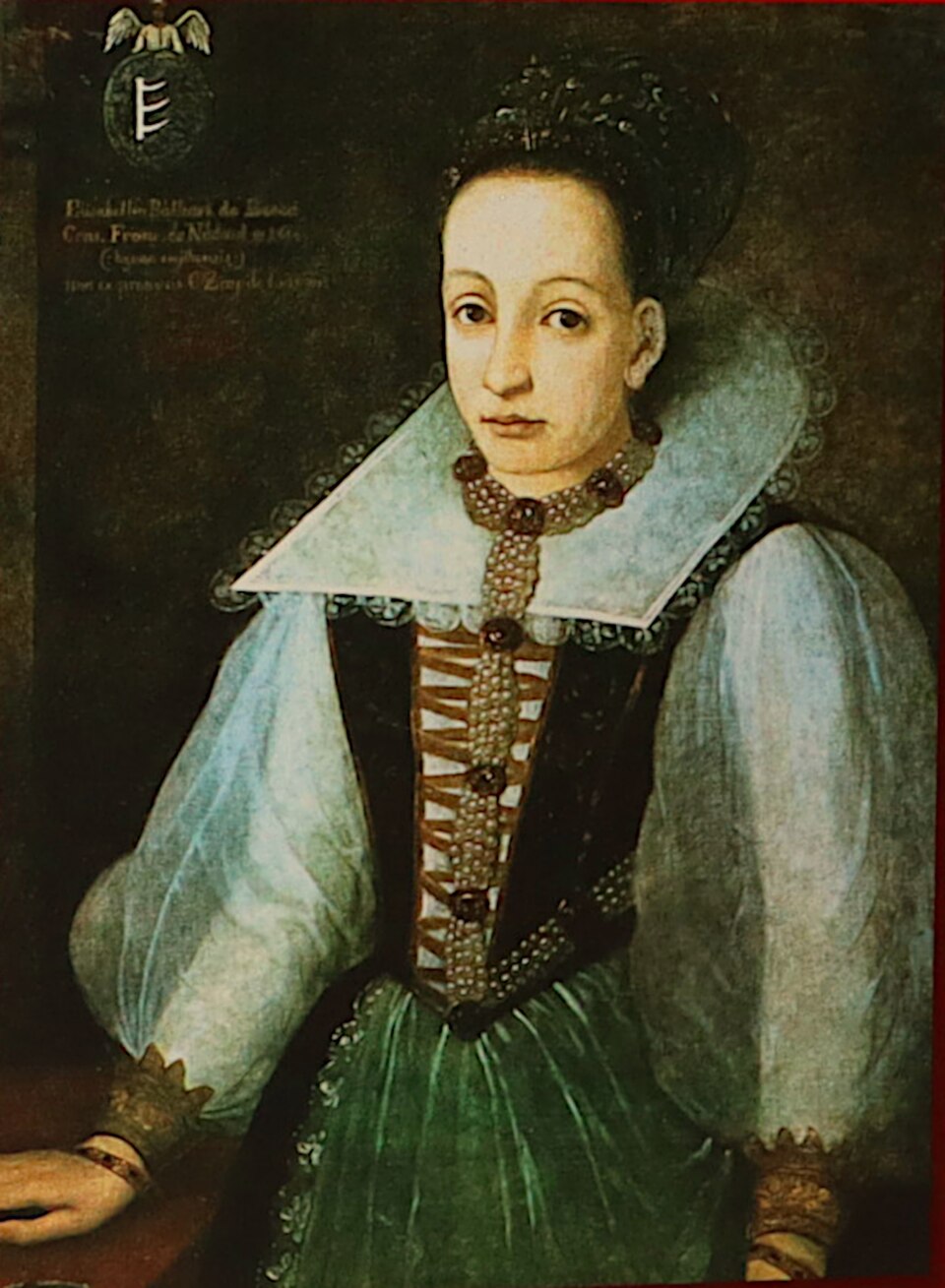
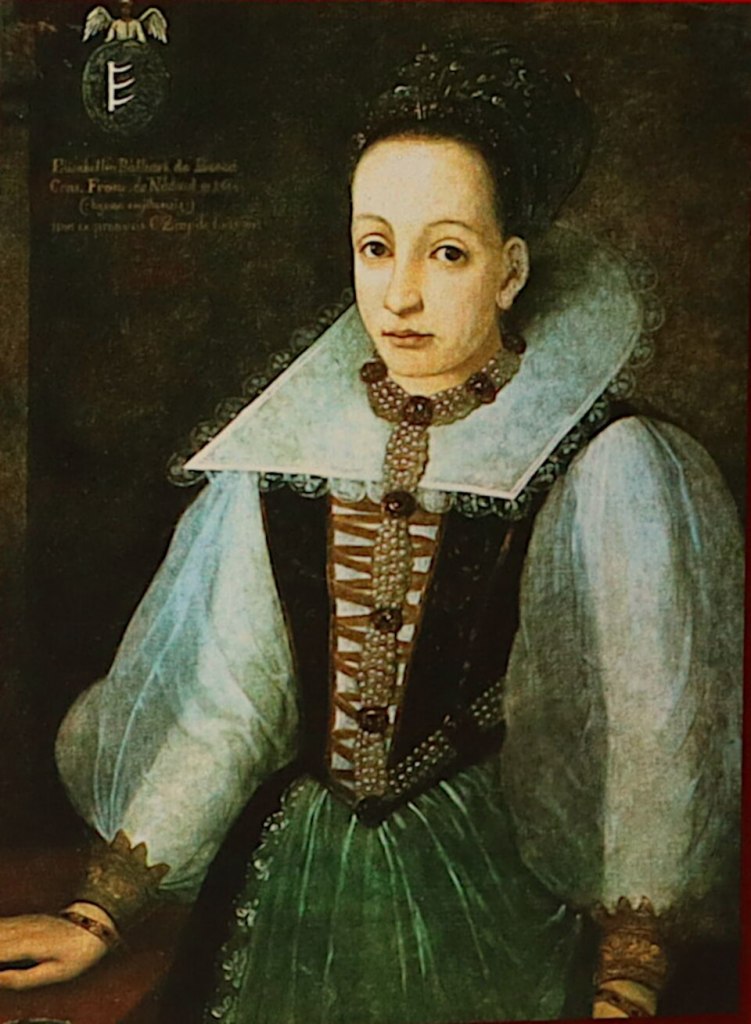
Elizabeth Bathory has become many things to many different people: a rare example of a female serial killer, an example of the demonization of strong women in history, or a macabre pop culture icon. But while a great deal has been written about her, is it possible to even know if she actually did commit any of the crimes connected to her name?
Sources
Craft, Kimberley. Infamous Lady: The True Story of Countess Erzebet Bathory (s.p., 2009).
____________. The Private Letters of Countess Erzsébet Báthory (s.p., 2011).
Thorne, Tony. Countess Dracula: The Life and Times of the Blood Countess, Elisabeth Báthory (Bloomsbury, 1997).
Turning Modern is a one-person production, so support is always welcome. You can contribute through Patreon or Ko-Fi.
Transcript
Once she was a noblewoman, whose hand in marriage was sought by many powerful families and who not only owned estates across Hungary, Slovakia, Bohemia, and Austria but managed them well. Her husband was once a hero, defending the kingdom and perhaps all of Europe from the Turks. She was now in her fifties. But instead of helping her now adult children start their own lives as budding matriarchs and patriarchs of great aristocratic families, though, she was sealed within the walls of her own castle. Only a small hole in the wall still connected her to the outside world, not that it mattered. The only person that visited her was Katalin, her youngest child, who would give the noblewoman her favorite meals and sweets and tell her news of the family and of developments in Hungary and Transylvania.
She was, of course, Elizabeth Bathory. We do actually know a fair amount about her life, perhaps more than even many people in her class. Yet we still can’t answer the most pressing and interesting question about her life. When she sat in her sealed-off chambers, did she reflect on the genuine crimes that would make her perhaps the most famous female serial killer in history? Or did she instead have to endlessly ruminate on the injustice done to her, an innocent woman, by the king, by one of her most trusted allies, and by her own family?
This is Turning Modern.
***
Of course, when Elizabeth was born in August of 1560 on her family’s estate in Nyírbátor, a town which sits on the Northern Great Plain of Hungary, no one could have guessed that she would become so famous her name would become proverbial. Certainly no one at the time could have even conceived that she would appear, albeit in odd and distorted forms, across countless books, movies, video games, and even operas, a 2012 musical, and several rock albums.
But to be fair, Elizabeth was somewhat exceptional. The Bathorys were one of the premier aristocratic clans of the region, with Elizabeth being the cousin of several Kings of Poland and princes of Transylvania. In a time when even many members of her class were illiterate and only able to sign their name, Elizabeth received a first-class education. She was familiar with the classics as well as the sciences of astronomy, botany, and mathematics, and she could read and speak in Hungarian, German, Slovak, and even ancient Greek and Latin. It seems Elizabeth also had some knowledge of medicine and anatomy, although the latter especially might not have been a good thing considering her alleged hobby.
We do have a glimpse of what she was like as a child. Apparently, she was something of a tomboy, who enjoyed fencing. There’s also an account that when she was a teenager that she had sex with a stablehand and got pregnant. The scandal was hushed up and the baby was spirited away, its fate unknown. Or, at least, that was the story peasants told decades after Elizabeth’s death.
Even if she actually did get pregnant unexpectedly, it didn’t get in the way of her duty to marry a nobleman and create a social and economic alliance between her family and another. When she was only 12, she was betrothed to the 17-year-old Count Ferenc Nádasdy, the scion of a wealthy noble family.
All biographies of Elizabeth Bathory make a point that the world Elizabeth and Ferenc grew up in was a violent one. By the time of her birth, Hungary was split into three zones: “Royal Hungary”, which was ruled by the staunchly Catholic Austrian Hapsbugs who claimed the Hungarian throne by right of ancestry; the principality of Transylvania, which was once part of Hungary but the mostly Protestant nobles there elected their own leaders in opposition to the Hapsburgs; and the part of Hungary claimed by the Ottoman Empire. This made the region a constant warzone where even in times of official peace raids by both Christian Hungarians and the Ottoman Turks were commonplace. The Bathorys and the Nádasdys were both Protestant and Calvinist. The Bathorys were frequently supporters of the princes of Transylvania, even when those princes weren’t one of their numbers. Yet, in the convoluted politics of Hungary at this time, some Protestant nobles did support the Hapsburgs, including Ferenc Nádasdy. In fact, the Hapsburgs would in time owe Ferenc a pretty sizable debt.
Ferenc was often away, fighting on the Hungarian front against the Ottoman Empire. The letters between Elizabeth and Ferenc are curt and business-like, although this wouldn’t have been unusual for the time. Perhaps, though, it is significant that increasingly Ferenc spent his time away from the battlefield at his northwest Hungarian childhood home of Sárvár while Elizabeth preferred her family’s castle at Csejthe in modern-day Slovakia. Later embellishments to Elizabeth’s story would suggest that Ferenc and Elizabeth had a falling out and perhaps even that Ferenc was abusive towards her or that he taught Elizabeth first-hand his knowledge of how to torture prisoners and became her first collaborator. This is all speculation, though. All that can be said is that they could stand each other enough to have four children that would live to adulthood, and that there’s no solid proof they were any different from any other family of their class. Elizabeth herself constantly travelled to various estates, and her surviving letters prove that she was an adept administrator. Nor did she neglect her responsibilities as a feudal lord and a patron. We know from her correspondence that she intervened to help a woman who had been raped and impregnated, she aided a woman whose husband was being held hostage by the Turks, and on numerous occasions she paid for physicians to tend to the peasants living on her estates. Even among her matter-of-fact letters, one can detect a haughty tone. Her steel shines through especially in the postscript of one letter written to a neighboring landowner who was infringing upon her own property. In Kimberley Craft’s translation, it reads, “know you this, that I will not allow myself to be dominated by men for long.”
By 1601, strange and ugly rumors started to spread about Elizabeth Bathory, despite her otherwise pristine reputation. Many of these rumors centered around Anna Darvolya, a Croatian servant of Elizabeth who was said to have been encouraging her to physically abuse the girls on Elizabeth’s staff with Ferenc’s knowledge, if not his involvement. According to the later testimony, an assistant pastor, Michael Zvonaric, was called to Elizabeth’s castle to preside over a burial. He heard that three of the servant girls were to be buried in the same coffin. Elizabeth would insist there were only two bodies in the coffin, which was already sealed, and explained that there had been a cholera outbreak on her estates. A quick burial had been arranged to help prevent panic. When Michael expressed discomfort with such a burial, Elizabeth waved him off. Later, he reported, the castle’s belfry master who had overheard the conversation took the minister aside, telling him that if he kept asking questions things would go badly for the servants.
There would be over 200 recorded testimonies of this kind at Elizabeth’s later trial. The narrative pieced together from these testimonies claim that it started with Elizabeth pinching, biting, and kicking her servants. Over time, it escalated to cutting them with knives, burning them, or sticking pins under their fingernails. Whether or not Ferenc knew about these alleged activities or even participated in them, after his death from a debilitating illness in 1603, the stories and later court testimonies seem to agree that Elizabeth’s sadism reached new heights. Servant girls were harshly beaten for minor infractions like taking too long to sew, and there seemed to be more deaths than were normal on Elizabeth’s estates, especially her favorite residence at Csejthe, with the coffins always sealed before the minister could arrive.
Pop culture infamy would surround the image of Elizabeth Bathory, bathing in the blood of virgins gathered from the villages surrounding her castle in a vain attempt to preserve her youth. No contemporary source makes such a claim. The stories of literal bloodbaths come from the early eighteenth century when a priest named Laszlo Turóczy discovered the court documents from Elizabeth Bathory’s trial and incorporated them with local folk tales he heard from peasants around Csejthe into his book, “Hungary, a Dated Compendium with Its Kings.”
In any case, the stories from the witness testimonies and her contemporaries are quite bloody enough. Along with Anna, Elizabeth surrounded herself with collaborators. These included three older women, the wet nurse, Ilona Jó Nagy; a woman named Dorottya Szentes; and a laundress, Katalin Beneczky. Strangely, Elizabeth’s inner circle also included an adolescent boy with the name János Újváry, who was usually called by his nickname “Ficzkó”, which meant “lad.” They assisted in Elizabeth’s torture sessions, or so it was claimed.
There is another ring of truth in the stories of Elizabeth bathing in virgin blood; testimonies were universal in saying that she almost always targeted young, unmarried women. They were beaten, starved, and outright murdered. One girl was drenched in cold water in the middle of winter and left to freeze to death. In a similar macabre display of inventiveness, one account says that in the summer Elizabeth had another girl stripped naked and covered in honey, so hundreds of insects would prey on her. A girl who ate one of two sweetbreads meant for Elizabeth had the other one shoved down her throat after it had been made steaming hot. The running theme in such stories is a desire to not only inflict pain and even death, but to degrade and humiliate. This is perhaps most clear in one claim, where Elizabeth forced a woman to carry a log around and hold it to her bare breast, pretending that it was a baby. When she tried to put down the log, Elizabeth screamed, “Suckle your child, you whore. Don’t let it cry!” Sometimes when the woman slept, Elizabeth would wake her up in the middle of the night and force her to again hold the so-called “child.” Kimberley Craft argues that one can connect violent escalation to times of stress in Elizabeth’s life, such as in 1605, when a peasant revolt devastated many of Elizabeth’s estates and nearly led to the loss of her fortune.
The minister at Csejthe and Michael Zvonaric’s superior, Istvan Magyari, had reportedly tried to bring his concerns to the authorities before and claimed that he denounced Elizabeth in a sermon even when she was sitting in the congregation. However, she wasn’t arrested until 1610, after Elizabeth reportedly started killing girls who had been sent to her castle by noble families to be educated. The man in charge of the investigation was György Thurzó, who was Palatine or viceroy of Royal Hungary under the Hapsburg King Mathyas. Thurzó, who was himself a Protestant, had in the past been a friend and ally of the Bathorys, shielding them from the Hapsburgs in spite of their connections to the Hapsburgs’ enemies in Transylvania. Now, though, he personally led a battalion of armed retainers to Castle Csejthe. In the middle of Christmas celebrations, they barged into the castle and detained Elizabeth. In a letter written to his wife, Thurzó claimed he personally saw dead and tortured girls, with Elizabeth herself in the middle of the act.
By the time of Elizabeth’s arrest, Anna Darvolya had already died. Her other accused accomplices, however, were not as lucky. Ficzkó, Dorottya, and Ilona would be tortured into confessing and condemned to death. The crimes of Ilona and Dorottya were deemed so heinous that their fingers were to be torn out. Then they would be killed and their bodies burned. Because of his age, Ficzkó was to just be immediately beheaded. As for Katalin, it was decided that there was not enough evidence against her from the testimonies. She was simply placed back in prison and presumably released later, although her ultimate fate has been forgotten.
There was now enough evidence to convict Elizabeth herself, but here politics finally got in the way. Elizabeth’s cousin Gábor Bathory was the reigning Prince of Transylvania. She was already writing to him, urging him to help her in any way possible. Also the fragile equilibrium between the Protestant and Catholic factions in the Hungarian nobility was in danger of rupturing. On one side, Thurzó faced the risk of pushing the Hungarian Protestants to the brink of rebellion. On the other, King Mathyas was demanding that Elizabeth be tortured into confession and executed, not so much in the name of justice but so that Mathyas would have the legal pretext to confiscate her vast estates and cancel the debts he still owed to her family. Thurzó placated the Bathorys and their Protestant sympathizers by working out a compromise with her children and sons-in-law: Elizabeth would be kept in life imprisonment, allowing her fortune to pass on to her heirs. This also had the no doubt intended side effect of preventing the Hapsburgs from tightening their grip on Hungary even further.
Whether she was a serial killer, an innocent victim of a vicious power play, or something in-between, Elizabeth was all but entombed in her own private rooms. One August night in 1614, she put her hands out through the hole in the wall, telling her guard, “Look, how cold my hands are!” The guard simply said, “It’s nothing, Mistress. Just go and lie down.” The next morning, she was found dead, with her pillow beneath her legs.
Normally, I try to keep my commentary to a minimum, but in this case I think it’s worth dwelling on the question: was she guilty? It is safe to say that her death toll was almost certainly not as high as 300, as one witness in the trial claimed, not least because her accomplices and different witnesses gave wildly different numbers. But could she have been completely innocent?
I believe there’s a strong case that she was. King Mathyas had every motive to see her brought low, to get himself out of the debts he owed her and acquire her vast lands. Thurzó may have ostensibly an ally to the Bathorys, but he would be involved in the plot to assassinate the catastrophically unpopular Gábor Bathory. Plus he wanted to see his own son get elected as prince of Transylvania. And, of course, in a society such as early modern Hungary, even a powerful, independent woman like Elizabeth Bathory is vulnerable in ways their male counterparts are not.
All that said, though, if I had to offer my own verdict, I would instead argue she was indeed guilty of at least some murders. Contemporary reports agree that, even before Thurzó got involved, the pastor Istvan Magyari had been raising suspicions for years. While Elizabeth’s supposed accomplices were tortured into confessing, many of the people who spoke out against her were not. Also I imagine it would be extremely difficult to get away with framing someone of an extraordinary series of crimes when dozens of named witnesses are involved, making it easy for others who knew the people and events in question to poke holes in such a conspiracy, even more so when there are powerful individuals who would have every reason to want to defend the Bathory name, if nothing else. And if Thurzó was an agent of the Hapsburgs, acting on their interests, he did a very lousy job. Not only did he thwart King Mathias’ attempts to claim Elizabeth Bathory’s estates, but he also seemed to still be defending the Bathory family’s interests like he always had, helping Elizabeth’s children mitigate any scandal emerging out of their mother’s arrest. Thurzó himself apparently didn’t get much out of Elizabeth Bathory’s downfall, except the ire of King Mathias, the one man in a position to ruin him.
For me, though, the most convincing thing is how oddly out of tune with her own time the accounts of Elizabeth’s crimes are. By that I mean the feeling I get from reading the trial records is that these are people confronting something unfamiliar. There’s evidence serial killers had existed all throughout history, but of course at the time there was no frame of reference for such a person, outside perhaps vague allusions in folklore. Even in a time and place of violence that us coddled moderns would find shocking, the idea of a person, especially an upper-class woman, hurting and killing the most vulnerable people in society, unmarried girls, just for their own pleasure outrages Elizabeth’s contemporaries to a degree that makes it sound literally inconceivable.
Powerful women were often attacked through trumped-up charges; just ask Anne Boleyn, whose story we’ll be hearing soon enough. But charges of heresy, witchcraft, sexual promiscuity, or plotting or committing the murder of a husband or another close male relative were the usual tactics for defaming a woman, not lurid tales of sadism and brutality. I propose that it would have taken a massive leap of imagination to accuse any woman at the time, much less one as conventionally respectable as Elizabeth Bathory, of being a torturer and multiple murderer. In addition, a crime like adultery or a clandestine murder is relatively easy to fabricate since such crimes can take place behind closed doors, and only one or two witnesses are required to get the ball rolling. A years-long killing spree, involving girls from dozens of families including affluent households and in castles filled with servants and retainers, would be much harder to spin out of thin air, if not impossible.
Well, that’s my opinion, anyway. Like I said, I really do believe both sides have good arguments to deploy; it’s just the argument for a guilty verdict seems more plausible to me. In the end, all we can do is agree with a remark made by one of Bathory’s servants who testified during her trial: “Only God knows an account of all her crimes.”
Thank you for listening, and happy Halloween.


Leave a Reply