A soldier named György Dózsa helps turn an army of peasant crusaders into a full-on revolution. His war on the nobles who ruined his country’s recent reforms is destined to have an impact, just not the one he wanted…
Sources
Albert-László. Barabási. Bursts: The Hidden Patters Behind Everything We Do From Your E-Mail to Bloody Crusades (Plume, 2011).
Makkai, Laszlo. “Neo-serfdom: Its Origin and Nature in East Central Europe.” Slavic Review 34.2 (1975): 225-238.
Molnár, Miklós. A Concise History of Hungary (Cambridge University Press, 2001).
Pascu, Ștefan. A History of Transylvania, trans. D. Robert Ladd (Wayne University Press, 1982).
Transcript
If you ever lived or traveled in Hungary, you may have had in your hands at some point a piece of currency that bore the face of a man named György Dózsa – or, at least, what is imagined to be his face, since there are no surviving contemporary depictions of him. One of these pieces was the 20-forints bill, which was in circulation from about 1947 to 1992. It shows this imagined yet once flesh and blood man looking sternly to his left. He wears the hat and coat of a burgher or perhaps a peasant of the time, with a close-cut beard. His face is marked with a distinct look of determination.
György Dózsa is one of those figures who straddles historical fact and legend. Under Hungary’s post-World War II Communist government, György became a hero of class struggle. But even after the fall of Communism, György’s image persisted as an embodiment of Hungarian nationalism.
And yet, famous as he is, György Dózsa likely died one of the most brutal deaths I’ve ever read about in history at the hands of his own country.
This is Turning Modern.
By the second half of the fifteenth century, Hungary was faced with a real existential crisis. The Ottoman Empire had taken Constantinople, the capital of the last direct vestige of the Roman Empire, and had steamrolled over Bulgaria, Serbia, and Bosnia. Besides southern Italy, Hungary was now the obvious item on the Ottomans’ list of future conquests.
Usually when people learn about this period of European history, they are usually exasperated by how those in power seemed to sit on their hands as the Ottomans took over Anatolia and then Greece and the rest of the Eastern Europe, especially when they learn about how much many Popes and monarchs of western and central Europe left the Byzantines trying to sail a sinking ship. This at least wasn’t always the case, however. Case in point: a historic royal election that took place in 1458.
The nobles of Hungary elected their kings in a general assembly called the Diet. Actually, at least a hint of some old elective principle wasn’t that unusual among European monarchies, even if it was usually just basically a strange little detail in the background The Hungarian nobility was more openly assertive when it came to choosing their rulers than some others, but even then, every monarch since the founding of the kingdom in the eleventh century was connected to the royal bloodline at least distantly or through marriage. At least, that was the case until 1458. After the death of the last king, the Austrian Hapsburg Ladislaus V, the Diet of Hungary elected Mathias Hunyadi. His father Janos was a celebrated war hero, who had been among the few of the time to win decisive victories against the Ottomans. He also happened to be a nobleman who had more wealth and land than the monarchy itself. After Janos’ death, Mathias’ older brother, also named Ladislaus, became head of the family. Unfortunately, Ladislaus was in a feud with King Ladislaus V’s chief chancellor, Count Ulrich of Selje, and at Ladislaus’ order the count was assassinated. Enraged and no doubt fearing what his most powerful subject might do as an encore, Ladislaus V had both the Hunyadi brothers imprisoned. Soon enough, Ladislaus Hunyadi was unceremoniously put to death. Matthias may have followed him, especially since the rest of his family started leading a rebellion, but then Ladislaus V became ill and died without an heir. When Ladislaus V fled the rebels in Hungary for his homeland of Austria he dragged a still imprisoned Matthias with him. Matthias remained a prisoner until after Ladislaus V died.
Just a couple of months later, the man who was a prisoner standing at the precipice of death was now king himself. He could claim no ancestry from a past monarch nor was he from a distinguished foreign dynasty. His historic election was made for various reasons, including the fact he was a compromise candidate preventing a civil war between rival claimants and factions, but he also owed his crown to his father’s reputation and his own personal popularity among the magnates. Most importantly, Matthias was hired to do the job of protecting Hungary from the Ottomans, and he did it superbly. Under the reign of Mathias Corvinus, as he became known, Hungary became the most well-oiled machine out of all the European states of the time. It had the famous Black Army, the largest standing army in Europe and an impressive array of fortifications at Belgrade. Nor was Mathias’ reforms all related to just the military. He put more control over Hungary’s judiciary and administration in the hands of professionals, rather than just the nobility. Determined to make Hungary a place that would attract the best scholars, artists, and engineers in Europe, he funded one of the largest libraries ever seen, the Bibliotheca Corvinica, and was arguably the first monarch outside Italy who embraced the Renaissance. All of this was just part of his own project of creating a nation that could stand up to the Ottomans.
It was during the reformist reign of Mathias Corvinus that György Dózsa was born, sometime around the year 1470, in the village of Dalnók in Transylvania. He was a child of the Székely people, a community some accounts have claimed were descended from the Huns or the Turks but who were instead likely descended from Hungarians granted special privileges and liberties in exchange for them living in and patrolling the kingdom’s then uninhabited peripheries. By the time György was reaching adulthood, King Mathias had died. He had tried to set up his only son Janos as his successor. However, since Janos was the son of Matthias and his mistress, he had a serious disadvantage as a candidate. Besides, the top nobles of Hungary had reason to regret their choice. Mathias had done his job too well. His government demanded more taxes from them to fund the bureaucratic machine he turned Hungary into and if the nobles tried to start a rebellion he actually treated them brutally like traitors. If history has set laws one of them is that even in times of crisis the rich and powerful may admit a crisis is happening but they’ll reassess the minute actually dealing with the crisis becomes inconvenient. It didn’t help that the Ottoman threat to Hungary had receded, partially because of Mathias. So, they reasoned like so many other people in power throughout history, what was the problem in the first place?
When Mathias died in the spring of 1490, for their next king the nobles went back to their old strategy of electing a prince from a neighboring country who had at least some kind of ancestral claim but wasn’t familiar with the ins and outs of Hungarian politics. Their choice was the already reigning king of Bohemia, Vladislaus, whose great-grandmother Mary of Anjou had been the Queen of Hungary in her own right. Crowned as Vladislaus II, the nobles soon gave the new king a nickname: “Yes, Alright”, so named because that is reportedly what he said every time a great magnate asked him for permission or for a favor. If they deliberately set out to find Mathias Corvinus’ exact opposite, they couldn’t have done better. The Black Army fell apart from a lack of funds and the massive bureaucracy Mathias Corvinus built either withered away or was coopted by the high nobility and the leaders of the Hungarian church. Even the low-ranking, “common” nobility was starting to feel the pressure from above. The tax burden that Mathias Corvinus tried to make at least somewhat more equitable by the standards of the era now shifted from the high nobility to low-ranking provincial nobles, the city burghers, and the landholding peasantry. To quote historian Miklós Molnár’s description of this period, “Social classes that had begun to rise found themselves sinking back, and the whole country sank with them.”
György Dózsa would have lived through this change in regime. As a young man he may have already heard peasants complaining about the more corrupt and plutocratic regime of King Vladislaus II and pining for the good old days of the one they were already calling King Mathias the Just. Early accounts also claim that György was something of a young thug, who allegedly killed a government official and robbed merchants. In his book Bursts, the scientist Albert-László Barabási argues that these early stories of György were probably just distorted and biased accounts of him clashing with local officials who were infringing upon the ancient rights of the Székely people. In the years following King Matthias’ death, many royal privileges that protected certain local communities from tax assessments were weakened or abolished altogether, so it was certainly possible. All the same, a pattern of defying authority through violence had already been set in György’s life.
The world in which György came of age was a tinderbox. On top of the tensions from tax rates and corruption, it was widely believed among the peasants and the rank-and-file clergy that the Ottoman Turks were heralds of the coming apocalypse. The peasants and low-tier clergy were also hearing from the Hussites of Bohemia, a religious movement that had many criticisms of the Church hierarchy similar to what the Protestants would argue in coming years and whose leader Jan Huss was notoriously betrayed and executed by officials despite a promise of safe passage. Much of the discontentment and outright rage people felt toward the Church that erupted in Hans Bohm’s would-be revolt was also simmering in Hungary.
György became a mercenary, who might have fought against the Ottoman Turks at Belgrade in 1513. One legend claims he personally overcame and slew an infamous Turkish commander who was a skilled swordsman, for which King Vladislaus rewarded György with a noble title. It would have been around this time that György would have heard about a decree issued by Pope Leo X in 1513, calling on even the common people to participate in organizing a crusade to take Constantinople back from the Ottoman Empire.
Unfortunately, the leading clergy in Hungary made one major mistake in entrusting recruitment for the crusade to the Franciscan monks of Hungary. For decades the Franciscan monasteries of Hungary had been hotbeds of revolutionary sentiment, perhaps because they recruited their numbers from young men who belonged to the segments of the peasantry that benefited from Mathias Corvinus’ reforms but were now floundering under the new regime. The monks and friars preached that the common people owed obedience only to the king and not the nobles, and that the Apocalypse where God will free the poor from oppression would happen within their lifetimes. One of these men was a friar and parish priest named Lőrinc Mészáros, who was one of the more successful organizers of the crusades.
In fact, clergy like Lőrinc did their work too well. So many peasants were leaving their fields to take up arms with the growing armies around the city of Pest that local nobles and officials became alarmed that not enough people would be around to take in the harvest in the fall. Some nobles hired armed brigades to chain peasants and their families to carts and take them home. Already the nobility had been looking at this Peasants’ Crusade with undisguised contempt, refusing to offer any leadership or food and other provisions despite the Church’s urgings. As the army started to march across the Great Hungarian Plain for Ottoman territory, heated arguments and then violent brawls between peasants and the landowners started breaking out.
The clerical leaders put in charge of the whole campaign just cancelled the whole thing, finally glimpsing the danger, but it was far too late. Many of the Crusade’s leaders ignored instructions to disarm and stop recruitment. Among them were György, who had befriended Lőrinc whose sermons had cemented his commitment to the cause. Preachers like Lőrinc not only rejected the orders to disperse, but a new theme entered their sermons. The king and the nobles wanted to stop the crusade precisely because they thought it would succeed. All along, the nobles and even King Vladislaus had been in league with the Ottomans. There was no chance that Constantinople could be taken back for Christendom until the threat at home was dealt with.
What exactly the rebellious crusade now wanted has been made unclear by biased later accounts and by centuries of myth and legend. Some said that György sought to make himself the new lord of Hungary, although this sounds like the kind of thing that would be later invented by chroniclers hostile to the revolt. In any case, it does seem like they talked openly of abolishing the nobility, replacing the top clergy in Hungary with a single bishop who would be elected by the people, and redistributing the land held by the Church and the nobles. György, his brother Gergeley, and Lőrinc were chosen as leaders. From the city of Cegléd which occupied a strategic position in central Hungary, György drew in more recruits and conducted raids against noble manors and defiant towns. It was said György did show mercy toward people fleeing the raids, helping them escape from his own, more vengeful officers, but at the same time he was quite ruthless, having hundreds of nobles and landlords executed by crucifixion or impalement. The bishop of Cegléd himself was impaled and left to rot within view of the local citizens.
The revolt became a true threat once it attracted the support of several towns and cities. Under György’s command even the untrained peasants at his command managed to capture several fortresses and supplies of artillery and get within striking distance of the capital of Buda. But they would not enjoy their success for long. In July of 1514, the crusaders suffered a staggering defeat at the hands of an army of hardened veterans led by Jonas Zapolya, a future king of Hungary, and by Stephen Bathory, who happened to be the grandfather of the notorious Elizabeth Bathory. (I’m saving her story for a special Halloween episode, by the way). Speaking of horror stories, we now get to the famous account of György’s execution.
In my research I’ve seen suggestions made by people who weren’t writing as scholars that this story is a myth or at least embellished but at the same time the actual published scholarly sources I’m using for this episode don’t question its authenticity. I’m not saying that as a matter of personal judgment; it could be that there’s a source out there somewhere I’m not aware of that actually does debunk the story of his execution based on evidence. I just think it’s all worth bringing up, even at the cost of a messy narrative, so people can start to make up their own minds. In fact, I’ll fess up and say this was a difficult episode to research and write not just because there weren’t as many sources I could access as I usually have, but because so many details about György’s life, even the parts that are attested to in contemporary documents, are so muddled with legend and propaganda. I even nearly gave up on doing this episode at all close to the eleventh hour.
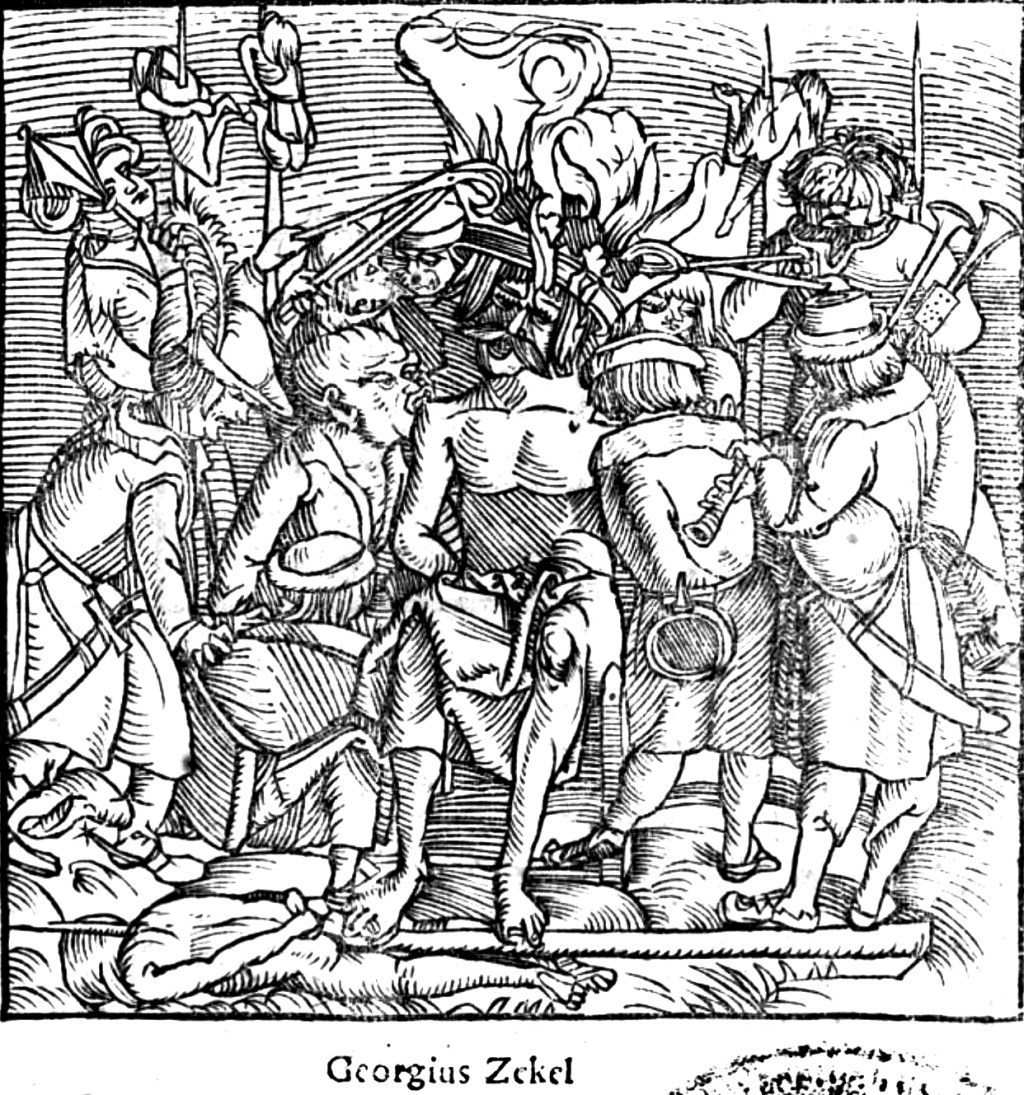
With all that said, according to the account György was brought before a small crowd of notables. As a group of monks sang holy hymns, he was forced to set on a metal throne, which according to some versions of the story had been heated. Then a crown of red-hot iron was placed on his head. Nine prisoners were brought before the mock king. One of them was his brother Gergeley, whom György had been begging the authorities to spare. Gergeley had not even wanted to really join the crusade in the first place, until György convinced him. Instead of being given a pardon, Gergeley was cut down before him. The executions then took red-hot pincers and began ripping out parts of György’s flesh. The surviving prisoners were ordered to bite into his body; those who refused were killed on the spot. One account claims that grown men who watched this fainted at the site, others simply left. Another said that the moment György died one could see an apparition of the Virgin Mary herself, escorting György’s soul to Heaven. As for the execution itself, there was a sacred and symbolic logic there on top of the brutality. To quote Barabási, “The country is a body, organic and alive, as the king had often emphasized. György must die the way he disfigured his homeland—by biting into its live body.”
The ones who agreed to cannibalize György so were spared from any further punishment and released. Apparently, the authorities were content with the punishment inflicted on him. In fact, a surprising number of the peasants involved in the crusades were given clemency. Someone needed to work the fields in time for the harvest, after all.
The revolt did not quite end there. Several leaders including Lőrinc escaped or eluded capture and carried on the fight in parts of Transylvania. Fights and massacres erupted all over the country. In the end, though, order was restored.
Still, György’s revolt unnerved those in power. That same year, by 1514 a proposed law code, the Tripartitum, was put together and presented to the Diet of Hungary. It would never be formally enacted, but nonetheless it would become a widely used source for Hungarian courts in the centuries to come. One source said the Tripartitum was “written in the blood of serfs.” To be fair, the Tripartitum codified a number of rights for both landholding and dependent peasants, but in other ways it also whittled away at their traditional rights. The rights of peasants to inherit and own land or to migrate were restricted. One day of service per week to the lords was now mandated and taxes and church tithes were set at fixed and high rates. To cap it all off, the Diet officially declared that the peasantry were now placed in a state of perpetual servitude in order to “remind you what a crime it is to rise up against your master.”
Admittedly this didn’t happen entirely as a crackdown following the revolts. Some historians have argued that eastern Europe experienced a period of neo-feudalism or “Second Feudalism”, something I already touched on in my episode about Hans Bohm. But to go into more detail, from the late fifteenth century and well into the sixteenth century, Bohemia, Poland, Austria, Livonia, and parts of northeastern Germany enacted laws that also prevented peasants from moving freely and restricted their rights over their own lands, after feudalism had been in long decline in most of the rest of western and central Europe. Historians have proposed numerous explanations. One is the political threat of the Ottoman Empire, another points to the fact that Western Europe was more urbanized than the East. A more elaborate theory considers that the economies of western Europe were rapidly changing due mainly to the beginnings of colonial expansion into the Americas. The theory goes that colonization led to an infusion of wealth and raw materials into western Europe, which in turn fueled an explosion in manufacturing. This boosted trade between western and eastern Europe, with western Europe trading manufactured goods and eastern Europe trading agricultural produce in turn. With the growth in trade came a growth in demand, and landowners had the incentive to keep their peasants stuck on their farmlands as much as possible.
Whatever the truth of the matter, and of course other historians have questioned the entire Second Feudalism thesis, the peasant crusade may have been fighting against forces that were already coalescing. At the very least, György’s revolution became an excuse to do what the powers that be wanted to do anyway.
Then there’s the what-if questions the crusade leaves behind. King “Yes, Alright” died, but before his death he managed to get the nobility to accept as king his ten-year-old son, who was named King Lajos II. By this point the nobility had such a tight grip over royal finances that Lajos and his household had to pawn several of their personal possessions at several points to afford necessities. The army faired no better, with entire border fortresses left in need of repairs or understaffed. In 1526, Sultan Suleiman of the Ottoman Empire marched to go to war against Hungary, the type of scenario King Mathias had tried to prepare for. At the Battle of Mohács, most of Hungary’s high nobility, the very nobles who had been running the state for the past couple of decades, was cut down, and the then twenty-year-old King Lajos died when he fell off his horse and died in a stream because he couldn’t get up due to the weight of his armor. Hungary itself literally shattered: there was Royal Hungary, which was claimed by the Hapsburgs of Austria in the name of Lajos’ sister Anna who had married into the family; the Ottoman province of Hungary; and the Principality of Transylvania, whose leaders first claimed to be the rightful kings of Hungary and maintained a precarious independence by playing the Ottomans and the Hapsburgs off against each other.
Would this have happened if Pope Leo had never tried rising a people’s crusade or if the clergy of Hungary had taken a different, better approach? Or if György’s revolt had been averted or if it had succeeded at least to the point that it provoked some beneficial reforms? Possibly; after all Hungary’s once formidable war machine had been breaking down from decades of neglect and underfunding while the Ottoman Empire was at what would prove in hindsight to be its peak. Still, it could very well have been decisive that the memories of the revolt were still so raw that peasants and burghers walked away from the call for recruits and some nobles and officials were extremely reluctant to try arming groups of peasants.
If nothing else, I would say it’s a cautionary tale about how the powerful’s attempts to protect their self-interest at the expense of everyone else can, sooner or even much later, backfire spectacularly.
 Turning Modern