Tag: history

  • The Drop-Out Who Destroyed a Society

    The Drop-Out Who Destroyed a Society

    In 1519, Europeans made their first diplomatic contact with an urbanized empire in the Americas—and, within a few years, that empire will no longer exist, in no small part because of a failed law student from Spain.

    Sources

    Cortés, Hernán. Letters from Mexico, trans. A.R. Pagden  (Orion Books, 1971).

    Florentine Codex, vol. 9, trans. Arthur J.O. Anderson and Charles E. Dibble, rev. ed.  (School of American Research, 1973).

    Gómara, Francisco López de. Cortés: The Life of the Conqueror by His Secretary, trans. Lesley Byrd Simpson (University of California Press, 1964),

    Restall, Matthew. Seven Myths of the Spanish Conquest (Oxford University Press, 2003).

    Townsend, Richard F. The Aztecs, rev. ed.  (Thames & Hudson, 2000).

    Transcript

    Today the Basilica of Our Lady of Guadalupe watches over the Plaza of the Americas in Mexico City. Countless pilgrims come there to see the centerpiece, an image of the Virgin Mary, as it has done since 1531. Although a newer building was constructed next to the old church in 1976 and claimed the Virgin Mary’s holy icon for itself, the older basilica not only still stands but remains open to visitors. However, the entire church hides something of a secret. It was built at the site a temple sacred to the goddess Tonantzin, the “Honored Grandmother” who presided over fertility. This is far from the only case of Christianity placing a thin veneer over older religious practice, but it is perhaps more appropriate than most. More than a place for Catholics to prove their devotion to the mother of Jesus Christ, the Basilica of Our Lady of Guadalupe remains a patriotic symbol for Mexico.

    The very name of the country of Mexico refers to the society that once worshipped Tonatzin, the Aztecs. The story of how the Aztecs’ empire ended was not a simple one of enemy armies swooping into their land. Instead it was the preposterous story of how circumstance and the decisions of one man, who was acting against the orders of his superiors the entire time, devastated an entire civilization.

    This is Turning Modern.

    Contrary to his reputation as a conqueror, Hernán Cortez was born a chronically ill child, who seemed destined to become a  clerk or a member of the church. In truth, he was too unmanageable to be made into a decent student, although he did learn quite a bit about law from the years he spent working as a notary. Cortez came back home as arguably the sixteenth-century Spanish equivalent of a college dropout. Yet while he wasn’t going to become a secretary for some prominent nobleman or a magistrate working for the monarchy, Cortez still had ambitions that were inflamed by the stories coming about a sailor named Christopher Columbus and lands unknown to both the Bible and the ancients.

    Using his family connections, Cortez seized on the first opportunity to go to the New World. Eventually he got a job as a notary and secretary for the governor of Cuba, Diego Velazquez. Cortez went far enough to secure his position in the new colony that he married Velazquez’s sister-in-law. However, being a man on the rise in a new colony was not enough for Cortez, although he may have also been motivated to leave Cuba because relations with Velasquez were starting to go south. In any case, Cortez worked hard to get appointed the commander of an expedition into Mexico, especially since he was interested in the rumors that there were vast hordes of gold and silver to be found there.

    The risks were incalculable. Just two years ago, members of one Spanish expedition into the Yucatan ended with the expedition’s members getting massacred. However, the possible rewards were enough that Cortez easily found a crew of around one hundred men. Along with religious missionaries, their ranks included professional mercenaries, younger sons of noblemen shouldered out of their inheritance by older brothers, and less distinguished men who were simply desperate or greedy for wealth and land.

    Velasquez signed off on the mission at first, but Cores had gone too far. Velasquez attempted to recall the expedition, but Cortez shrugged off the order, even though it made him guilty of mutiny. Instead, Cortez used his knowledge of the law to start building a case that he was acting directly under the authority of the Holy Roman Emperor and King of Spain, Charles V, and not a mere colonial governor.

    From this point on the true story is buried under layers of myth, legend, and outright propaganda. One persistent claim would have it that the natives that Cortez came across were overawed by the strange men from across the sea who seemed connected to blindingly fast beasts with four legs, so much so they thought the god Quetzalcoatl had returned to reclaim his kingdom. This is nonsense; the Aztecs could easily understand that the Spanish were simply a people they had never encountered before. Now it does seem to be true that the Aztecs were frightened by horses and were at a disadvantage because of the Aztecs’ steel armor and guns.

    Cortez had help, though. The first was the greatest ally of Cortez and all would-be conquerors of the Americas from Europe, the disease of smallpox, which preyed on the American populations that had no natural defense against it. Some modern estimates hold that smallpox claimed as much as 90 percent of the indigenous population of the Americas. A possible eyewitness account of the outbreak of the plague from an Aztec perspective might have been preserved in the Florentine Codex, which was written by a Franciscan friar decades after Cortez arrived in the Americas but was drawing on the testimonies of indigenous converts to Christianity. It reads, “But before the Spaniards had risen against us, first there was prevalent a great sickness, a plague. […] No longer could they walk; they only lay in their abodes, in their beds. […] There was death from hunger; there was no one to take care of another; there was no one to attend to another.”

    Fate also put essential allies on Cortez’ path. Cortez came across a friar named Geronimo de Aguilar. Stranded by a shipwreck, he was captured by some Mayans and escaped, but not before he learned the local Mayan language. Then a local Aztec leader gave Cortez twenty enslaved women. One of them as Malintzin, who became remembered with notoriety as La Malinche, who spoke both the Mayan Chontal language and the Aztec language of Nahuatl. With her help as a translator, Cortez was able to negotiate and strike deals with local leaders.

    This made Cortez especially dangerous. The Aztecs’ authority was built on the obedience, grudging or otherwise, of regional chieftains. Some were only kept in line by the threat of force. This was probably why the emperor of the Aztecs, Moctezuma II, made the move he did. In a decision still debated by historians, Moctezuma didn’t send an army to crush Cortez and his band, but instead a formal delegation to invite them to come to the Aztec capital of Tenochtitlan. This was his way of containing the threat, especially as it was undeniable that the presence of the Spanish was already sending ripples through the Aztecs’ delicate system of alliances and vassals. His greed inflamed by the extravagant gifts offered by the delegates, Cortez agreed to go, leaving some of his men behind to guard the territory they occupied in modern-day Veracruz.

    In his letters back to Spain, Cortez expressed astonishment over Tenochtitlan, a vast, well-populated city built over a lake, its streets and buildings interlaced with canals and connected with countless bridges. He writers, “The city is so big and so remarkable that, although is much I could say of it which I shall omit, the little I will say is, I think, almost unbelievable, for the city is much larger than Granada and very much stronger, with as good buildings and many more people than Granada had when it was taken.”

    Less positive was their impression of the Aztec priests who staffed the temples. A memoir written by one of Cortez’ comrades, Bernal Diaz, writes this: “They wore black cloaks like cassocks and long gowns reaching to their feet. Some had hoods like those worn by canons, and others had smaller hoods like those of Dominicans, and they wore their hair very long, right down to their waist, and some had it even reaching down to the ankles. Their hair was covered with blood, and so matted together that it could not be separated, and their ears were cut to pieces by way of penance. They stank like sulfur and they had another bad smell like carrion.”

    There’s no doubt this account was biased, but it does raise an issue worth addressing given the way people have been, let’s say, using history in recent years: the Aztec practice of human sacrifice. I don’t want to argue the point, so let me just have an interlude with a hypothetical of sorts. Let’s say there’s a parallel world where the Aztecs colonized Europe or at least they colonized Portugal and Spain. In other words, it’s a world where the Sunset Conquest took place; people who are fans of Crusader Kings will know what I’m talking about. In their version of the 21st century, the descendants of the Aztecs gave up human sacrifice centuries ago, and their political commentators and scholars are having their own debates over how the Aztec colonization of Europe should be viewed. Some still hold the traditionalist view that the Aztecs brought civilization to Iberia. After all, their descendants may have sacrificed humans to the gods, but these Spanish and Portuguese, they had crowds watch while people were burned alive just because they were accused of secretly worshipping their god the wrong way or they loved people of the same sex.

    That’s just something to keep in perspective if one is tempted to think a society was better off experiencing a Hernán Cortez.

    Anyway, let’s get back to Cortez himself, who is about to have his first meeting with Moctezuma. The first meeting is recounted in Cortez’ letters: “And they were all dressed alike except that Moctezuma wore sandals whereas the others went barefoot; and they held his arm on either side. When we met I dismounted and stepped forward to embrace him, but the two lords who were with him stopped me with their hands so that I should not touch him; and they likewise all performed the ceremony of kissing the earth.”

    For two weeks Cortez through his interpreters negotiated with Moctezuma, trying to get him to acknowledge Charles V as his God-given sovereign. Matters came to a head when he heard reports of a violent clash between his men in Veracruz and some locals, which made him believe that Moctezuma was trying to cut Cortez off from the rest of his forces, or so he would later claim. Whatever the exact truth, Cortez tricked Moctezuma into giving him a private audience in his chambers, giving his men the opportunity to take Moctezuma hostage. After several tense days, Moctezuma gave in. He would allow Christian worship to take place in the Great Pyramid of Tenochtitlan and would acknowledge Charles V as his overlord. With a hint of genuine sympathy, Cortez’s secretary, Francisco Lopez da Gomara, described the speech Moctezuma gave to an assembly of the Aztec elite:

    “You will please me by giving yourselves to this captain as vassals of the Emperor and King of Spain, our sovereign lord, to whom I have already submitted as his servant and friend. And I implore you to obey him henceforth, as you have obeyed me, and give and render him the tributes, taxes, and services that you have rendered me, for you cannot give me greater pleasure.” Moctezuma could say no more, because of his tears and sobs, and all the people wept so bitterly that for a good while they could not even answer him. They sighed and groaned so heavily that they even moved the hearts of our men; but in the end they said they would do as he commanded.”

    Moments like this is why in some historical narratives Moctezuma is seen as a cowardly dupe, cowed and outmaneuvered at every turn by the Spanish. Rather, I think this was a deliberate move to get the Spanish to press their luck too far. He might have also been aware that Cortez had got disturbing news. Velasquez sent a small army to capture Cortez and bring him back to Cuba to be tried for insubordination and treason. Reluctantly, Cortez again split his forces, leading some of his men to confront Velasquez’s squad while leaving one of his lieutenants, Pedro de Alvarado, in charge in Tenochtitlan.

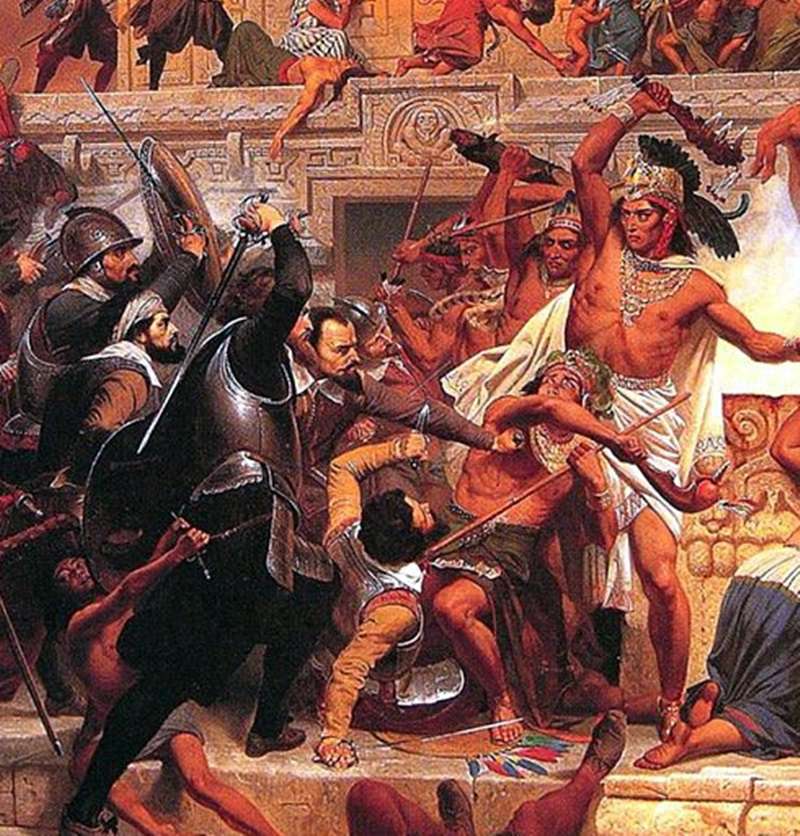
    For reasons lost in the chaos – either Alvarado had been acting out of fear and hatred or he had been tricked by one of the Aztecs’ native enemies – he ordered a massacre of the Aztec people during a religious festival. The Florentine Codex, again likely using the words of an Aztec eyewitness, says, “And the blood of the brave warriors ran like water; it was as if it lay slippery. [. . .] And the Spaniards went everywhere as they searched in the. . . [buildings]. Everywhere they went making thrusts as they searched, in case someone had taken refuge.”

    The manhandling of their monarch was bad enough; the massacre of most of the empire’s nobles in the middle of one of the holiest festivals on the calendar was too much. The inhabitants of Tenochtitlan came out in force, pelting any of the Spanish they saw with stones and darts. Cortez had beaten Velasquez’s squad, only to return to a city that had slipped into chaos. At his urging, Moctezuma stood above the mob on a palace parapet, wearing the turquoise crown, begging for calm from his people. His subjects responded with furious shouts and with stones, one of which dealt a fatal blow to his head. Falling back, Moctezuma’s Spanish jailers hurried him to his bed where he would linger in agony for three days. Cortez and his priests tried to convince him to convert to Christianity, but Moctezuma died a believer in the gods of his ancestors. In his imagining of Moctezuma’s final moments, the writer Arthur Miller, in his play The Golden Years, has Moctezuma turn on his deathbed to a remorseful Cortez who hopes to atone for his crimes by saving the emperor’s soul and quip, “Your god is bloodier than mine.”

    Not long after Moctezuma breathed his last, the Spanish were driven out of Tenochtitlan by its people. This might have marked the moment when destiny finally turned against Cortez, but unfortunately, he was saved by his most precious ally, smallpox. The potential leaders of the empire who were not slain in Alvarado’s massacre, including Moctezuma’s brother and successor, were mostly killed by the plague. Soon enough, Tenochtitlan and the entire Aztec Empire would be claimed and remade by the Spanish.

    Was all this inevitable? How much of a part did one man, a failed law student named Hernán Cortez, play in the downfall of not just an empire but a society? If you go by scholars who are of the persuasion that geography and environment shape history, it was indeed inevitable. Any meeting of the peoples of the Old World and the New would have ended in violence, which the Old World was geared by circumstance to win. I don’t agree. Not just because I find such understandings of history to be callous and simply wrong, but because I just don’t believe in inevitabilities in history. What if someone other than Cortez had made first contact with the Aztecs, leading not to conquest but to agreements, albeit rather unequal agreements, similar to those reached between the Congolese and the Portuguese? I could be wrong. Even before the discovery of the Americas, Charles V already had pretenses of becoming the world emperor worthy of biblical prophecy, and the brutality of the European colonization of the Canary Islands and the Caribbean had already set the tone for what was to come.

    But that’s the thing about counterfactuals. You can never be completely sure; don’t trust anyone who says history ran a predictable course. After all, who can say we actually do live in the best of all possible worlds?  

  • Martin Luther on Trial

    Martin Luther on Trial

    Martin Luther braves persecution by the Church to come to the city of Worms to have his case heard by Emperor Charles V. In this contest between a reviled monk who is the son of a mine owner and a monarch whose empire spans an ocean, the victor is perhaps not the person one would normally expect…

    Sources

    Gregory, Brad S. The Unintended Reformation: How a Religious Revolution Secularized Society (Harvard University Press, 2012).

    Luther, Martin. Works: Letters I, vol. 48, ed. and trans. Gottfried G. Krodel (Fortress Press, 1963).

    Parker, Geoffrey. Emperor: A New Life of Charles V (Yale University Press, 2019).

    Roper, Lyndal. Martin Luther: Renegade and Prophet (Penguin Random House, 2016).

    Transcript

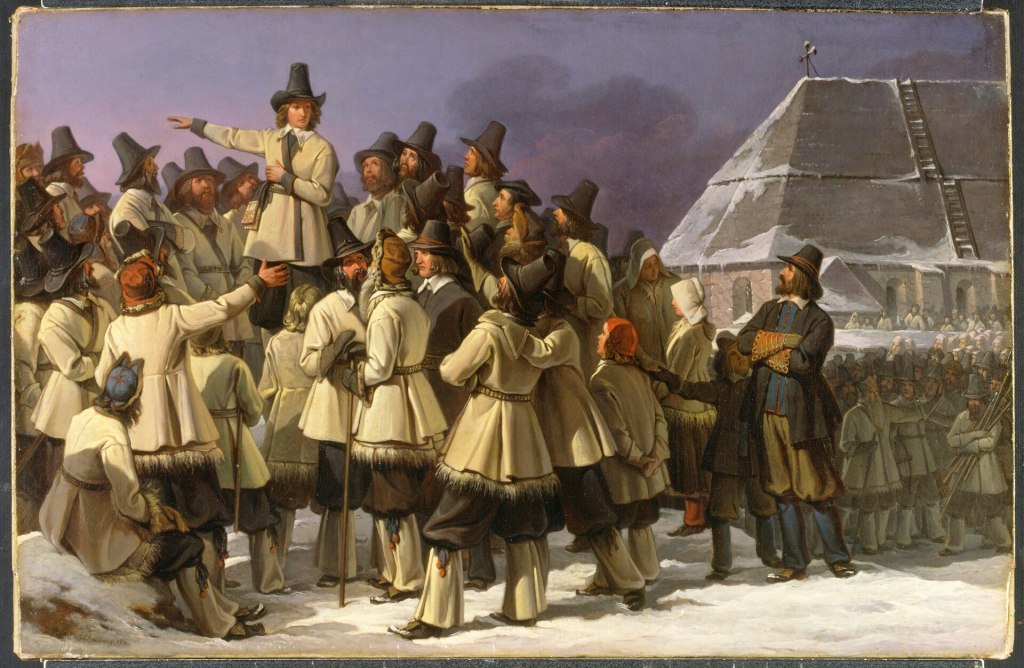
    On a spring day in 1521, a crowd of over 2,000 clogged the streets of the German city of Worms. Many of them were locals, but some had travelled from other towns and regions, just to catch a glimpse of the man who would be arriving.

    A wagon slowly weaved around the hordes of people. Suddenly, it stopped. The man who stepped out of it before the curious and admiring gazes of dozens of people was no king or general or bishop, but a monk and professor of theology whose father owned some copper mines. Even so, people across Europe from peasants to nobles now knew his name: Martin Luther. Once Luther had left the carriage, another monk emerged from the mob and embraced him like an old friend. He also touched his robes three times, like a petitioner hoping for a blessing from a saint.

    Someone who may have glimpsed Martin Luther’s arrival without knowing who he was or why he was there might have guessed that it was a joyous occasion. Instead, Luther was there to be judged before the most powerful man in Europe, Emperor Charles V. If Luther felt any genuine terror in that moment, no one knew but him. As far as his confidents knew, Luther would dive into the lion’s den without hesitation. In fact, he was even prepared to become a martyr.

    This is Turning Modern.

    According to Martin Luther himself, it was a thunderstorm that put him on the path to becoming one of the chief architects of the modern world. When he was a law student and traveling home to visit his family, he was caught in a severe summer thunderstorm near the village of Stotternheim. Likely because his father Hans owned several copper mines, Luther cried out to Saint Anna, the patron saint of miners, and swore that he would become a monk if he survived the storm. And that is exactly what Martin Luther did. In a sign of the defiance he would show throughout his life, he became a monk against the wishes of his stern father, who wanted him to become a lawyer who could represent their family’s interests. It should be said, though, that Martin did everything he could to avoid seeing his father for months after he went to a monastery. As Martin Luther’s modern biographer Lyndal Roper remarks, Luther’s “first step was the rebellion against his father.”

    While his decision to become a monk was likely also motivated by Luther’s lifelong struggles with depression and the recent death of a close friend, there really isn’t much of a reason to doubt Luther’s sincerity here, especially because that part of Germany was known for its violent thunderstorms in the summer. As he settled into the monastic life and rose through the ranks to become a professor of theology, Luther continued to be haunted by depression and the sense that he was awash with sin, much to the chagrin of his confessor, who had to endure Martin Luther’s hours-long, guilt-soaked confessions.

    Eventually Luther’s critical eye turned away from himself and toward the church, especially because of the practice of selling documents promising the remission of sins, called indulgences. Historians now tend to agree that Luther didn’t actually nail his famous Ninety-Five Theses criticizing the Church to the door of the cathedral in Wittenberg. Still, the Ninety-Five Theses were written with the purpose to start scholarly debates, and when they were disseminated through the newfangled technology of the printing press, they immediately provoked the ire of the Church. Luther himself seems to have genuinely had no idea how much controversy he was stirring up.

    Further writings published by Luther added fuel to the fire, both by giving his enemies in the Church ammunition and by making him famous across Germany. As we saw in the previous episode about Hans Behem and the peasant revolt that almost was, Germany had long been simmering with widespread resentment against the Church. For centuries the Church had clashed with Germany’s rulers, the Holy Roman Emperors. Also Germans were well aware that the tithes they paid to the Church more often than not went to funding the papacy’s construction projects in Rome or wars between the Papal States and their Italian rivals. The fact members of the upper ranks of the clergy and independent monasteries were also secular princes, more so in Germany than anywhere else in Europe, made the clergy a particularly unwelcome and burdensome presence in many Germans’ lives, from the members of city councils to the peasantry. One might say that it wasn’t so shocking that Martin Luther became such an overnight sensation, but that a Martin Luther didn’t come along sooner even without help from the printing press.

    In any case, Luther’s story might have turned out very differently if he didn’t have a powerful protector, one of the leading princes of Germany, Elector Frederick III of Saxony. When Pope Leo X excommunicated Luther and Luther kept publishing works critical of the Church, it was Frederick III who kept Luther from being packed off to Rome. Frederick arranged to have Luther’s case put before not the Pope, but the Holy Roman Emperor, Charles V. Charles V was the most powerful monarch the world had ever seen, at least on paper. Through lucky accidents of marriage and birth and political maneuvering, his family had gone from being upstarts on the brink of political extinction to one of the great powerplayers in Europe, claiming not just the office of Holy Roman Emperor but Austria, Naples, Sicily, the modern-day Netherlands and Belgium, Spain, and Spain’s colonies in South and Central America. Unfortunately, this meant Charles was stuck with the unenviable task of running a flimsy patchwork empire, comprised of peoples who all had their own languages, laws, and political institutions and traditions. Making it worse for him was the fact that Charles V was, in the words of Dirk Hoffman-Becking, host of the excellent History of the Germans podcast, “just an average man.”

    Even when the exact magnitude of what Luther would create was far from clear, the disgraced monk already posed a challenge to Charles V’s already overtaxed mind. The papal representative was already calling on Charles V to condemn Luther was a heretic, and alienating the papacy was dangerous since the Pope could side with Charles V’s most powerful rival, King Francois I of France. But on the other hand, the office of Holy Roman Emperor was an elective one, and to help ensure his own recent election Charles V had made a number of concessions to the German princes. One of these was promising that no subject of theirs would be put on trial before a foreign court, and that included the papal court in Rome. Besides that, Charles V was well-aware that Luther was already a celebrity in Germany. Having him killed risked a massive revolt, and since Charles V was already dealing with violent resistance in his dominions in Spain, he could ill-afford to fight rebellions on two separate fronts. Charles V’s advisors also saw in Luther a potential weapon that could be used to bring the Pope to heel, if need be.

    So, when Frederick III asked Charles V to allow Luther to be heard at a planned meeting of the German princes at Worms and to give him a safe conduct, Charles V agreed. It was a decision supported by most of his advisors, but the papal ambassador Girolamo Aleandro was, of course, outraged. During an argument with one of Charles V’s advisors, he prophetically warned, “You will soon see such a fire that all the water in your North Sea will not extinguish it.”

    When Luther heard that the emperor had granted him an opportunity to plead his case at Worms, he told his correspondents that he would not go if the emperor was just going to browbeat him into repenting. If ,on the other hand, he was going to be condemned and executed, he was willing to become a martyr. This was not a remote possibility. Everyone knew very well the case of Jan Hus, a Czech priest also accused of heresy by the Church and who was also promised a safe conduct so he could appear before the Holy Roman Emperor, only to be arrested and burned at the stake.

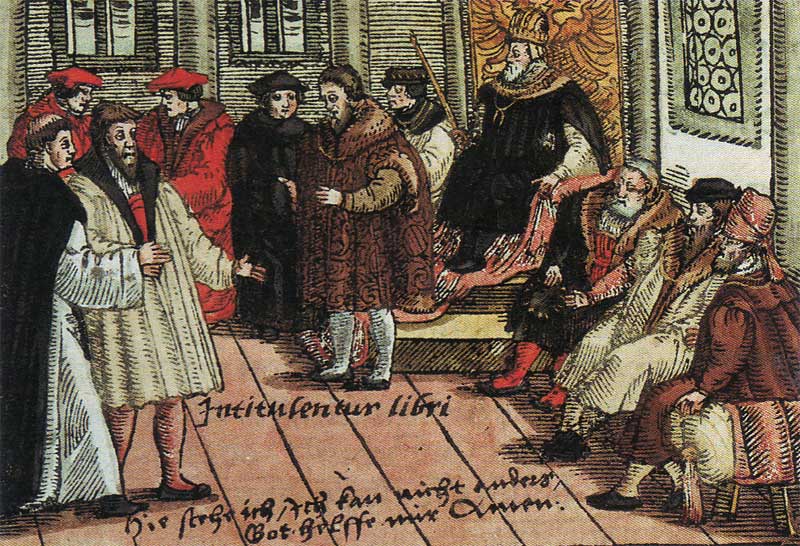
    Once Luther arrived for his hearing, he was brusquely told by the imperial marshal to answer as briefly as possible, an order that Luther would characteristically ignore. Then he was brought into a large, packed meeting hall. There were up to a thousand people present, not just foreign ambassadors, members of the clergy, German princes or their representatives, and members of the imperial family and court, but also locals from the city and average people who could afford to make the trip. Charles V himself sat on a raised dais, directly facing where Luther spoke. The theologian Johann Eck, who had been a friend of Martin Luther but in recent years had turned into one of his harshest critics, was there, representing the emperor. He pointed toward a pile of books on a bench, all written by Luther since the Church condemned the Ninety-Five Theses, and asked in Latin and then German if Luther had written these books. A theology professor who was acting as a defense attorney of sorts for Luther shouted that the titles of the books should be read for everyone assembled. With that, Eck read out the titles and a brief summary of each one. When he was done Luther cracked a joke: “You haven’t mentioned all my books!”

    Ignoring the jibe, Eck asked again in both Latin and German if he would admit to writing these books, and if he did write them, if he would recant of what they said. Observers remarked that Luther appeared anxious. He responded at first by swearing loyalty to the emperor. Then he admitted that he wrote the books, but as for the second question, he asked the emperor to grant him another day so he could consider his answer because “this is a question of faith and the salvation of souls, and because it concerns the divine Word, which we are all bound to reverence, for there is nothing greater in heaven or on earth.”  Charles withdrew from the court to consult with Eck and his advisors. Returning after some time, he granted Luther’s request.

    It was a delaying tactic. Luther had actually been informed beforehand what he would be asked. In fact, he was annoyed at the lack of a real debate. In one letter, Luther complained that he expected that an army of theologians would face him in a rhetorical battle. Instead, he was, in his own words, just asked, “Are these your books? Yes. Do you want to renounce them or not? No. Then go away!” Anxious and disgruntled as he was, at least Luther enjoyed accommodations near where the Diet was held that were worthy of a nobleman. In fact, it was the same building several distinguished knights were also staying in. Meanwhile the papal delegate Aleandro was stuck in a shabby, poorly heated room. It was a subtle but clear sign of where many people’s sympathies really laid.

    The next day, Luther was not called into the Diet until the late afternoon. When he arrived, he was brought to an even larger hall lit only by several torches and that was so crowded with spectators that even some of the German princes had to stand. Even then, he had to wait for two hours while delegates debated on the topic of administrative reforms. Finally, though, the audience got to see the main event. Luther was again asked if he wrote these books and if he recanted what he wrote. Speaking in Latin and then repeating himself in German, Luther began by apologizing to the emperor for being a man not used to the imperial court, but only life in a monastery. Then he moved on to his actual answer. He admitted he wrote the books, but he quickly added that the books were all written with different purposes in mind. Some he wrote just to explain God’s word in plain language, some to criticize what he saw as abuses in the Church and the papacy, and some he had written to argue against defenders of the papacy. He could not recant what he wrote in the first category of books since they were just reflecting biblical teachings, remarking “even my enemies themselves are compelled to admit that these are useful, harmless, and clearly worthy to be read by Christians.” As for his writings about papal tyranny, well, if he was compelled to recant of those writings, it would only vindicate his own criticisms of said papal tyranny. With his usual acidic wit, Luther added that he just did not want to “add strength” to allegations of papal tyranny, “especially if it should be reported that this evil deed had been done by me by virtue of the authority of your most serene majesty and of the whole Roman Empire”. When Luther declared that the “whole German Nation was vexed and oppressed in Rome”, Charles V, who had been silent up until now, became irritated and ordered Luther to move on.

    This time, Luther complied. As for the third kind of book, Luther could not repent of those either, because he hadn’t written anything in those that went against Scripture. Sure, he admitted that he might have been more vicious in his writing than was appropriate for a Christian, but, Luther added, “I do not set myself up as a saint.” If anyone there could prove that he had erred against the Word of God, Luther would be the first to throw his books into the flames. Otherwise, “he would not retract a single word he had written.” Then Luther addressed the emperor directly, pleading with him to allow his works to continue to be published.  

    It was now Eck’s turn to speak. He countered by saying “that everything that [Luther] admitted writing in his books. …was heresy that had long since been condemned by [church] councils” and ‘for that reason there was no point in discussing something that had already been discussed, declared to be evil, reproved and condemned by the Church, which had issued holy decrees and very good decisions on the matter:. Rather than just being defensible interpretations of Scripture, Luther’s writings instead claimed, according to Eck, that “we must believe that our predecessors for the past thousand years were heretics and were not saved; and it would be reckless and a great error to think that one man, with little authority, wanted to condemn so many good Christians.”  At this, Luther fired back with one of the most famous speeches in history: “Unless I am convinced by the testimony of the Scriptures or by clear reason (for I do not trust either in the Pope or in councils alone, since it is well known that they have often erred and contradicted themselves), I am bound by the Scriptures I have quoted and my conscience is captive to the Word of God. I cannot and will not retract anything, since it is neither safe nor right to go against conscience.” An account published by his supporters added these famous words that were not included in the original transcripts of the Diet of Worms: “I cannot do otherwise, here I stand, may God help me. Amen.’ Whatever Luther actually said in that moment, it caused the emperor to interrupt the proceedings again. Charles V had been raised in Burgundy with French as his main language and his German and Latin were both not up to par. Nonetheless, Charles V understood all he needed to. He stood up and declared, “That is enough: I do not wish to hear any more from someone who denied the authority of the councils!”

    Luther’s appeal to his conscience has often been seen as a pivotal moment in history, and rightfully so. Still, Lyndel Roper warns us that we shouldn’t interpret what Luther was talking about in a modern sense. Luther was not talking about a moral and strongly felt but still technically subjective stance, like what we might mean by “conscience.” He saw himself not as presenting a new interpretation of Christianity, but as fighting for the true understanding of the Christian Gospels.  This is what Roper means when she writes, “When Luther said his conscience was ‘captive to the Word of God’ he meant that it could not be moved or altered; he ‘knew’ with his whole being — mind and emotion — what God’s Word was, and could not deny it.” In his writings, Luther explicitly condemned the notion of an individual interpretation of Scripture. For him, there was only the truth of God’s Word and corruptions of it. I don’t doubt Luther would be horrified to learn about the present-day situation in my country of the United States, where even in a small-ish city you might find all within walking distance churches belonging to four or five different denominations, at least. Even so, in Luther’s own lifetime other would-be reformers were publishing their own challenges to his doctrine. If enough people claim that they know the truth but their truths all look different from one another, then the distinction between what’s truth and what’s individual opinion really just doesn’t matter anymore. Further, it’s a thin line between the kind of conscientious stand Luther made and one made for a secular cause, like democratic freedom or a particular understanding of human rights. Regardless of what Luther meant, it’s really not unreasonable to draw a straight line between Luther’s defiant declaration of conscience and modern ideas of the individual and subjectivity.

    The significance of what happened in that moment does not seem to have been lost on Luther and his supporters and enemies. The Elector Frederick later said that Luther “spoke well”, but added that “he is too bold for me.” After Charles V stormed out of the hall and the German princes began leaving the chamber themselves, the imperial court’s Spanish attendants tried blocking the doors, shouting, “Burn him! Burn him!” However, Luther’s German supporters swarmed around him and carried him out of the hall on their shoulders. As he was carried out of the building, Luther made to the crowds the same gesture German knights typically made when they won a joust. His allies also remarked that Luther’s anxieties and fears seem to have dissipated and he was unusually cheerful after the day’s events. Still, Luther didn’t press his luck. He quickly left Worms before there was any chance his safe conduct might expire or be revoked. In the middle of Luther’s travels, Frederick III had his agents kidnap Luther after a faked highway robbery. Luther was secretly set up in Wartburg Castle, isolated in the mountains of Thuringia. There Luther would remain for almost a year. Before then, Luther did write a letter addressed to Charles V, assuring him that he would have recanted if someone had just convinced him that his interpretation of Scripture was wrong. He concluded with a plea: “I beg Your Sacred Majesty once more for Christ’s sake not to allow me to be crushed by my enemies, to suffer violence and be condemned since I have so often made myself available, as is becoming to a Christian and obedient man.” Charles V never saw the letter because no one dared give it to him.

    Charles V himself was so disturbed by Luther’s defiance that he spent that night writing a response. In it, he argued that he had a sacred obligation to defend the Church because he was descended from several royal houses that were all famous for defending the true faith. He then wrote, “I am entirely determined to dedicate my kingdoms and lordships, my friends, my body, my blood, my life and my soul” to battling heresy. He continued that to permit “heresy or a diminution of the Christian religion to rest in the hearts of men through our own negligence would bring permanent dishonour on us and our successors. Having heard the perverse reply that Luther gave yesterday in the presence of all of us, I tell you now that I regret having delayed so long before proceeding against him and his false doctrine, and I have decided to hear no more from him.” After that, Charles V signed the Edict of Worms, which made Luther an outlaw, forbade anyone to give him a place to stay or to eat with him, and outlawed publications of his writings. By the time copies of the Edict were distributed, though, Luther was already safe in Wartburg Castle.  

    Both the Church and the emperor had now declared war on Luther, so his supporters were surprised that he remained cheerful in the following weeks. Perhaps Luther knew that he had already won, despite all the forces arrayed against him. If so, Luther wouldn’t have been the only one who glimpsed this. One of Charles’ Spanish secretaries, Ifonso de Valdes, said as much when he wrote after the issuing of the Edict of Worms, “Some imagine that this marks the end of the tragedy, but I believe it is not the end but the beginning. I see that the minds of the Germans are very agitated against the pope; and I also see that they do not attach much weight to the emperor’s edicts, because as soon as Luther’s books see the light of day, they are sold constantly and with impunity in every street and square. You can easily conjecture what will happen as soon as the emperor departs.”

    Thank you for listening.

  • The “Journalist” Who Covered the Ottoman Invasion of Egypt

    The “Journalist” Who Covered the Ottoman Invasion of Egypt

    Writing in the years of 1516 and 1517, an inhabitant of Cairo likely witnessed firsthand a new era as Egypt lost its independence and was forcibly annexed by the Ottoman Empire. However, he not only observed the collapse of the old regime, but also the toll it took on the people.

    Sources:

    Finkel, Caroline. Osman’s Dream: A History of the Ottoman Empire (Basic Books, 2005).

    Ibn Iyas. An Account of the Ottoman Conquest of Egypt, trans. W.H. Salmon (Royal Asiatic Society, 1921).

    Ibn Iyas. Journal d’un Bourgeois du Caire, ed. and trans. Gaston Wiet (Libraire Armand Colin, 1945).

    Lord Kinross. The Ottoman Centuries: The Rise and Fall of the Turkish Empire (HarperCollins, 1979).

    Petry, Carl F. The Mamluk Sultanate: A History (Cambridge University Press, 2022).

    Transcript

    Ibn Iyas’ friends and relatives told him he should leave Cairo and join them in fleeing to the countryside. However, he refused. After all, he was a historian, and he had an obligation to posterity if nothing else. He knew that he was living through the beginning of a new age for Egypt.

    The looting had not been as horrific as he feared. Even so, he was afraid to leave his home. He carefully made sure that he did not wear anything that might cause him to be mistaken for a member of the old ruling class, the Circassians. Regardless, when he realized that their new ruler was going to be passing by his kinsman’s house, he braved the crowds and the guards and made his way to the roof, where the house’s residents slept under the stars on hot days. From there, he could see the new Sultan, a barrel-chested man with a thick and well-combed moustache, riding his horse in front of cheering crowds and surrounded by guards keeping an eye out for possible assassins sympathetic to the old regime.

    As the world changed around him, Ibn Iyas took out some parchment and began to write his notes.

    This is Turning Modern.

    Mamluk Egypt had one of the stranger governments in history, so much so that I’m reluctant to try to even describe it as someone who isn’t an expert just in the political history of medieval Egypt. The name given to it by modern historians comes from the Mamluks, regiments of elite Turkish soldiers recruited from among slaves by the rulers of the Islamic Caliphate. As the Caliphate crumbled into smaller nations, some of these rulers recruited their own Mamluk regiments. That was the case of the Ayyubids of Egypt, but then, in the thirteenth century, the dynasty was overthrown by the Mamluks, who went on to impose their authority over the Levant, Syria, and the holy cities of Mecca and Medina, making them the preeminent Islamic state.

    Historian Carl F. Petry describes the state the Mamluks created as a kind of military oligarchy. The officers of different regiments vied for control over the state. There was still a Sultan and he wielded a great deal of power, but he was elected by the officers of whatever regiment was in the ascendency at the time. Still, the Mamluks never really had any kind of formal system of succession, nor did they denounce the principle of hereditary rule. In fact, occasionally the sons of the previous Sultan would be selected to succeed him, although in such cases it was usually because the military oligarchy found it prudent to choose the son of a popular Sultan to be nothing more than  their mouthpiece. At the same time, it was true that many of the Mamluk Sultans were at least distantly related to each other, and there was one hereditary dynasty, the Qalawuni, who held power almost continuously through the late thirteenth and early fourteenth centuries. With different factions in the army scheming and maneuvering against each other, it’s just that any potential dynasty-makers just didn’t last long. So one could probably compare Mamluk Egypt to the Roman and Byzantine Empires, where the turnover in rulers and would-be dynasties were so high it arguably might as well have been an elected office. Sensitive to their reputation as usurpers who had destroyed a famous dynasty, the Mamluks gained legitimacy in the eyes of the rest of the Islamic world by welcoming the Abbasids, the old dynasty that once ruled over the entire Islamic Caliphate. After losing their capital of Baghdad to Mongolian invaders, the Abbasids came to Egypt, where they would still have the title of Caliph but they would only enjoy a purely ceremonial and religious role while the Mamluk Sultans and officers did all the actual ruling.  

    Starting with Sultan Barquq in 1382, the Mamluks began to look to a particular people for their leaders. Barquq had started out as a slave from Circassia, a region in the northern Caucasus. Circassians were a predominantly Christian people with blue eyes, auburn or reddish hair, and pale skin. The women had a reputation of being exceptionally beautiful and particularly strong-willed, while the men were thought to be handsome, strong, and to make excellent soldiers. While these were positive stereotypes, unfortunately for the Circassians they meant that Circassia was a frequent target for Italian and Turkish slave raiders. Among the Mamluks, it became common for Circassian slaves to be forced into the army or into service at the royal court, freed after a term of service, and then rise through the military and the political ranks. One such Circassian man was Barquq, who was chosen as Sultan in 1382. He started out life as the son of a Christian Circassian and then became the first of many Circassian Sultans who would rule over Egypt. Almost every Sultan after Barquq would also be Circassian. Essentially, the Mamluk regime became one that enslaved and trafficked people into slavery, but it also made its enslaved men, ones who came from a Christian ethnic minority no less, into its own monarchs.

    Of course, Mamluk Egypt was not just a giant military barrack. With Baghdad conquered and razed by the Mongols, its capital of Cairo became the new thriving intellectual center of the Islamic West. For whatever reason, scholars in Egypt, Syria, and the Levant under the Mamluks were especially prolific when it came to writing history. Over the course of the Mamluk era, hundreds of different kinds of histories would be written, from multivolume narrative histories to yearly chronicles to biographical dictionaries. Many were written with literary flair and it became fashionable to include poems with one’s historical narrative. One German scholar has even argued that these historians eventually broke away from traditional narratives about kings, wars, and religion and began writing about the everyday.

    That brings us to Ibn Iyas or, to use his full name, Zayn al-Din Abu’l-Barakat Muhammad ibn Ahmad al-Nasiri al-Jarkasi al-Hanafi, author of a monthly historical chronicle titled “Marvels Blossoming Among Incidents of the Epochs.” Not much is known about him except he came from a wealthy family but one that could still be described as “bourgeois.” He was educated at home by two distinguished scholars, a privilege usually just reserved for the nobility. Ibn Iyas has been described as being like a journalist, and I have to agree. In some ways his book reads more like modern journalism than history. It even has a ring of a TV newscaster about it. Mostly the book lists events month by month with little commentary from the author, although he does occasionally insert his own commentary or moral judgment on events. Sometimes he’ll even jot down a poem, a popular practice among Egyptian historians of the era

    Despite the promise of marvels, a good portion of the book involves detailing political appointments made by the Sultan, battles fought on the empire’s frontiers, the downfall of various ministers and courtiers, reports of when the Nile River floods, and so on. But that said, Ibn Iyas also gives interesting glimpses into everyday life in Egypt. Here’s some examples: he describes a woman and five men getting arrested because they were eating salted fish and getting drunk on wine in broad daylight in a public park in Cairo during Ramadan. Somehow –  unfortunately he doesn’t say or didn’t know how – the woman escaped while all five men were caught and put in a jail for a while. In another case of true crime, he mentions that a servant murdered a milkman because he refused to sell him a pot of milk. There’s also a description of the Sultan personally presiding over the opening of a series of polo matches at the old Roman Hippodrome in Alexandria.

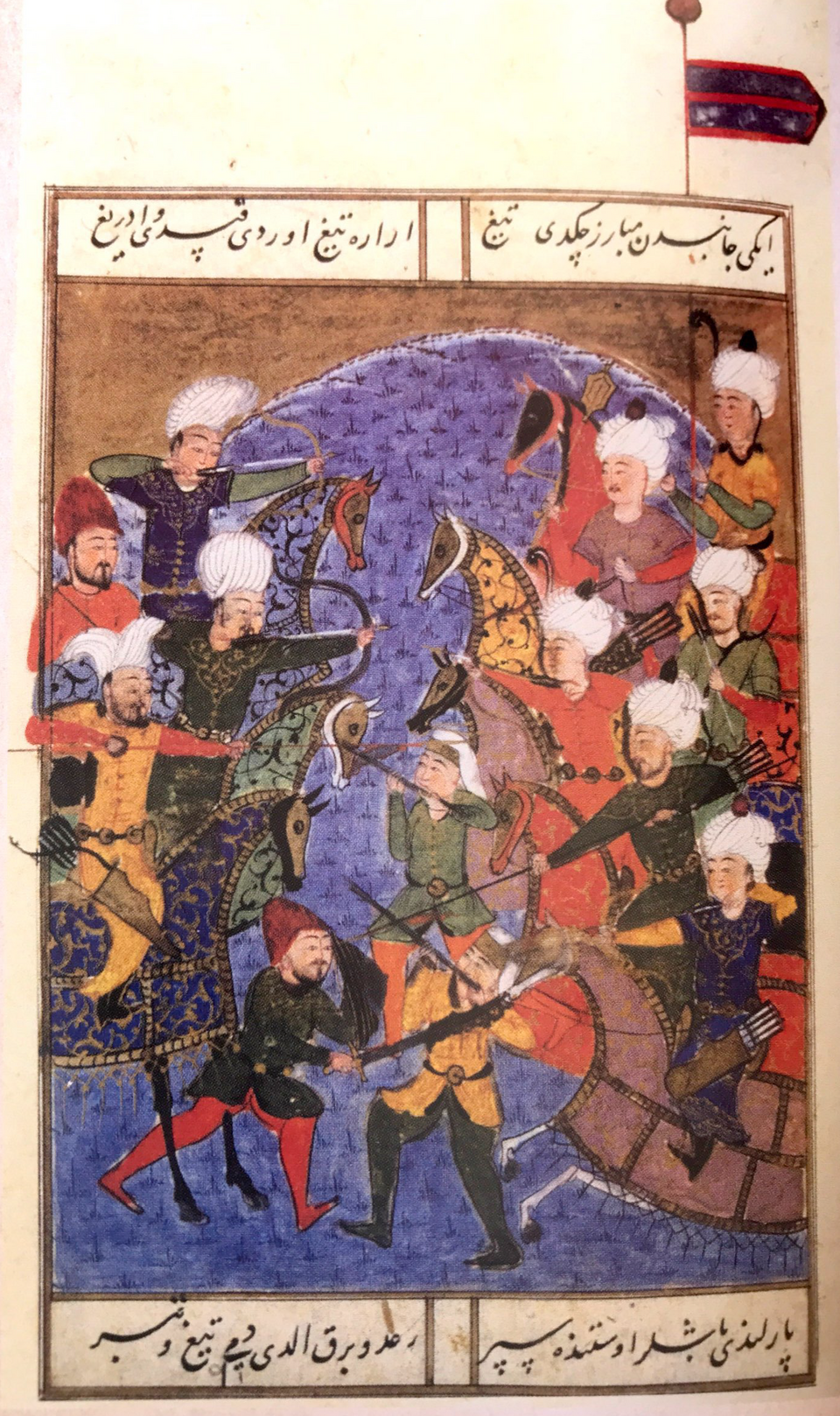
    The most dramatic moment, though, was one I suspect Ibn Iyas wishes he didn’t live through: the conquest of Egypt by the Ottoman Empire and the end of its independence until the 19th century. Both the Mamluks and the Ottomans belonged to the Sunni branch of Islam, but tensions began to fester when the Ottomans conquered Constantinople, making the Ottomans the Mamluks’ chief rivals for control over trade from Asia and the Silk Road. When the Persian Empire was revived under the Safavid dynasty, who belonged to the rival Shia sect, the Mamluks infuriated the Ottomans by staying neutral instead of supporting them in their conflicts against the Safavids. In fact, the Mamluks and the Ottomans fought a war against each other before from 1485 to 1491, although it ended in a stalemate.

    As with so many catastrophic defeats and pivotal assassinations recorded by historians, Ibn Iyas claims that in the year 1516 there were ominous portends of the Mamluks’ downfall. “It was said that a woman gave birth to a boy with two heads, four arms, and four legs ; the Sultan was amazed when he saw it. It was said that a similar portent had appeared in the time of the Imam ‘Ali”, Imam ‘Ali being the fourth Caliph whose assassination led to the Sunni/Shi’a split. Ibn Iyas writes that the same day as the birth there was three days straight of rain and lightning, accompanied by eerily yellow sunsets.

    The Ottoman Sultan of the time was Selim, a physically imposing man who was notorious for having officials who enraged him or were strongly suspected of corruption executed on the spot. On the Mamluk side was Qansuh al-Ghuri, an aged Circassian who was known to be both a talented writer of poetry and an avid polo player. Unfortunately Ibn Iyas paints al-Ghuri as a spendthrift tyrant, whose taxes and levies were unsufferable, although given that the last war with the Ottomans left the Mamluk treasury bare this might have been unavoidable. Selim’s ambassadors approached al-Ghuri with the offer of an alliance against the Safavids, but al-Ghuri refused to give up Mamluk neutrality.   

    After scoring a major victory against the Safavids, Selim marched toward Iran to press the advantage. At least, that’s the official story. Historians have debated whether that was Selim’s original plan or if it was a ruse to trick the Mamluks into letting their guard down. In any case, the governor of the city of Aleppo in northern Syria had decided to betray the Mamluks and secretly aligned with the Ottoman cause. What exactly went down isn’t entirely clear, just that the governor of Aleppo sent a fabricated report to al-Ghari that instead the Safavids had managed to drive the Ottomans back. Suspecting that there might be a threat from the Safavids, al-Ghuri ordered a military build-up at Aleppo. This massing of troops near his border was just the pretext Selim needed. Selim turned his army around toward Syria while the Ottoman propaganda machine declared that the Mamluks had joined forces with the heretical Safavids and had been caught preparing to stab the Ottomans in the back while they were out fighting against the Safavid threat. The fact that the Safavids had in the past reached out to the Mamluks for an alliance made it look like there was smoke coming from this non-existent fire, but in fact the Mamluks maintained their neutrality with the Safavids and the Ottomans alike.

    The Ottomans had superior firepower, having adopted gunpowder technology much faster than the Mamluks could. However, the Mamluks could still raise an army as large if not larger than any force the Ottomans could muster, but it would take time. At least according to Ibn Iyas, Selim was well-aware of this and attempted delaying tactics. He sent representatives to discuss peace with Mamluk leaders at Aleppo, but Ibn Iyas says “this was mere bluff and trickery to prevent the Sultan’s going to war, and to shake his determination which was borne out by subsequent events.” Despite Selim trying to buy himself time through diplomacy, al-Ghuri raised an army himself and went to Aleppo.

    On August 24, 1516, al-Ghuri’s army and the Ottoman forces faced each other on a field near the Syrian village of Dabik. Knowing that the Ottoman army was superior in numbers, al-Ghuri tried the tactic of making a mad dash to the center. This actually worked at first, startling the Ottoman soldiers and scattering them. Ibn Iyas, who likely talked to at least one person who was at the battle, describes what happened next, “Selim thought seriously of a retreat or a surrender, as over 10,000 of his men had been killed. At first the army of Egypt was victorious; would that it had continued so ! But a report reached the Karanisah Memlooks that the Sultan had ordered the important Memlooks not to go into action at all, but to let the Karanisah Memlooks fight alone, which dampened their ardour. Meanwhile Atabek Sudun had fallen, also Malik al-‘Umara Si Bai, governor of Damascus, and a great number of the right flank turned defeated. This was followed by the flight of Khair Bey, governor of Aleppo, and the defeat of the left flank, Amir Kansuh Ibn Sultan Chirkess being taken prisoner, some said killed. Moreover, Khair Bey was said to be secretly in league with Selim against al-Ghuri, a report which was confirmed later. He was, moreover, the first to fly before all the troops, and proclaimed defeat. But this loss was inflicted on the Egyptian troops by the will of Providence in fulfilment of His decrees….It was a time to turn an infant’s hair white, and to melt iron in its fury. The field of Dabek was strewn with corpses and headless bodies, and faces covered with dust and grown hideous. Dead horses lay everywhere, saddles were scattered about, also swords inlaid with gold, steel sets of horse-armour, helmets, armour, and bundles of clothing.”

    The battle would prove to be not just a tactical defeat. Ibn Iyas’ account continues, “Now as the confusion and terror increased Amir Tamr al-Zardkash feared for the safety of the Sultan’s standard, so he lowered it, folded it up, and concealed it. Then he approached the Sultan and said to him : ;Our King and Master, the troops of Selim are upon us, save yourself and go back to Aleppo.” When the Sultan understood this a kind of paralysis fell upon him, which affected one side, and caused his jaw to drop. He asked for water, and they brought him some in a golden cup, from which he drank a little. Then intending flight, he turned his horse round, moved on a few paces, fell off his horse, stood for a moment, and died from the shock of his defeat. His body was not found amongst the dead, nor was it ever known what became of it ; it was as if the earth had swallowed it up there and then. Therein is a lesson to him who considers.” Ibn Iyas leaves al-Ghuri a brief poem as a cold epitaph: “Look with wonder at al-Ashraf al-Ghuri, Who, after his tyranny had reached its height in Cairo, Lost his kingdom in an hour, Lost this world and the world to come.”

    The Mamluks were not popular in Aleppo, which might explain why the governor of the region was so ready to stab al-Ghuri in the back. It certainly explains why Selim was able to take the city easily. He even rubbed it in. Ibn Iyas writes about how Selim “sent off a man who walked with a limp and was beardless, with a wooden club in his hand, who went up to the citadel, entered it without opposition, affixed seals to the stores therein, and took possession of money, arms, and other articles of value. Selim did this that it might be said that he took the citadel of Aleppo by means of a limping man with a wooden club, and the weakest man in his army.”

    The Ottomans were also able to take the Syrian capital of Damascus practically unopposed. Meanwhile the Mamluk officials in Cairo scrambled to find a new Sultan. They unanimously chose al-Ghuri’s chancellor and another Circassian who began as a slave working in the palace, who was crowned as Tuman Bay II. Tuman Bay, rather understandably, tried to refuse, but the officials, according to Ibn Iyas, “replied that there was no one else but him, and that there was no way out of it, whether he wished it or not.”

    Unfortunately, one of Tuman Bay’s first acts was hearing an official letter sent by Selim himself. ‘It has been revealed to me that I shall become the possessor of the east and west, like Alexander the Great. You are a Memlook, who is bought and sold, you are not fit to govern. I am a king, descended through twenty generations of kings, and have taken possession of the country by agreement with the Caliph and the judges…If you wish to escape violent treatment let an issue of coinage be struck in our name in Egypt, and let the public sermons be delivered also in our name ; and become our governor from Gaza to Egypt, while we will rule from Syria to the Euphrates. But if you do not obey us, then I will enter Egypt, and kill all the Circassians there, ripping open those with child and destroying the unborn.’ When this letter was read to the Sultan he wept and was terrified.”

    To try to win God’s favor before the inevitable confrontation, Tuman Bay banned Christian and Jewish merchants throughout the empire from selling any beer, wine, or hashish. However, Ibn Iyas notes, “But no one paid any attention to this order, and things went on just as before.” Not far from Cairo, Tuman Bay’s army built a series of barricades, in preparation for the arrival of the Ottoman forces. The battle took place on January 22, 1517. This time, the Mamluks were prepared, and Ibn Iyas notes that “countless numbers of the Turks were killed.” Like with the battle of Dabek, though, the Turks were able to rally after their initial failures. Nor did the Mamluks have an effective way to deal with the Ottomans’ firepower advantage. According to Ibn Iyas, “The noise of their musketry was deafening, and their attack furious.” Some of the officers and Turin Bay managed to escape, but the war had been won. Cairo belonged to the Ottomans. After only two battles, the Ottoman Empire had more than doubled its territory and had taken complete control of the holy cities of Jerusalem, Mecca, and Medina. Selim also took the Abbasid caliph, al-Mutawakkil III, from Cairo to Constantinople and soon began using the title of caliph himself.

    Without only a couple of months, Tuman Bay was captured. Selim was actually inclined to spare him, but his advisors convinced him that he would always remain a threat. So Tuman Bay was hung and his corpse displayed on the city gates of Cairo. Nor were the people of Cairo entirely safe. Al-Ghuri writes, no doubt from personal experience, that, “Many Turks entered the mills and took away the mules and worn-out horses and a number of camels belonging to the water-carriers. They plundered, in fact, everything that came in their way, whether dry goods or anything else. The pillaging went on all that day until after sunset. Then they went to the granaries in Cairo and plundered the grain which was public property. No one had thought that they would do this, but such was the decree of Fate.” The new bosses targeted Circassians, killing them on the spot for weeks after the invasion. This led to another case of how grand historical events brought about suffering for the people on the ground, at least as Ibn Iyas claims. “The Turks would arrest people in the streets, telling them they were Circassians; and when they declared that they were not, they would tell them to ransom themselves from death, and extort whatever sums of money they chose so that the people really became their prisoners.” Ibn Iyes also claims local criminals pretended to be Turkish soldiers in order to cover up their crimes while wealthy people around Cairo paid Turkish soldiers to stand guard at their houses so other Turks would not loot them.

    We don’t know for sure, but Ibn Iyas may have been there when the new Sultan Selim made his first appearance in Cairo. “He formed a cavalcade and entered Cairo by the Bab al-Nasr gate, and went through the city, preceded by an immense number of led horses and a large force of infantry and cavalry, which occupied the whole of the streets ; the procession went through the Zawllah Gate under the Rab‘, and on to Bulak, to the camp under the embankment. As the Sultan passed through the city he was cheered by all the populace.”

    Of course, Ibn Iyas was not the first historian or chronicler to be an eyewitness to major historical events. Still, though, while it may not be unprecedented there is something modern or at least something that rides the line between journalism and history in how he weaves the everyday with major events. We don’t know what happened to him except he did survive the Ottoman occupation of Cairo, continuing to write until 1521. As for Selim, the man who brought an end to the Mamluks’ strange experiment in government, he died from cancer only two years later after greeting cheering crowds in Cairo. In his final years, under the not terribly original penname Selimi, he wrote a poem commemorating his conquest of Egypt among his other victories:

    Sunken deep in blood of shame I made the Golden Heads [i.e. the Kızılbaş] to lie.

    Glad the Slave [i.e. the Mamluks], my resolution, lord of Egypt’s realm became:

    Thus I raised my royal banner e’en as the Nine Heavens high.

    From the kingdom fair of Iraq to Hijaz these tidings sped,

    When I played the harp of Heavenly Aid at feast of victory.

    Through my sabre Transoxiana drowned was in a sea of blood;

    Emptied I of kuhl of Isfahan the adversary’s eye.

    Flowed down a River Amu [i.e. the Oxus] from each foeman’s every hair –

    Rolled the sweat of terror’s fever – if I happed him to espy.

    Bishop-mated was the King of India by my Queenly troops,

    When I played the Chess of empire on the Board of sov’reignty.

    O SELIMI, in thy name was struck the coinage of the world,

    When in crucible of Love Divine, like gold, that melted I.

    Thank you for listening.