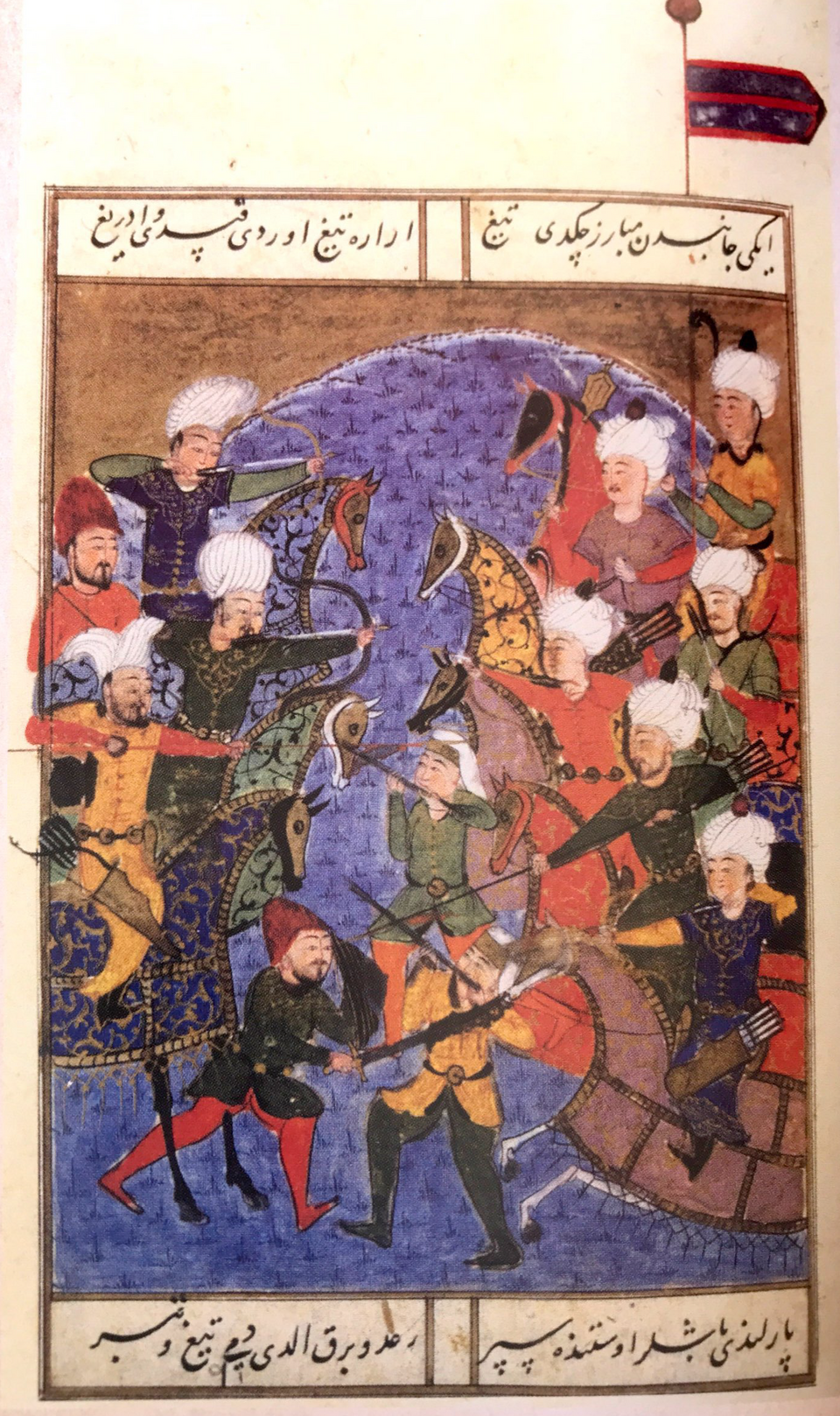
Writing in the years of 1516 and 1517, an inhabitant of Cairo likely witnessed firsthand a new era as Egypt lost its independence and was forcibly annexed by the Ottoman Empire. However, he not only observed the collapse of the old regime, but also the toll it took on the people.
Sources:
Finkel, Caroline. Osman’s Dream: A History of the Ottoman Empire (Basic Books, 2005).
Ibn Iyas. An Account of the Ottoman Conquest of Egypt, trans. W.H. Salmon (Royal Asiatic Society, 1921).
Ibn Iyas. Journal d’un Bourgeois du Caire, ed. and trans. Gaston Wiet (Libraire Armand Colin, 1945).
Lord Kinross. The Ottoman Centuries: The Rise and Fall of the Turkish Empire (HarperCollins, 1979).
Petry, Carl F. The Mamluk Sultanate: A History (Cambridge University Press, 2022).
Transcript
Ibn Iyas’ friends and relatives told him he should leave Cairo and join them in fleeing to the countryside. However, he refused. After all, he was a historian, and he had an obligation to posterity if nothing else. He knew that he was living through the beginning of a new age for Egypt.
The looting had not been as horrific as he feared. Even so, he was afraid to leave his home. He carefully made sure that he did not wear anything that might cause him to be mistaken for a member of the old ruling class, the Circassians. Regardless, when he realized that their new ruler was going to be passing by his kinsman’s house, he braved the crowds and the guards and made his way to the roof, where the house’s residents slept under the stars on hot days. From there, he could see the new Sultan, a barrel-chested man with a thick and well-combed moustache, riding his horse in front of cheering crowds and surrounded by guards keeping an eye out for possible assassins sympathetic to the old regime.
As the world changed around him, Ibn Iyas took out some parchment and began to write his notes.
This is Turning Modern.
Mamluk Egypt had one of the stranger governments in history, so much so that I’m reluctant to try to even describe it as someone who isn’t an expert just in the political history of medieval Egypt. The name given to it by modern historians comes from the Mamluks, regiments of elite Turkish soldiers recruited from among slaves by the rulers of the Islamic Caliphate. As the Caliphate crumbled into smaller nations, some of these rulers recruited their own Mamluk regiments. That was the case of the Ayyubids of Egypt, but then, in the thirteenth century, the dynasty was overthrown by the Mamluks, who went on to impose their authority over the Levant, Syria, and the holy cities of Mecca and Medina, making them the preeminent Islamic state.
Historian Carl F. Petry describes the state the Mamluks created as a kind of military oligarchy. The officers of different regiments vied for control over the state. There was still a Sultan and he wielded a great deal of power, but he was elected by the officers of whatever regiment was in the ascendency at the time. Still, the Mamluks never really had any kind of formal system of succession, nor did they denounce the principle of hereditary rule. In fact, occasionally the sons of the previous Sultan would be selected to succeed him, although in such cases it was usually because the military oligarchy found it prudent to choose the son of a popular Sultan to be nothing more than their mouthpiece. At the same time, it was true that many of the Mamluk Sultans were at least distantly related to each other, and there was one hereditary dynasty, the Qalawuni, who held power almost continuously through the late thirteenth and early fourteenth centuries. With different factions in the army scheming and maneuvering against each other, it’s just that any potential dynasty-makers just didn’t last long. So one could probably compare Mamluk Egypt to the Roman and Byzantine Empires, where the turnover in rulers and would-be dynasties were so high it arguably might as well have been an elected office. Sensitive to their reputation as usurpers who had destroyed a famous dynasty, the Mamluks gained legitimacy in the eyes of the rest of the Islamic world by welcoming the Abbasids, the old dynasty that once ruled over the entire Islamic Caliphate. After losing their capital of Baghdad to Mongolian invaders, the Abbasids came to Egypt, where they would still have the title of Caliph but they would only enjoy a purely ceremonial and religious role while the Mamluk Sultans and officers did all the actual ruling.
Starting with Sultan Barquq in 1382, the Mamluks began to look to a particular people for their leaders. Barquq had started out as a slave from Circassia, a region in the northern Caucasus. Circassians were a predominantly Christian people with blue eyes, auburn or reddish hair, and pale skin. The women had a reputation of being exceptionally beautiful and particularly strong-willed, while the men were thought to be handsome, strong, and to make excellent soldiers. While these were positive stereotypes, unfortunately for the Circassians they meant that Circassia was a frequent target for Italian and Turkish slave raiders. Among the Mamluks, it became common for Circassian slaves to be forced into the army or into service at the royal court, freed after a term of service, and then rise through the military and the political ranks. One such Circassian man was Barquq, who was chosen as Sultan in 1382. He started out life as the son of a Christian Circassian and then became the first of many Circassian Sultans who would rule over Egypt. Almost every Sultan after Barquq would also be Circassian. Essentially, the Mamluk regime became one that enslaved and trafficked people into slavery, but it also made its enslaved men, ones who came from a Christian ethnic minority no less, into its own monarchs.
Of course, Mamluk Egypt was not just a giant military barrack. With Baghdad conquered and razed by the Mongols, its capital of Cairo became the new thriving intellectual center of the Islamic West. For whatever reason, scholars in Egypt, Syria, and the Levant under the Mamluks were especially prolific when it came to writing history. Over the course of the Mamluk era, hundreds of different kinds of histories would be written, from multivolume narrative histories to yearly chronicles to biographical dictionaries. Many were written with literary flair and it became fashionable to include poems with one’s historical narrative. One German scholar has even argued that these historians eventually broke away from traditional narratives about kings, wars, and religion and began writing about the everyday.
That brings us to Ibn Iyas or, to use his full name, Zayn al-Din Abu’l-Barakat Muhammad ibn Ahmad al-Nasiri al-Jarkasi al-Hanafi, author of a monthly historical chronicle titled “Marvels Blossoming Among Incidents of the Epochs.” Not much is known about him except he came from a wealthy family but one that could still be described as “bourgeois.” He was educated at home by two distinguished scholars, a privilege usually just reserved for the nobility. Ibn Iyas has been described as being like a journalist, and I have to agree. In some ways his book reads more like modern journalism than history. It even has a ring of a TV newscaster about it. Mostly the book lists events month by month with little commentary from the author, although he does occasionally insert his own commentary or moral judgment on events. Sometimes he’ll even jot down a poem, a popular practice among Egyptian historians of the era
Despite the promise of marvels, a good portion of the book involves detailing political appointments made by the Sultan, battles fought on the empire’s frontiers, the downfall of various ministers and courtiers, reports of when the Nile River floods, and so on. But that said, Ibn Iyas also gives interesting glimpses into everyday life in Egypt. Here’s some examples: he describes a woman and five men getting arrested because they were eating salted fish and getting drunk on wine in broad daylight in a public park in Cairo during Ramadan. Somehow – unfortunately he doesn’t say or didn’t know how – the woman escaped while all five men were caught and put in a jail for a while. In another case of true crime, he mentions that a servant murdered a milkman because he refused to sell him a pot of milk. There’s also a description of the Sultan personally presiding over the opening of a series of polo matches at the old Roman Hippodrome in Alexandria.
The most dramatic moment, though, was one I suspect Ibn Iyas wishes he didn’t live through: the conquest of Egypt by the Ottoman Empire and the end of its independence until the 19th century. Both the Mamluks and the Ottomans belonged to the Sunni branch of Islam, but tensions began to fester when the Ottomans conquered Constantinople, making the Ottomans the Mamluks’ chief rivals for control over trade from Asia and the Silk Road. When the Persian Empire was revived under the Safavid dynasty, who belonged to the rival Shia sect, the Mamluks infuriated the Ottomans by staying neutral instead of supporting them in their conflicts against the Safavids. In fact, the Mamluks and the Ottomans fought a war against each other before from 1485 to 1491, although it ended in a stalemate.
As with so many catastrophic defeats and pivotal assassinations recorded by historians, Ibn Iyas claims that in the year 1516 there were ominous portends of the Mamluks’ downfall. “It was said that a woman gave birth to a boy with two heads, four arms, and four legs ; the Sultan was amazed when he saw it. It was said that a similar portent had appeared in the time of the Imam ‘Ali”, Imam ‘Ali being the fourth Caliph whose assassination led to the Sunni/Shi’a split. Ibn Iyas writes that the same day as the birth there was three days straight of rain and lightning, accompanied by eerily yellow sunsets.
The Ottoman Sultan of the time was Selim, a physically imposing man who was notorious for having officials who enraged him or were strongly suspected of corruption executed on the spot. On the Mamluk side was Qansuh al-Ghuri, an aged Circassian who was known to be both a talented writer of poetry and an avid polo player. Unfortunately Ibn Iyas paints al-Ghuri as a spendthrift tyrant, whose taxes and levies were unsufferable, although given that the last war with the Ottomans left the Mamluk treasury bare this might have been unavoidable. Selim’s ambassadors approached al-Ghuri with the offer of an alliance against the Safavids, but al-Ghuri refused to give up Mamluk neutrality.
After scoring a major victory against the Safavids, Selim marched toward Iran to press the advantage. At least, that’s the official story. Historians have debated whether that was Selim’s original plan or if it was a ruse to trick the Mamluks into letting their guard down. In any case, the governor of the city of Aleppo in northern Syria had decided to betray the Mamluks and secretly aligned with the Ottoman cause. What exactly went down isn’t entirely clear, just that the governor of Aleppo sent a fabricated report to al-Ghari that instead the Safavids had managed to drive the Ottomans back. Suspecting that there might be a threat from the Safavids, al-Ghuri ordered a military build-up at Aleppo. This massing of troops near his border was just the pretext Selim needed. Selim turned his army around toward Syria while the Ottoman propaganda machine declared that the Mamluks had joined forces with the heretical Safavids and had been caught preparing to stab the Ottomans in the back while they were out fighting against the Safavid threat. The fact that the Safavids had in the past reached out to the Mamluks for an alliance made it look like there was smoke coming from this non-existent fire, but in fact the Mamluks maintained their neutrality with the Safavids and the Ottomans alike.
The Ottomans had superior firepower, having adopted gunpowder technology much faster than the Mamluks could. However, the Mamluks could still raise an army as large if not larger than any force the Ottomans could muster, but it would take time. At least according to Ibn Iyas, Selim was well-aware of this and attempted delaying tactics. He sent representatives to discuss peace with Mamluk leaders at Aleppo, but Ibn Iyas says “this was mere bluff and trickery to prevent the Sultan’s going to war, and to shake his determination which was borne out by subsequent events.” Despite Selim trying to buy himself time through diplomacy, al-Ghuri raised an army himself and went to Aleppo.
On August 24, 1516, al-Ghuri’s army and the Ottoman forces faced each other on a field near the Syrian village of Dabik. Knowing that the Ottoman army was superior in numbers, al-Ghuri tried the tactic of making a mad dash to the center. This actually worked at first, startling the Ottoman soldiers and scattering them. Ibn Iyas, who likely talked to at least one person who was at the battle, describes what happened next, “Selim thought seriously of a retreat or a surrender, as over 10,000 of his men had been killed. At first the army of Egypt was victorious; would that it had continued so ! But a report reached the Karanisah Memlooks that the Sultan had ordered the important Memlooks not to go into action at all, but to let the Karanisah Memlooks fight alone, which dampened their ardour. Meanwhile Atabek Sudun had fallen, also Malik al-‘Umara Si Bai, governor of Damascus, and a great number of the right flank turned defeated. This was followed by the flight of Khair Bey, governor of Aleppo, and the defeat of the left flank, Amir Kansuh Ibn Sultan Chirkess being taken prisoner, some said killed. Moreover, Khair Bey was said to be secretly in league with Selim against al-Ghuri, a report which was confirmed later. He was, moreover, the first to fly before all the troops, and proclaimed defeat. But this loss was inflicted on the Egyptian troops by the will of Providence in fulfilment of His decrees….It was a time to turn an infant’s hair white, and to melt iron in its fury. The field of Dabek was strewn with corpses and headless bodies, and faces covered with dust and grown hideous. Dead horses lay everywhere, saddles were scattered about, also swords inlaid with gold, steel sets of horse-armour, helmets, armour, and bundles of clothing.”
The battle would prove to be not just a tactical defeat. Ibn Iyas’ account continues, “Now as the confusion and terror increased Amir Tamr al-Zardkash feared for the safety of the Sultan’s standard, so he lowered it, folded it up, and concealed it. Then he approached the Sultan and said to him : ;Our King and Master, the troops of Selim are upon us, save yourself and go back to Aleppo.” When the Sultan understood this a kind of paralysis fell upon him, which affected one side, and caused his jaw to drop. He asked for water, and they brought him some in a golden cup, from which he drank a little. Then intending flight, he turned his horse round, moved on a few paces, fell off his horse, stood for a moment, and died from the shock of his defeat. His body was not found amongst the dead, nor was it ever known what became of it ; it was as if the earth had swallowed it up there and then. Therein is a lesson to him who considers.” Ibn Iyas leaves al-Ghuri a brief poem as a cold epitaph: “Look with wonder at al-Ashraf al-Ghuri, Who, after his tyranny had reached its height in Cairo, Lost his kingdom in an hour, Lost this world and the world to come.”
The Mamluks were not popular in Aleppo, which might explain why the governor of the region was so ready to stab al-Ghuri in the back. It certainly explains why Selim was able to take the city easily. He even rubbed it in. Ibn Iyas writes about how Selim “sent off a man who walked with a limp and was beardless, with a wooden club in his hand, who went up to the citadel, entered it without opposition, affixed seals to the stores therein, and took possession of money, arms, and other articles of value. Selim did this that it might be said that he took the citadel of Aleppo by means of a limping man with a wooden club, and the weakest man in his army.”
The Ottomans were also able to take the Syrian capital of Damascus practically unopposed. Meanwhile the Mamluk officials in Cairo scrambled to find a new Sultan. They unanimously chose al-Ghuri’s chancellor and another Circassian who began as a slave working in the palace, who was crowned as Tuman Bay II. Tuman Bay, rather understandably, tried to refuse, but the officials, according to Ibn Iyas, “replied that there was no one else but him, and that there was no way out of it, whether he wished it or not.”
Unfortunately, one of Tuman Bay’s first acts was hearing an official letter sent by Selim himself. ‘It has been revealed to me that I shall become the possessor of the east and west, like Alexander the Great. You are a Memlook, who is bought and sold, you are not fit to govern. I am a king, descended through twenty generations of kings, and have taken possession of the country by agreement with the Caliph and the judges…If you wish to escape violent treatment let an issue of coinage be struck in our name in Egypt, and let the public sermons be delivered also in our name ; and become our governor from Gaza to Egypt, while we will rule from Syria to the Euphrates. But if you do not obey us, then I will enter Egypt, and kill all the Circassians there, ripping open those with child and destroying the unborn.’ When this letter was read to the Sultan he wept and was terrified.”
To try to win God’s favor before the inevitable confrontation, Tuman Bay banned Christian and Jewish merchants throughout the empire from selling any beer, wine, or hashish. However, Ibn Iyas notes, “But no one paid any attention to this order, and things went on just as before.” Not far from Cairo, Tuman Bay’s army built a series of barricades, in preparation for the arrival of the Ottoman forces. The battle took place on January 22, 1517. This time, the Mamluks were prepared, and Ibn Iyas notes that “countless numbers of the Turks were killed.” Like with the battle of Dabek, though, the Turks were able to rally after their initial failures. Nor did the Mamluks have an effective way to deal with the Ottomans’ firepower advantage. According to Ibn Iyas, “The noise of their musketry was deafening, and their attack furious.” Some of the officers and Turin Bay managed to escape, but the war had been won. Cairo belonged to the Ottomans. After only two battles, the Ottoman Empire had more than doubled its territory and had taken complete control of the holy cities of Jerusalem, Mecca, and Medina. Selim also took the Abbasid caliph, al-Mutawakkil III, from Cairo to Constantinople and soon began using the title of caliph himself.
Without only a couple of months, Tuman Bay was captured. Selim was actually inclined to spare him, but his advisors convinced him that he would always remain a threat. So Tuman Bay was hung and his corpse displayed on the city gates of Cairo. Nor were the people of Cairo entirely safe. Al-Ghuri writes, no doubt from personal experience, that, “Many Turks entered the mills and took away the mules and worn-out horses and a number of camels belonging to the water-carriers. They plundered, in fact, everything that came in their way, whether dry goods or anything else. The pillaging went on all that day until after sunset. Then they went to the granaries in Cairo and plundered the grain which was public property. No one had thought that they would do this, but such was the decree of Fate.” The new bosses targeted Circassians, killing them on the spot for weeks after the invasion. This led to another case of how grand historical events brought about suffering for the people on the ground, at least as Ibn Iyas claims. “The Turks would arrest people in the streets, telling them they were Circassians; and when they declared that they were not, they would tell them to ransom themselves from death, and extort whatever sums of money they chose so that the people really became their prisoners.” Ibn Iyes also claims local criminals pretended to be Turkish soldiers in order to cover up their crimes while wealthy people around Cairo paid Turkish soldiers to stand guard at their houses so other Turks would not loot them.
We don’t know for sure, but Ibn Iyas may have been there when the new Sultan Selim made his first appearance in Cairo. “He formed a cavalcade and entered Cairo by the Bab al-Nasr gate, and went through the city, preceded by an immense number of led horses and a large force of infantry and cavalry, which occupied the whole of the streets ; the procession went through the Zawllah Gate under the Rab‘, and on to Bulak, to the camp under the embankment. As the Sultan passed through the city he was cheered by all the populace.”
Of course, Ibn Iyas was not the first historian or chronicler to be an eyewitness to major historical events. Still, though, while it may not be unprecedented there is something modern or at least something that rides the line between journalism and history in how he weaves the everyday with major events. We don’t know what happened to him except he did survive the Ottoman occupation of Cairo, continuing to write until 1521. As for Selim, the man who brought an end to the Mamluks’ strange experiment in government, he died from cancer only two years later after greeting cheering crowds in Cairo. In his final years, under the not terribly original penname Selimi, he wrote a poem commemorating his conquest of Egypt among his other victories:
Sunken deep in blood of shame I made the Golden Heads [i.e. the Kızılbaş] to lie.
Glad the Slave [i.e. the Mamluks], my resolution, lord of Egypt’s realm became:
Thus I raised my royal banner e’en as the Nine Heavens high.
From the kingdom fair of Iraq to Hijaz these tidings sped,
When I played the harp of Heavenly Aid at feast of victory.
Through my sabre Transoxiana drowned was in a sea of blood;
Emptied I of kuhl of Isfahan the adversary’s eye.
Flowed down a River Amu [i.e. the Oxus] from each foeman’s every hair –
Rolled the sweat of terror’s fever – if I happed him to espy.
Bishop-mated was the King of India by my Queenly troops,
When I played the Chess of empire on the Board of sov’reignty.
O SELIMI, in thy name was struck the coinage of the world,
When in crucible of Love Divine, like gold, that melted I.
Thank you for listening.
 Turning Modern
Leave a comment