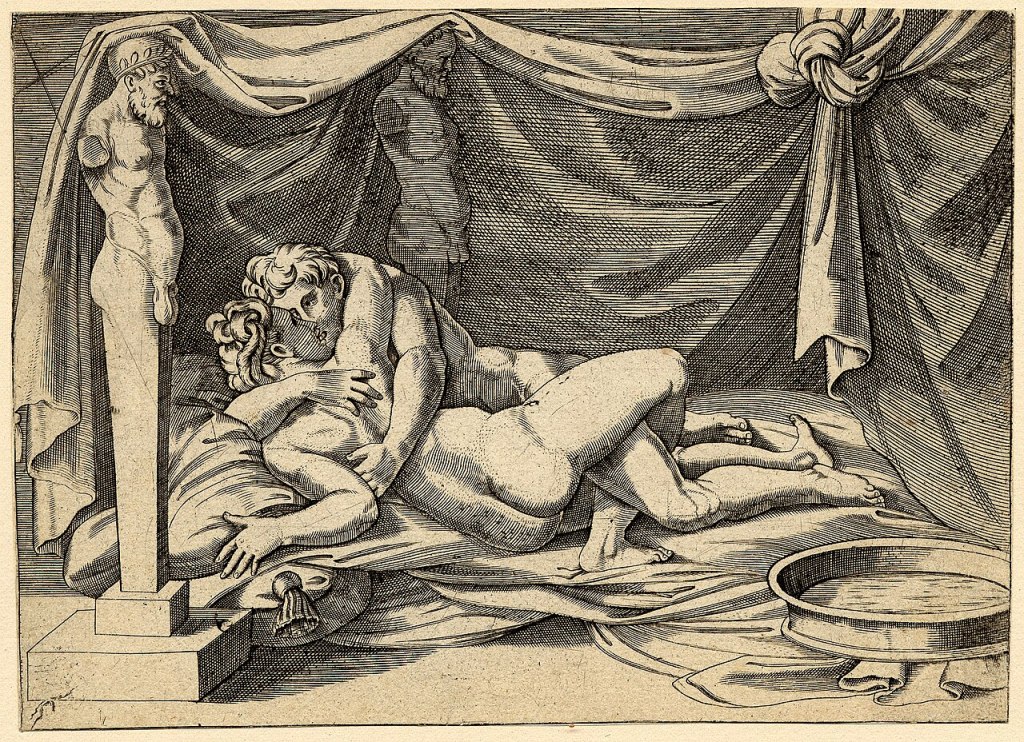
The apprentice of a legendary artist, the first publisher in history to be sued over copyright, and a famous satirist team up to create a provocative work of erotica that enraged the Pope himself.
Sources:
Romano, Giulio; Raimondi, Marcantonio; Aretino, Pietro; and Waldeck, Count Jean-Frederic-Maximilien. I Modi: The Sixteen Pleasures, An Erotic Album of the Italian Renaissance, trans. and ed. Lynne Lawner (Northwestern University Press, 1988).
Talvacchia, Bette. Taking Positions: On the Erotic in Renaissance Culture (Princeton University Press, 1999).
Vasari, Giorgi. Vasari’s Lives of the Most Eminent Painters, Sculptors, and Architects, vol. III, trans. Mrs. Jonathan Foster (London: George Bell & Sons, 1894).
Transcript
In the year 1520, the great artist Raphael passed away. His apprentices Giulio Romano and Gianfrancesco Penni were tasked with finishing the projects Raphael’s workshop in Rome had yet to complete. There was an invigorating creative freedom in the prospect of finally becoming a master, Giulio had to admit despite his grief. But it was also frightening. Penni was already a master with a workshop of his own. Giulio on the other hand would have to strike out on his own and find his own patrons, without Raphael behind him.
Raphael had loved him like he was his own son, and Giulio saw Raphael as more than a mentor in turn. So while Raphael had a tendency to keep his apprentices on a tight leash and to keep their own ideas on the shelf, he did help Giulio develop his own project, even as he was suffering from the illness that would kill him.
It was this last collaboration with his master that might prove his financial salvation. On his own time Giulio enjoyed making sketches of real people in the nude and in the act of making love. He would gift or sell these to his friends and to Raphael’s patrons. Through Raphael he knew an engraver and printer who could and likely would print copies of those images and sell them en masse. There were always prudes, of course, but Giuliano knew from experience that there was no shortage of clients who would pay well for such art. He even knew men of the cloth and one cardinal who had accumulated quite the collection.
It had to be a sure thing.
This is Turning Modern.
I’ve heard it said that, almost as soon as humans invent a new medium, they use it for porn. In 1839, when Louis Daguerre invented the first technology that could develop photographs that do not fade over time, within a year’s time brand-new photographic studios were producing erotic nudes. The first explicitly erotic film, depending on how you define “erotic film”, was made within months of the first publicly shown motion picture, “Workers Leaving the Lumiere Factory.” It was called “Bedtime for the Bride” and it showed a woman giving a striptease. Even in the 1980s, years before America Online made the Internet accessible to a broad swathe of the general public, people on Usenet forums were sharing pornographic images scanned from magazines and slash fiction.
So…what about the printing press? We know less about the earliest works that were printed that were erotic. The issue gets murkier if you judge what would be taboo by the standards of the time. Giovanni Battista Palumba was an early printmaker who specialized in artistic scenes depicting nude male and female figures who were sometimes in suggestive scenes, but these all portrayed scenes from ancient Greek and Roman mythology, which made them mostly if not completely uncontroversial. If that sounds strange, well, today you could probably get away with showing Michelangelo’s David or the Venus de Milo to a middle school class….maybe, it’s hard to tell in my country the United States, especially nowadays.
Guilio Romano’s project would be different from Giovanni Battista Palumba’s prints. His were not figures from myth, but contemporary figures in explicitly erotic poses. And some if not all of his figures would be based on real people, including well-known Roman courtesans. At some point, he named it I modi, which in Italian means “The Ways” or maybe more accurately “The Positions.” It wasn’t completely new, of course. Erotic drawings existed even in the pious Middle Ages; some were even drawn on prayer books. Most people who could afford manuscripts at all could only afford one or two books, so it was necessary to be economical. Explicitly sexual art was painted in private villas or exchanged among groups of connoisseurs. But few pieces that showed naked bodies in sexual acts without the respectability of classical or biblical themes were shown in public, and as far as we known none were to be published through the printing press.
For his plan, Giulio Romano turned to one of Raphael’s collaborators, a printmaker named Marcantonio Raimondi from Bologna. Marcantonio had already made his mark on history, albeit in a rather scandalous way. In 1510, Marcantonio was privileged to see a series of engravings on the Life of the Virgin Mary by the German artist Albrecht Durer. Marcantonio was enthralled by the images, so much so he published them as his own while making only small modifications. Even though he changed some of the images, Marcantonio didn’t notice or he didn’t bother to remove Durer’s signature monogram, “A.D.”, which appeared on the foreground in all the images. Not seeing imitation as the highest form of flattery, Durer sued Marcantonio through the courts of the Republic of Venice, the first lawsuit for copyright infringement in history. The court would only order Marcantonio to stop including Durer’s monogram, however.
We don’t know exactly when, but Giulio and Marcantonio reached an agreement. Giulio made twenty drawings of heterosexual copies, each in a different sexual position, and Marcantonio made engravings based on the drawings that would be the basis for printed copies. The prolific biographer of Renaissance artists, Giorgio Vasari, records what happened next:
Giulio Romano next employed Marcantonio to engrave twenty plates of figures, the character of which was highly offensive ; and what was still worse, Messer Pietro Aretino wrote a most indecent sonnet for each, insomuch that I do not know which was the most revolting, the spectacle presented to the eye by the designs of Giulio, or the affront offered to the ear by the words of the Aretine. This work was highly displeasing to Pope Clement, who censured it severely, and if it had not happened that when it was published Giulio had already left Rome for Mantua, he would certainly have been very heavily punished by the Pontiff. Many of these designs were meanwhile discovered in places where they ought least of all to have been expected, and the work was not only prohibited, but Marcantonio, being arrested for his share in the same, was cast into prison, and would have fared very hardly if the Cardinal Ippolito de’ Medici and Baccio Bandinelli, who was then at Rome and in the service of the Pope, had not interfered to procure his release. And certain it is that the endowments which God has conferred on men of ability ought not to be abused, as they too frequently are, to the offence of the whole world, and to the promotion of ends which are disapproved by all men.
Vasari, who wrote many years after the fact, did get one detail wrong. The first print runs of I modi were made without Pietro Aretino’s involvement, but the images alone were enough to provoke Pope Clement’s wrath. Why, though, if such images were constantly passed around privately without the Church getting involved? In her book Taking Positions: On the Erotic in Renaissance Culture, Bette Talvacchia argues the reason is quite simple. It was one thing for people to have such images in the privacy of their homes; it was quite another to publish them, where anyone with the money could buy them from a bookseller or street vendor.
Pope Clement ordered the prints as well as the copper plates used for the printing to be confiscated and destroyed. The order must have been fairly successful. Only nine images survive from these early runs and are now in the British Museum, with the…intimate parts of each person’s bodies carefully removed. As Vasari notes, Marcantonio was thrown into a Roman prison. By luck or deliberately, Giulio Romano was already out of town once Pope Clement unleashed the authorities. He had found a patron, Duke Frederico Gonzaga of Mantua. We don’t know if the duke found out about Giulio’s work through I modi, but he shared Giulio’s interest in risque subject manner. One of Giulio’s projects for the duke was a series of frescos on the myth of Cupid and Psyche, painted in a banquet hall in the Palazzo della Te in Mantua. Despite the Pope’s efforts, though, I modi was not destined to be forgotten by history, all because of the intervention of one man, Pietro Aretino.
Aretino is a fascinating figure in his own right. Lynne Lawner hails him as “the first journalist and publicist of the modern world.” He was known for writing and placing in public satirical verses about the politics of the papal court in Rome. In 1525, he even wrote a play, titled “The Courtesan”, that scathingly mocked the papal court and Roman authorities for their corruption and hypocrisy. Even so, Aretino welcomed controversy in his own life, declaring in one of his own poems, “I am a sodomite.” While Pope Clement seems to have been surprisingly willing to let Aretino have his say, Aretino did have one high-ranking enemy at the papal court: Gian Matteo Giberti, the bishop of Verona and one of the Pope’s advisors. Aretino would not only work to convince the Pope to release Marcantonio from prison; he would write his own poems to accompany each of the I modi. Again, we’re not exactly sure of the chronology, but by 1527 Marcantonio began publishing I modi again, this time with the poems published alongside the images that inspired them. It was in this form that we have the most complete surviving version of I modi and which apparently became a sensation across Europe, so much so that in England the name Aretino became synonymous with lewdness.
Here’s Lynne Lawner’s translation of Sonnet 15. I kept her use of the original Italian to describe specific acts, but I’m sure you’ll still be able to understand the meaning:
“Come view this, you who like to fottere,
Without being disturbed in that sweet enterprise:
This man here simply goes about his business
Carrying her off, fottendo wherever he wants to.
You don’t need to go to school
To learn in detail how to do that thing.
Study this image: there’s no charge.
Anyone who loves and cares can fottere.
Look how he’s lifted her in his arms,
Her legs up high on either side of him
She looks as though she’d faint away from pleasure.
IT doesn’t bother them that they’re exhausted.
Indeed, it seems like they like the game very much
They long to swoon in the very act;
Yet they stay upright and solid,
United, panting, focused on such great pleasure
They cannot but be happy while it lasts.”
What made this work so shocking to men like Giorgio Visari years later wasn’t just the description of the sex act. One of the core teachings of the Church was that, even in a lawful marriage, sex was sinful if it was done without the purpose of procreation. Aretino has the lovers in I modi revel in having sex in ways that cannot result in conception. As Aretino has a man exclaim in another sonnet, “May my lineage die out with me.”
But there’s even more to it than that. As just images I modi was provocative but not entirely outside the norm of erotica for the time. With Aretino’s verses, however, I modi is transformed into a joyful celebration of hedonism, a declaration that physical pleasure may not be sinful after all. As Lynne Lawner puts it, “I modi proposes an alternative world to the decorous life of the courts: a world outrageous, sinful, heretical, profane, and blasphemous yet humanistic in its heritage. Here natural forces are seen as divine, and man, as he takes on the guise and spirit of these forces, becomes immortal.”
As for the collaborators, Giulio Romano stayed in Mantua, where he established a workshop that later became a school of art, until his death in 1546. Marcantonio, unfortunately, did not get to enjoy such a peaceful life. The same year that I modi was likely published alongside Aretino’s poems, Marcantonio happened to be in Rome when the city was brutally pillaged by the Spanish and German soldiers of the Holy Roman Emperor Charles V. Marcantonio was wounded during the looting and held hostage. While his friends and family were able to pay his ransom, he died shortly thereafter from his wounds. As for Aretino, he somehow continued to enjoy great success despite being known as the “scourge of princes.” Still, he was hardly safe. By 1526, he was no longer welcome in Rome and relocated to Mantua. There he struck up a friendship with Duke Frederico, but given that Aretino could not help but step on the toes of the powerful that friendship did not last long. Frederico even asked Pope Clement if he wanted him to have Aretino killed. Needless to say, Aretino eventually left Mantua too. In the end, he died from a heart attack in Venice at the age of 64, although I prefer to believe an old legend that says he actually died because he laughed too hard.
Their legacy, I modi, would set the pace for erotica throughout the early modern era. In a time when the Catholic Church found itself embattled by Protestants and when people were increasingly looking to pre-Christian eras for new ways to understand the world and achieve happiness, erotica like I modi wasn’t just about titillation or even shock value; it could carry political and philosophical statements as well. And, believe it or not, it would continue to do so through the Reformation until the French Revolution.
Thank you for listening.


Leave a Reply