Piero de’ Medici is gone, and a new rising star is a hotshot preacher named Girolamo Savonarola. Once an itinerant preacher and lecturer, Savonarola now finds himself hobnobbing with King Charles VIII of France and even having a say in Florence’s newly rebuilt, Medici-free republic.
Transcript
Today, we’re leaving behind the Medici golden age. This episode marks the start of a new season, the Holy Family. It’s an era that begins with the Medici being driven out of their home city. By rights they should have faded into obscurity. Yet, ironically, this will be the time when they really left their mark on European and even world history. A Medici would assume the role of antagonist in a little tiff you might have heard of called the Protestant Reformation. The family would also, like that other great Italian family the Borgias, take a part in the story of how the golden age of the Italian city-states drew to a close and how Italy would lose much of its independence to the great powers of Europe for roughly 300 years. Basically, this season is about how a dynasty stripped of political power and the bank they founded and driven into exile just simply refused to step off the stage of history.
Sadly, though, Piero knew none of this. All he did know in the winter of 1494 was that the odds were pretty good he and his brothers and children would never see Florence again. The Signoria of Florence had officially banished him and his brothers. Also the signore ruling Bologna, Giovanni Bentivoglio, only coolly welcomed the Medici since he was worried that the man who gave him the troops and money that helped prop up his regime, Duke Ludovico of Milan, would stop writing the checks. Rightfully worried that Bentivoglio was just waiting for some pretext to imprison them, Piero and Giovanni Medici quietly moved on to Venice, ironically the same refuge where Piero’s great-grandfather Cosimo ended up. One of the great banking dynasties of Venice, the Lippomani, put the Medici up in one of their villas. Still, though, charity only goes so far even for the great and powerful, and Piero would find himself obliged to sell off his father’s collection of jewels. This was especially once the Signoria confiscated all the funds of the Medici bank, which was practically bankrupt by the time Piero was overthrown anyway.
During this chaotic time, Piero fired off multiple letters to the Signoria. His tone was apologetic, but he still fought back against accusations of tyranny. Also he asked the Signoria to send him and his family some clothes from the Palazzo Medici, which they dutifully did in order to, in their own words, quiet him down. Indeed, he claimed all the wanted was a chance to return to Florence and live quietly as a private citizen with his children. To Piero’s credit, it was Charles VIII and his advisors who floated the idea of forcing the Signoria to reinstall Piero, and Piero declined or at least made a show of doing so, asking only that he be allowed to return as a private citizen.
When Piero did lose his temper, it was with Duke Ludovico, whom Piero with good reason blamed for his family’s downfall. He wrote to Ludovico asking for money, perhaps funds which Ludovico did actually owe to the bank, but instead Ludovico responded with a letter that was apparently “brusque and acerbic.” Ludovico refused to give Piero a dime, but he did offer to let the Medici take refuge in Milan. Piero fired back that since his life was all he had left, he would not trust it to Ludovico.
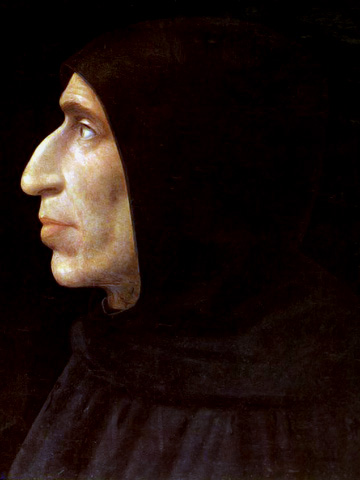
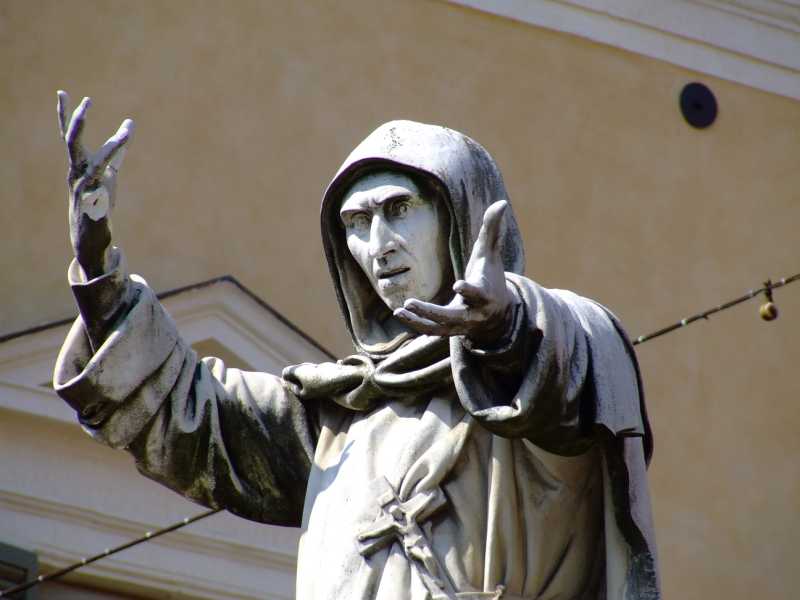
But let’s leave Piero stewing in Venice and turn our attention to a man who I’ve been keeping off the stage until now, Girolamo Savonarola. He was born on September 21, 1452, the third of seven children of Niccolo Savonarola and Elena Bonacossi. His mother was descended from an aristocratic family that once ruled Mantua. Meanwhile his father was a merchant and his paternal grandfather Michele Savonarola taught medicine at the University of Padua and was the court physician of Duke Niccolo III of Ferrara. However, the Savonarolas had fallen on hard times and was on the brink of at least relative poverty, since Niccolo Savonarola’s business ventures had a tendency to end in failure.
Like most families of the Renaissance middle class, his parents hoped Savonarola would go to a university and then get a job as a government official or go into medicine or law. Later writings about Savonarola would claim that even as a child he showed signs that he instead felt he was being called by God. Instead of childhood games he was more interested in prayer or building little alters, or so these whitewashed accounts claimed. But these are all just tropes and cliches common to most medieval biographies of saints, although we get the probably authentic details that even as an adolescent Savonarola was the introverted sort who preferred going on solitary walks in nature and that he enjoyed playing the lute and sketching in a sketchbook. Certainly at first he did take the normal track his parents wanted for him and became a student at the University of Ferrara where he studied philosophy and at least some medicine.
That changed though, and Savonarola reluctantly decided to join the church as a friar in the Dominican order. Why he radically changed course in his life isn’t clear, but I don’t think even if we could call up Savonarola through an Ouija board and interview him he’d be able to explain it. After all, even in our less religiously charged times it can be difficult for people to explain why they ended up converting to a new religion or making a life-changing commitment to a religious organization. In his own words to a young Florentine man late in his life, Savonarola did say, “When I was in the world I said a thousand times that I would never become a friar; yet I had to go when it pleased God. I couldn’t eat and I was going around in circles. When a person gets the idea he can’t sleep; then once he arrives he lives entirely contented.”
There is an intriguing little hint about Savonarola’s origin story, though, in the form of a story that apparently came from Savonarola’s own brother Mauro and which is believable precisely because it doesn’t put Savonarola in the best light, especially by the standards of saints. While he was at the university, he met and fell in love with Laudomia Strozzi. If you remember past episodes, the Strozzi were one of the Medici’s main rivals in the world of banking. Laudomia was an illegitimate daughter of the family. Anyway, they struck up a friendship and would talk to each other from their bedroom windows across the alley that separated their two houses. One day, Savonarola worked up his nerve and proposed to her. Laudomia brutally turned him down, allegedly saying, “Do you think that the blood of the great house of Strozzi would deign to be united with the house of Savonarola?” Supposedly Savonarola snapped back, “And do you think that the house of Savonarola would care to give one of its legitimate sons to a bastard like you?” Perhaps not coincidentally, Savonarola’s decision to join the church came soon after this spat. Honestly between this and the attitude Savonarola would show toward women the rest of his life, I really do suspect that if he had been born somewhere in the English-speaking world in our time Savonarola would have ended up posting memes about alpha and beta males to 4chan.
Anyway, whatever drove him Savonarola was staying with his parents when he decided to take the faithful step. He actually secretly left home to join a monastery. He left behind a letter to his father, which read, ““I have no doubt that my departure is very painful to you, particularly because I stole away so secretly, but by this letter I want you to understand my soul and will, so that you may take comfort from it and realize that I have not made this move in so childish a way as some people think. And first of all I want you, as a manly spirit and disdainer of fleeting things, to be swayed by truth, rather than – as women are – by passion, and to judge in accordance with the empire of reason whether or not I was right to flee from the world and to pursue my own calling…Answer me therefore. Is it not some great good for a man to flee from the filth and iniquities of the wretched world, in order to live as a rational being and not live a beast among swine? And would mine not have been a great ingratitude to have prayed God to show me the straight way to take, he having stooped to show it to me, and then not to take it?” Given that his parents’ hopes hinged on Savonarola bringing in a fat income, their reaction is understandable. It certainly didn’t help that, when Savonarola’s mother wrote to him asking for money to support the family, his only answer was that she and his sisters should give up their worldly cares and join the monastic life like him.
I doubt Savonarola would have given them money regardless, but it certainly didn’t help that Savonarola’s career in church didn’t take off right away. He didn’t or couldn’t advance far in the church’s academic hierarchy and was just assigned posts teaching theology or preaching around northern Italy without establishing himself anywhere. In May of 1482, he was asked to work as a lecturer at the monastery of San Marco in Florence. Even though he was living in the city that would make his name, he made no splash at all, and after five years he was reassigned elsewhere.
Likely enough this would have been the course of Savonarola’s life, an obscure preacher and theology instructor. But then, fate stepped in or, more likely, Count Pico della Mirandola. Yes, this is the very same Pico who was a notorious humanist who challenged everyone to disprove his theses and whose writings were condemned by the Church. At some point Pico became more devout and befriended Savonarola. It was Pico’s idea that Lorenzo the Magnificent invite Savonarola to Florence and offer him an official position as a preacher at the monastery of San Marco.
Lorenzo agreed. Perhaps he did it just as a personal favor of Pico, but likely enough Lorenzo also liked the cut of Savonarola’s jib. See, even early on Savonarola had a disdain for worldliness. While this made him a misogynist and an anti-intellectual – at one point, for example, Savonarola bragged about destroying the copies of Plato he had owned and read as a university student – he also had a skepticism of worldliness and church politics that was appealing in a time when the high clergy of the Church was flaunting their wealth more than ever. The ambitions of Pope Sixtus IV for his family and the fact those ambitions led to wars appalled Savonarola. In a poem he wrote after the death of Pope Sixtus, he begged Jesus to forgive the papacy, declaring in two verses, “I see nothing but swords, Jesus, forgive our iniquities!”
Contrary to what one might think especially if you grew up in a majority Protestant Christian country, the Catholic Church actually did tolerate criticism, just within certain boundaries, and Savvonarola was not shy about denouncing worldly, ambitious prelates of the church. This was the time Lorenzo himself was locking horns with the Pope, so maybe cultivating Savonarola was a subtle way of undermining the Church. If so, though, Savonarola proved to be too good a weapon. He didn’t shy away from also decrying the poverty and inequality he saw in Florence as a whole. Now, don’t get me wrong, there wasn’t a concept of separation of church and state, and humanists believed the rulers of states should look toward both Socrates and Jesus as their moral models. However, it was one thing for a preacher to urge the people in power to embrace the Christian virtues, to call for peace, and to decry the sins and the luxuries of the rich and powerful. It was another thing entirely for a preacher to almost explicitly comment on the actual policies of the government, which was something Savonarola did more and more frequently, although Savonarola did have enough sense to name no names. Nor was Savonarola tolerant of the humanist trends Lorenzo had encouraged. He denounced everything from nude statues to clerics translating and reading pagan writers to secular poets. Savonarola also began to suggest he had the gift of prophecy, and that he foresaw judgment coming for Italy.
An example were his Lenten sermons of 1491, which called out the Signoria to change their ways and make Florence a truly holy city by punishing immorality, uplifting the poor, and keeping Florence out of wars. These sermons finally made Savonarola a household name around Florence, which only made Lorenzo the Magnificent even more uncomfortable about this force he conjured up in his own city. Still, Lorenzo never really lifted a finger against Savonarola. The most is that Lorenzo started favoring Mariano da Genazzano, a preacher from the Augustinian order, who in the world of the Catholic Church were the Domenicans’ main rivals. Mariano liked to needle Savonarola in his sermons, openly saying the idea that anyone even a holy man could see the future is laughable. However, Mariano’s direct attacks on the up-and-coming Savonarola only made him unpopular.
One of the myths, again still repeated by some modern historians, is that Savonarola set himself up as an enemy of the Medici once he started getting a popular platform. This simply isn’t true. Lorenzo and his inner circle were worried about Savonarola’s influence, but Savonarola never criticized the Medici, directly or otherwise. Later stories that Savonarola urged Lorenzo on his deathbed to repent of his tyrannical control over Florence were completely fabricated. In fact, even after Lorenzo died, Savonarola stayed quiet about the Medici up until Piero was overthrown. He was even reluctant to approve of the revolution in his sermons, until he was absolutely sure of the direction the winds were blowing.
It was only with the chaos surrounding Piero’s overthrow that Savonarola stopped being a commentator and actually stepped into Florentine politics. The Signoria of Florence knew how superstitious King Charles VIII of France was, so they asked Savonarola to lead a small delegation that would meet with him. Savonarola eagerly agreed. They found Charles VIII in Pisa, where the Florentine governor of the city had fled and Charles was basking in the adoration of the citizens who welcomed him as a liberator. It was a pivotal moment. As you might have gleamed from the titles I’ve been using, it was Savonarola who liked to compare the French invasion of Italy to the biblical flood and Florence to Noah’s Arc, but like Noah Florence would only survive the flood if its people were righteous. Now Savonarola was face to face with his flood, which had to be an amazing moment for the once itinerant preacher and teacher, even if his flood came in the form of a very short king. Charles was impressed by Savonarola, no doubt because he claimed Charles was “sent by God to chastise the tyrants of Italy.” To Savonarola’s credit, he was also bold enough to warn Charles that God’s wrath could even fall on his instruments, which is what would happen if he harmed Florence and its people. Charles VIII was so impressed that he insisted on having a private audience with Savonarola, although we don’t know exactly what was discussed.
Savonarola and the delegation returned to Florence, likely at the request of Charles. As soon as he could Savonarola tried to reassure the nervous crowds, telling them that King Charles did not intend to attack the city. He urged the Florentines to see the fact that the Medici were overthrown without bloodshed as a sign of God’s favor, and to not seek revenge upon former members of the Medici party. Nor should they seek violence on the French. Unfortunately, it wasn’t a good sign when Charles VIII did arrive at the city at the head of his armor. He was dressed in black velvet, with a lance on his hip and holding a sword, which was the traditional posture of a conqueror.
Luckily, though, Savonarola had apparently succeeded in calming the mood, and probably more importantly Florence had a long history of pro-French politics. And even though the king was striding into Florence like Julius Caesar into Gaul, he and his soldiers were greeted by crowds chanting, “Francia! Francia!” Florence’s French honeymoon was short lived, however. Over the next few days there were brawls between the occupiers and the citizens of Florence. In one case, French soldiers even tried to take a Florentine hostage, until an angry crowd freed him and drove the soldiers off. Miraculously, in the end only ten people were killed, which Savonarola with some justification saw as a miracle.
Matters between the people in power went in a similar direction. In the palace of the Signoria, Charles VIII and his advisors and the gonfalonier Piero Capponi, who in a strange coincidence knew Charles when he was a child, hashed out a treaty that would supersede Piero’s earlier concessions. There was a very tense moment when Charles was outraged that the treaty would give him less of a loan than promised during negotiations. Leaping up from his chair, Charles shouted, “I will sound my trumphets”, a very clear threat that he would give his army the order to sack Florence. Without hesitating, Capponi grabbed the treaty, ripped it up, and rejoined, “If you sound the trumpets, we will ring our bells”, before heading toward the stairs. As you probably know, the bells were traditional Florentine call for arms.
Charles VIII knew very well that fighting a guerilla campaign on city streets is not a situation any commander should put himself in. So Charles defused the situation, joking, “Oh, Capponi, Capponi, what a capon you are!” A capon is a term for a castrated rooster. Why this defused things…well, who knows? A new treaty was drawn up and Charles signed it. The major provisions were that the Signoria would give Charles a loan of 120,000 florins, which was a hefty 80,000 florins less than what Piero had promised. Also Charles offered to return Pisa, Livorna, and the northern border fortresses to Florence once Naples was conquered.
One snag was what to do with Piero de Medici. The very moment Piero was driven out of Florence was when the hope of creating a new Medici-dominated government run by Piero’s cousins died. Piero’s wife Alfonsina and her mother, who were holed up in a convent in the suburbs of Florence, had showered Charles’ advisors with bribes to try to get the king to put the Medici back in power, but Charles or at least his advisors knew the tide had turned against the Medici. The most Charles asked of the Signoria was that they lift Piero’s exile, with the understanding that Charles would do nothing to help put Piero back into power unless the people voted to restore him. Whatever promises he made Piero, Charles was satisfied. After all, the last thing Charles wanted was to get bogged down in Florentine politics.
There is a story reported in fact in some of the early biographies of Savonarola that he came across Charles in armor and on the verge of letting his army loot Florence. Only Savonarola, invoking the righteous wrath of God, got Charles to end the occupation and move in. This is definitely rubbish. Charles did overstay his welcome, but it was just to ensure that the government of Florence would remain friendly. Now it was time for him to take out his next target, Pope Alexander VI himself.
Now that the king and his army were out of the city, there was one more chore to deal with: namely, decide what kind of government they would have. This would have been a lot to ask under any circumstance, and it was even worse in a Florence that was still undergoing an economic recession and had suddenly and unexpectedly overthrown its government. Simply because the Medici party had been in power for so long the government was still dominated by former members of the Medici party, like Bernardo Rucellai and Piero Capponi himself, and by the old upper class, the ottimati. Up against the ottimati were the self-described “friends of the popolo”, who wanted a complete purge of the old regime and genuine reforms that would open up more political offices for the lower middle and working classes.
Even the ottimati, though, admitted they could not return to the old status quo before Cosimo de’ Medici and some constitutional reforms were needed. First, they abolished the Council of Seventy and the Council of One Hundred and the various electoral committees, all of which the Medici used to stay in power. All of these changes had to be approved by a general assembly, which was carried out under an armed guard. According to one observer, “Some people shouted yea, and this was considered enough.” As the crowd was slowly leaving, some people amongst themselves some turned around and protested that the popular consent was not truly counted. The Signoria then ordered to have them forcibly removed and it plowed ahead with even more ambitious reforms. All the old legislative councils would now be abolished and replaced by a Great Council, although the committees advising on legislation would remain.
Larger than any legislature that existed in Florence before, the Great Council would have 500 members. Any punishment of a citizen or a new law had to meet two-thirds approval. Besides serving as the new legislature, they had a role in the selection of new magistrates and would have final approval of all laws proposed by the Signoria. Also, the Great Council had a say in all administrative offices. Candidates would still be chosen by lot, but then the names of all candidates would be submitted to the Great Council who would vote for the final choice. Anyone who had been considered for high office or had at least a great-grandfather who qualified could serve on it. This was a compromise between the middle class and the ottimati, keeping eligibility for the Great Council open…but not too open.
Still, although Savoronola played up to the friends of the popolo, he did approve of the Great Council. With the new republic, though, he used his sermons even more openly as a way to push for new laws and reforms. Not all of his proposals were popular among the members of the Great Council; his idea to lower the sales taxes on food and wine that impacted the poor fell flat. But the Signoria and the Grand Council did heed his call for a right to appeal charges of treason and an amnesty for the Medici, except for direct descendants of Cosimo de’ Medici, and their supporters.
So, Piero de’ Medici was relying on the kindness of strangers in Venice and what was once his family’s greatest asset, their bank, was now dead and gone. Meanwhile Savonarola was about to help make the revitalized Florentine republic a shining example for the rest of the Christian world and King Charles VIII was about to humble the Borgia Pope and build an empire that would straddle the Mediterranean from Bordeaux to Jerusalem.
What could possibly go wrong?


Leave a Reply