The fourth Medici to come to power as “unofficial lord” of Florence is Lorenzo the Magnificent’s son, Piero. Although a strapping, handsome, and popular young man, forces within the regime are already working against him. But the real threat is starting to stir many miles outside of Florence…
Transcript
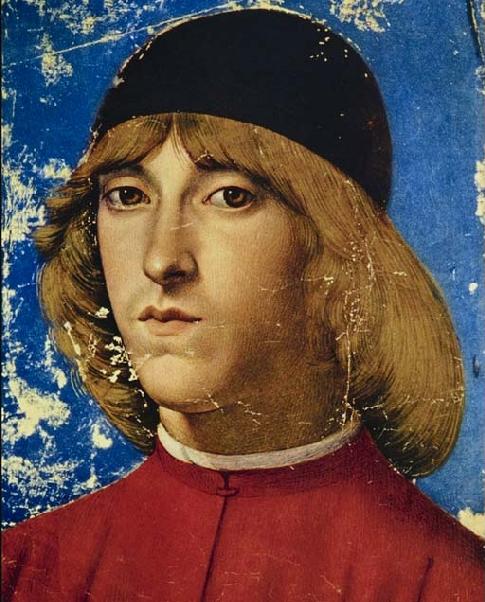
Piero de Medici or Piero II if you want to be specific was the oldest of Lorenzo the Magnificent’s sons who lived past infancy, born on February 15, 1472. This is a bit of a spoiler but I should mention he’s also remembered by history with the sobriquets “the Unfortunate” or “The Brief”, as you probably noticed in this episode’s title. There was never really any question that Lorenzo’s place on the invisible throne of the Medici would be filled by his eldest son Piero. After Lorenzo’s death only a single vote in the Council of Seventy, out of all the legislative councils in the government, went against a bill that would have Piero inherit everything from Lorenzo, including his political responsibilities. This was despite the fact that Piero was too young for political office according to Florentine law.
Maybe Lorenzo would have instead made his brother Giuliano heir if he had lived. Certainly Lorenzo belittled his son’s intellectual abilities, if the story that Lorenzo thought of him as the dumbest of his three sons is at all true.
Modern historians have tended to agree with Lorenzo de’ Medici. In his book on the Medici, J.R. Hale describes him this way: “Piero was an example of a not uncommon type: the young man who feels that early success excuses him from continuous effort.” It’s easy skimming through the history books that Piero was just a dumb jock, but I don’t think that’s fair. True, Piero did grow up into a very athletic adult. He loved horse riding and racing and spear throwing, enjoyed hunting and falconry, and dabbled in what we might call today body building. His favorite sport to play wasn’t something for the faint of heart either. He played a uniquely Florentine sport, calcio fiorentino, “Florentine football”, which is also in the present day called, “calcio storico”, “historic football.” It’s like if you mixed together football or soccer if you’re American, rugby, and maybe a bit of mixed martial arts. And needless to say it wasn’t played with even rudimentary protective gear.
Still, Piero did not really live up completely to the jock stereotype. He wasn’t an exceptional student, but he also wasn’t a bad one. He shared his dad’s love of poetry and several poems of his survive. Also he would write and sing songs on the lyre. Yet his contemporaries, even people who were stridently anti-Medici, remarked that he was witty and used his sense of humor to put the people he talked to at ease. I like the way G.F. Young describes him: “He was simply an ordinary young noble of his day, without more brains than other people possessed. But the Medici had always had more brains than other people possessed; it was expected of them.” I mean, try to put yourself in Piero’s shoes. Imagine being just 20 years old and suddenly you have to take over your father’s old job, with said job being the head of an arts and small business network, the CEO of an international banking corporation, and the Secretary of State and Prime Minister of a country all at the same time. Plus the bank is going bankrupt and the king of France is constantly sending you angry letters demanding that you let his army occupy your country, but we’ll get to all that next time.
It didn’t help that Lorenzo really didn’t give Piero much of an opportunity to grow into the job. Lorenzo did send Piero on diplomatic missions since he was just thirteen years old, just like Lorenzo’s father did with him, but he usually did not entrust him with any real political offices or responsibilities. The most is Piero had his own network of clients and when he was seventeen he was elected to be the head of a confraternity sponsored by the Medici that organized the distribution of bread to the poor. Then later he was briefly the go-between between his father and the controller of finance and, when Lorenzo was away at Naples, Piero was tasked with making sure two candidates favored by Lorenzo got nominated to the executive council in charge of state security, the Eight. Exactly why Lorenzo kept his son away from the actual nitty-gritty of politics was anyone’s guess. Maybe he was waiting for his son to get older when a Florentine would traditionally start his political career or perhaps it was the same paranoia over sharing power that affected his relationship with his brother years ago. Whatever the reason, Piero was even more unprepared for leadership than he should have been.
Also some of the sources hint that Piero’s wife’s family was a bad influence on him. Of course, this might have just been old-fashioned xenophobia and misogyny. After all, blaming a wife and her family for a ruler’s bad moves is an extremely old tradition going all the way back to the beginnings of written history. Plus contemporaries did agree that Piero and his wife Anfonsina did love each other, settling into a kind of domestic bless even before their wedding when they met for the first time in Rome. The couple would have two children, both born shortly after their marriage, Clarice and Lorenzo II. But sources do suggest that Piero’s wife Alfonsina, whatever her sincere feelings for Piero, was a bit of a snob and looked down on her Medici in-laws. As much as women do get unfairly blamed for being a negative influence on their husbands, it does seem possible Piero felt something of an inferiority complex next to his aristocratic in-laws and it shaped his policies.
Worse, it does seem like he actually didn’t really have the temperament for the business, unlike his ancestors. Lorenzo had a devil-may-care attitude, but he did relatively quickly grew into the job. Perhaps if he was given more time Piero would have done the same. However, even Alison Brown, whose biography of Piero is very even-handed, admits that in his dealings with his enemies Piero was both “lazy and hyperactively scheming.” And even though Piero was well-liked among some for his genuine affability, he could also be incredibly dense and insensitive, like when he allegedly asked Michelangelo of all people to make a snowman for him and his kids in the courtyard of the Medici Palace and Michelangelo threw a fit, which is something anyone that knew Michelangelo would have predicted. Also Piero used a legal maneuver similar to eminent domain to take a popular public park in Florence and turn it into a private jousting field for him and his friends. If something like that was done today, Piero could have just called the new arrangement a public-private partnership designed to reduce inefficiency and maximize resources. Alas, he was living in the fifteenth century, not the 21st. But most of all, it just doesn’t seem he had it in him to be the pathological overworker his father was. Alison Brown does prove in her biography that Piero’s reputation for blowing off all his responsibilities is greatly exaggerated, but there were certainly times when Piero was off hunting or working on his biceps when he should have been at his work desk.
Part of the problem was that while Piero probably wasn’t the spoiled brat some historians made him out to be he must have let his position as the golden boy of the Medici clan get to his head, at least a little. After all, unlike any of his predecessors, Piero was quite gorgeous. One of the leading members of the Medici party, Matteo Franco, wrote that “the poor lad cannot go outside the door without all Florence running after him.” Worse was one incident where Piero went on a trip and acted in a way that provoked the disapproval of not just his father, but all of Florence. Before Lorenzo the Magnificent’s death, in the fall of 1492 Piero led an embassy to Rome to congratulate the new pope Alexander VI. Trying to keep up with his Orsini in-laws, Piero was so gaudily dressed when he went to Rome it offended Ludovico Sforza, who thought Piero, this little child of bankers, was trying to surpass the princes of Italy. Worse, Piero returned to Florence wearing his luxurious garbs, which violated Florence’s own laws against dressing up ostentatiously. Piero had also definitely broken from the Medici tradition of men dressing up like middle-class patricians. One observer Piero Parenti claimed that the sight of Piero dressed up in gold finery “made the whole city want to throw up.”
It might have been this arrogance that caused Piero to surround himself with some of the young up-and-comers he knew through his social circle. But if we want to be fair, it could have been a deliberate policy decision to try to balance the overbearing power of his father’s old clique with some new blood completely loyal to him. However much thought Piero gave it, though, it inspired some in the Medici party to talk between themselves about replacing Piero with his wealthier cousins, the sons of Pierfrancesco.
Meanwhile, over in the Alps in France, another young man named Charles is also getting accustomed to the position he inherited. Much like Piero de’ Medici, Charles was also inexperienced but called upon to fulfill the legacy of a father who became a legend in his own lifetime. This Charles was no other than the new king of France, Charles VIII, and his eagerness to live up to his father and his other ancestors will lead him to overturn the entire Italian system of alliances that Lorenzo the Magnificent had carefully set up and change the trajectory of Piero’s life and the history of Florence into directions no one could have foreseen.


Leave a Reply