As soon as he inherits his father’s place as head of the rich, international Medici Bank, Cosimo gets a target on his back in a Florence where politics are increasingly molded by the sponsorship of the rich and not by the guilds. The minute he steps on the public arena, not only is Cosimo’s political career is in danger, but his very life.
Transcript
Giovanni di Bicci has, largely because of his connections to one of several rival popes, become a wealthy banker. Although drawn into politics by just the mere fact of his wealth and by his family’s reputation as supporters of the populist cause, Giovanni largely stayed out of politics. So much so, in fact, that no one was sure if he sided with the conservative or the populist cause. As a result, Giovanni had a great deal of political capital when he intervened to stop the conservatives, at the time led by Rinaldo degli Albizzi, from disenfranchising members of the minor guilds and replacing them with nobles and members of the major guilds. Also, he decisively supported a major tax reform that replaced the city’s sales and poll taxes with the Catasto, a system in which the property and revenues of the city’s citizens were surveyed and taxed based on citizens’ wealth and income.
His growing prestige netted Giovanni a marriage with a Florentine noblewoman, Piccarda Bueri. Their first children were twins, Cosimo and Damiano, born on April 10, 1389. If the name Cosimo brings to mind a certain lanky doofus, you’re not alone.
Damiano and Cosimo were named after two saints of the same name, who were also twin brothers. According to legend, the saints were doctors who treated patients without charge and were both tortured and killed during the anti-Christian persecutions of the Roman emperor Diocletian. Apparently the fact the boys were twins and the connection between the name Medici and saints who were doctors was irresistible. Cosimo himself appreciated the connection. Even though his twin Damiano died shortly after birth, Cosimo made the day he was named, which happened to be the Church’s feast day for Cosimo and Damiano, and not the day he was actually born, his official birthday. Piccarda and Giovanni had another son, Lorenzo, born sometime in 1395. It would be the descendants of this Lorenzo many years down the line who would be a thorn in the side of Cosimo’s own descendants. During their lifetimes, though, the brothers seem to have been close and partners in both banking and politics.
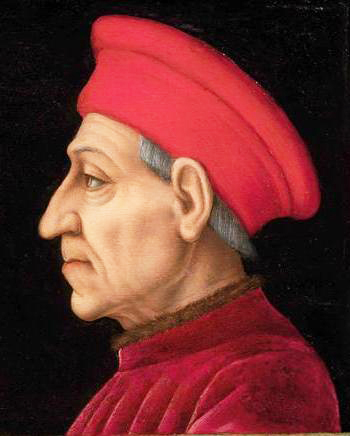
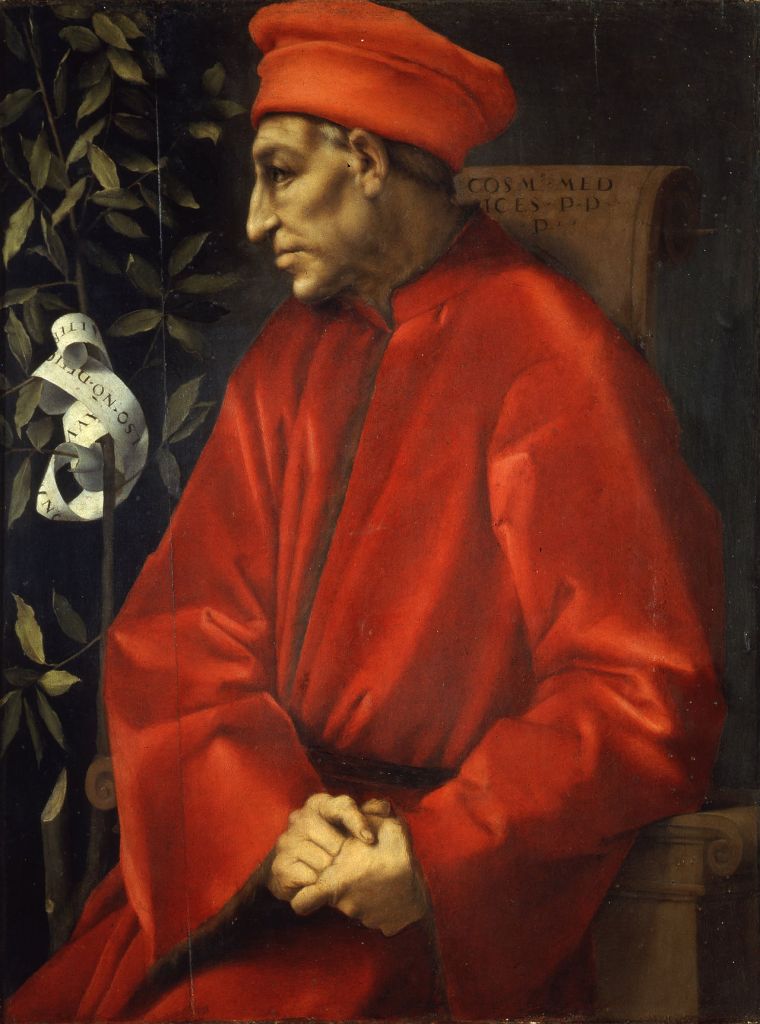
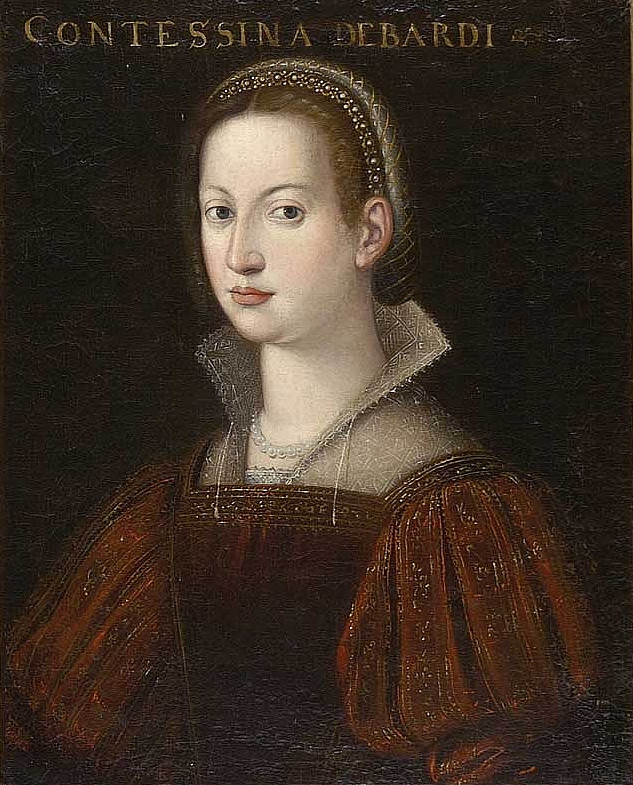
Almost nothing is known about Cosimo’s childhood and early adulthood, except he and Lorenzo started working in the family bank early on and stayed completely out of politics. We don’t even have a clear image of what Cosimo looked like in his youth, since the only portraits of him that survive were painted in his old age. What we can say is that, like any member of a great Florentine family, his career started when his parents arranged his marriage to a suitably prestigious bride. Sometime around 1415, Cosimo married Contessina de Bardi, the daughter of one of the city’s most famous banking dynasties. In fact, you might remember it was the Bardi and their risky loans to King Edward III of England who helped cause the recession that brought Walter of Brienne to power. Well, as is usually the cause, the Bardi did not suffer the brunt of their mistakes. Although they were no longer fabulously wealthy as they had been about a century ago, they were still valuable allies for new power players like the Medici.
While we may not know much about his early years, we do know more about Cosimo’s personality and private life than his father or indeed any previous member of his family. Drawing from his sources, the sixteenth century Florentine historian Scipione Ammirato described Cosimo as being of medium height and olive complexion. A modern historian Mary Hollingsworth describes him as “a devoted family man, fond of Contessina and their children, even tolerant of the way his wife fussed over him during his frequent attacks of gout” but also “a shrewd banker and a devious politician, who could be ruthless when necessary.”
Devious as he definitely was, even people who would later criticize Cosimo’s regime over Florence praised his virtues. Despite being a venomous critic of the Medici regime later on, the chronicler Giovanni Cavalcante greatly admired Cosimo himself, writing: “If I believed the virtues in men were immutable and perpetual in this transitory and momentary life of ours, I would have dared to say that he was a divine man rather than mortal.” Cosimo certainly remembered his father’s advice about staying humble while never diluting the dignity of the Medici. He dressed in public like any other member of the major guilds or wore the red robes of a physician, a fashion pun on the name Medici. As we will see, though, Cosimo could be more ruthless than even his worst enemies, if the situation allowed for it.
Cosimo’s intelligence is the one thing without question. Under his management, the Medici bank could boast branches in Venice, Rome, Ancona, Geneva, Bruges, Avignon, and London. By Cosimo’s time, the bank was bringing in yearly profits of 12,000 florins. Some purported sayings of his that have come down do review something of a practical, calculating mentality, such as, for example, “A gentleman can be made with two yards of red cloth” and “Better a city ruined than lost.”
Although he was wealthy, Cosimo was naturally generous or understood that the best way to defuse resentment was to share. Machiavelli hailed Cosimo as “liberal and humane.” Every birthday Cosimo held parties every time for his birthday, which included not only a banquet for family and friends, but he also invited servants and bank employees.
Still, Cosimo was like so many of his generation fascinated by the new trends in learning. He wasn’t a scholar or a creator himself. But I mentioned before that he was an obsessive book collector. It’s important to clarify he actually read the books he collected, too. We can tell because he liked marking passes of interest with three dots arranged in a fancy triangle. In particular, he had a deep and sincere interest in philosophy, especially Neoplatonism, and like his father was involved in patronage. Cosimo also sat on the board that eventually decided to use Filippo Brunelleschi’s plan to erect the dome on the Florence Cathedral. While his father owned only a few books, including a Bible and devotional texts, Cosimo had a massive library. At least according to Cosimo’s friend and biographer Vespasiano da Bisticci, Cosimo could remember the titles and authors of every single one of his books, and remembered the name of the previous owner of at least one of the books. Also, he became something of an expert in agriculture, at least according to Vespasiano:
“Of agriculture he had the most intimate knowledge, and he would discourse thereupon as if he had never followed any other calling. At San Marco the garden, which was a most beautiful one, was laid out after his instructions…He did much fruit planning and grafting; and, wonderful as it may seem, he knew about every graft that was made on his estates; moreover, when the peasants came into Florence, he would ask them about the fruit trees and where they were planted. He loved to do grafting and lopping with his own hand. One day I had some talk with him when, being then a young man, he had gone from Florence – where there was sickness – to Careggi. It was then February, when they prune the vines, and I found him engaged in two most excellent tasks. One was to prune the vines every morning for two hours as soon as he rose…Cosimo’s other employment, when he had done with pruning, was to read the Moralia of Saint Gregory, an excellent work in thirty-five books, which task occupied him for six months.”
Cosimo was also a dedicated family man. He and Contessina had two sons, Piero and Giovanni, and both parents doted over them, judging from the family letters that survive to this day. Contessina herself seems to have been a very conscientious parent. Anyone with a gently nagging mother who keeps at them even when they become an adult themselves could probably relate to this letter that Contessina wrote to Piero at the age of 22 while he was staying with his uncle Lorenzo and aunt Ginevra on the Medici estate in the Mugello:
“I am sure you are all very busy there, particularly Ginevra, so make sure you help her in any way you can, and keep your own things tidy and don’t leave one thing here and another there, and tell my other son to do the same. It would be well that both of you should order a pair of shoes from P. You have a pair of hose with the shoes, but he has not. So I send you a pair of his oldest hose which button on to the shoes. Tell the bearer who it was that sent you those new shoes which do not fit, and he will inform Francesco Martelli who ordered them for you.”
Unfortunately, while Cosimo’s father was faithful to his mother, at least as far as we know, the same isn’t true for Cosimo. He had an illegitimate child, Carlo, whose mother was a slave named Maddalena. Slavery was practically non-existent or outright illegal in most of northern Europe, but it still existed around the Mediterranean with Venice as a major importer of slaves from eastern Europe and the Caucasus region. But slavery in Europe itself at this time was much more rare than it had been in antiquity, and in Italy slaves were usually used as domestic servants by the rich, unlike the African chattel slaves who would soon be used for plantation labor in the Americas. Because the enslavement of Christians was still strictly forbidden, Maddalena may have been a Muslim. We also know she came from Circassia (Sirkashia), a country just northeast of the Black Sea and bordering the modern-day nation of Georgia. Circassian women were prized in the slave trade because they were thought to be exceptionally beautiful with their pale skin and dark eyes. But we do not have an actual image of her, nor do we know what became of her.
Carlo was raised alongside Cosimo’s legitimate sons. We don’t know Contessina’s feelings about this, but this was a common enough family arrangement in elite society. But as any Shakespeare fan knows there still was a very strong stigma attached to illegitimacy, and it was probably because of the whole stereotype of the illegitimate son who threatens their legitimate brothers that Cosimo forced Carlo into a church career. Carlo did indeed spend his life in the background, whether by choice or, well, not by choice, eventually becoming an abbot and dedicating himself to the collection of medallions.
By the time his father died, Cosimo was already 45. Although he had quietly stayed out of politics, he was well on his way to becoming the richest man in Florence by a considerable margin. And such wealth meant that, whether he liked it or not, either he was going to get involved in politics or politics were going to get involved with him.
This is a good point to explain how much money mattered in Florentine politics – of course, it mattered a lot – and how the conservatives managed their stranglehold on the government for so long. Certainly they first came to power as a backlash against the Revolt of the Ciompi, but that was a long time ago. After all, no one from Cosimo’s generation, the generation coming into political power if not there already, would have been alive for or remembered the Revolt and Salvestro de’ Medici’s brief populist dictatorship. How could they cling to power in a system that allowed lots? Oh, there were ways, there are always ways, For instance, there’s money, specifically patronage.
Patrons and their clients were a regular part of how the politics of Italian city-states worked since the days people still chatted in Latin. A patron would pay off the debts or arrange a job or a marriage or whathaveyou for a less well-off man, who would then become the patron’s client. In exchange for the patron’s support and favors, the client would do a favor in turn. If that sounds like a certain famous scene from Godfather, well…
Don’t feel bad. We won’t be the first person to draw a comparison between the Mafia and the politics of ancient Rome or Renaissance Italy.
Anyway, in terms of Florentine politics, clients would repay their patrons with political favors. Want to get a law passed or your brother-in-law in the Signoria? If you got enough clients holding the right levers, no problem. While that was the oldest and most trusty weapon in the conservatives’ arsenal, it wasn’t the only one. There were also the balia, which were councils with broad legal and judicial powers appointed by the government in order to create some continuity and stability in a government where the terms of most offices expired in just a couple of months. Originally ballias were just used to handle extraordinary situations like financial crises or wars. But the conservatives in power found them useful in making sure that even after they became a minority in government they still had power in the ways that matter. But in case these more subtle methods didn’t work, the conservatives also gave themselves a sledgehammer. In 1393, when Meso degli Albizzi was still alive and the de facto leader of the conservatives, he alleged that there was a populist conspiracy to topple the government. Modern historians doubt there was anything to this conspiracy besides perfectly legal opposition to the regime, but of course that hardly mattered. The suspicion of conspiracy and treason was enough to get Meso to banish his leading rivals, including many members of the prominent Alberti family. To legitimize these mass banishments, Meso’s government voted itself the power to disenfranchise or create new citizens. They used that power to bar the new rising families, who tended to back populists, from political offices. With the stroke of a pen, the conservatives gave themselves the power to shape the entire political class for the next generation.
If that wasn’t enough, circumstances also changed in the conservatives’ favor. The wars with Milan exhausted Florence, but it also saw the powers that be score a massive victory. In 1406, Florence finally conquered their old rival, Pisa. Meanwhile, at home, the whole social landscape was changing slowly but inevitably. Between the top families getting richer as Florence became the dominant power of Tuscany and the conservatives’ reforms that kept the rising, new middle class from achieving any real political careers, patronage mattered more than ever. And as patronage became more important for any ambitious member of the middle class to rise, the guilds just mattered less and less. Once guilds controlled the ladder up Florentine society, but now the only real way to reach the ladder was through rich dynasties like the Bardi, the Albizzi, and, of course, the Medici.
By Cosimo’s day, the man at the top of the heap was Meso’s son, Rinaldo degli Albizzi, the same man who tried to engineer the mass disenfranchisement campaign and provoked Giovanni de Bicci into comparing him unfavorably to his father. The modern historian Christopher Hibbert succinctly described him as “a haughty, proud, impulsive man, reactionary and priggish.” In private with his family and supporters, Cosimo dismissively called Rinaldo “the knight”, in reference to a knighthood the government granted him and which he never stopped showing off.
Rinaldo was not so arrogant, though, that he didn’t know a threat when he saw one. Not long after Giovanni di Bicci died and Cosimo took his place as head of the family, Rinaldo started testing the waters for a preemptive strike. After all, Giovanni di Bicci’s last couple of political acts had once again excited populist hopes over Medici leadership, and Cosimo’s wealth and banking connections alone put him in charge of the most formidable network of clients Florence had ever seen.
Meanwhile, Rinaldo’s first priority was to shore up his regime, and nothing can do that like a successful war. The last obstacle to Florence’s total domination of Tuscany was the city of Lucca. It had been Florence’s ally, but after the war the signore of Lucca suddenly set up an alliance with Milan, giving Rinaldo the perfect pretext of war. The invasion started off with an outburst of patriotic support. However, the war proved far more taxing than Rinaldo’s advisors assured him, and they became so reliant on loans from Cosimo de’ Medici that even Cosimo’s great wealth was strained. Essentially, Cosimo was bankrolling most of the war effort. You almost can’t blame Rinaldo for seizing the initiative…at least, if we didn’t have history’s hindsight.
As for the war, on December 2, 1430, Florence suffered a catastrophic defeat against a Milanese force sent to relieve Lucca. A Florentine observer remarked, “It is no longer a matter of obtaining Lucca but of preserving our own state.” Discontent was rife. Finally, a treaty was negotiated by April of 1433 with one of the conservative leaders Palla Strozzi and Cosimo himself serving as diplomats. Only the intervention of Venice stopped Lucca from demanding anything more than just a return to the status quo from before the war.
Once Cosimo was done with the work of making peace, he knew he was vulnerable and that Rinaldo was targeting him. The Medici began transferring money to safe places and selling their shares in the Monte. Cosimo also went on a strategic vacation to the Medici estate in the Mugello in the summer of 1433. However, he knew he had no choice but to comply when he was summoned back to Florence on September 1, 1433. As soon as he arrived, he was arrested and put on trial.
The prosecutor was Niccolo Tinucci, a former supporter of the Medici who switched sides. Cosimo and his supporters were accused of illegally influencing political appointments, bribing officials, and, most serious of all, plotting a violent coup and using their political influence to prolong the war against Lucca so Cosimo could make more of a profit on his loans to the government. The accusations about political appointments and bribing officials were certainly true, but they were true about everybody. The ones about a coup and extending the war were almost certainly not true, especially because Rinaldo was accused of also trying to stretch out the war. There was some resistance to the inevitable verdict. One of the people on the committee trying Cosimo, despite being a client of Rinaldo, claimed he was sick so he could get out of voting and share responsibility. In any case, though, the committee voted for Cosimo’s banishment, along with the banishment of his brother Lorenzo and his cousin and key supporter Averardo, and the disenfranchisement of the entire Medici clan except for the descendants of Vieri de’ Medici who remained loyal to Rinaldo. Upon hearing the Cosimo gave a mournful speech, including the line, “If I thought that this my misfortune and terrible ruin might serve to bring peace to this blessed people, not only would exile be acceptable, but I should even welcome death, if I were sure that my descendants, O Signori, might pride themselves on my having been the cause of the wished-for union of your Republic.”
Rinaldo wanted to have Cosimo killed, but he dared not. However, he did get away with keeping Cosimo in prison for nearly a month. Cosimo’s accommodations were sparse, and he was so afraid of poison he bribed the guards to allow him to receive meals from home. To use Cosimo’s own words about his imprisonment:
“I was detained till Oct. 3rd for two reasons. 1) They wished to insist in the balia that the government should be carried on according to their ideas or else they would kill me, and this decided my friends and relatives in the balia to yield. 2) They thought that if, while in prison, I could not attend to my affairs, I should go bankrupt. But in this they failed, for our credit suffered nowhere; on the contrary, money was offered to me by several foreign merchants and lords and a large sum was sent to Venice. They soon realized that their plan to drive us bankrupt had failed.”
Although he didn’t get to see Cosimo dead, Rinaldo must have thought he had handled Cosimo like his father dealt with the Alberti. Later, though, he would have reason to regret the steps he took and remark, “One should either not lift a finger against the mighty or, if one does, do it thoroughly.” Or, to put it another way: if you come for the king, don’t miss.


Leave a Reply