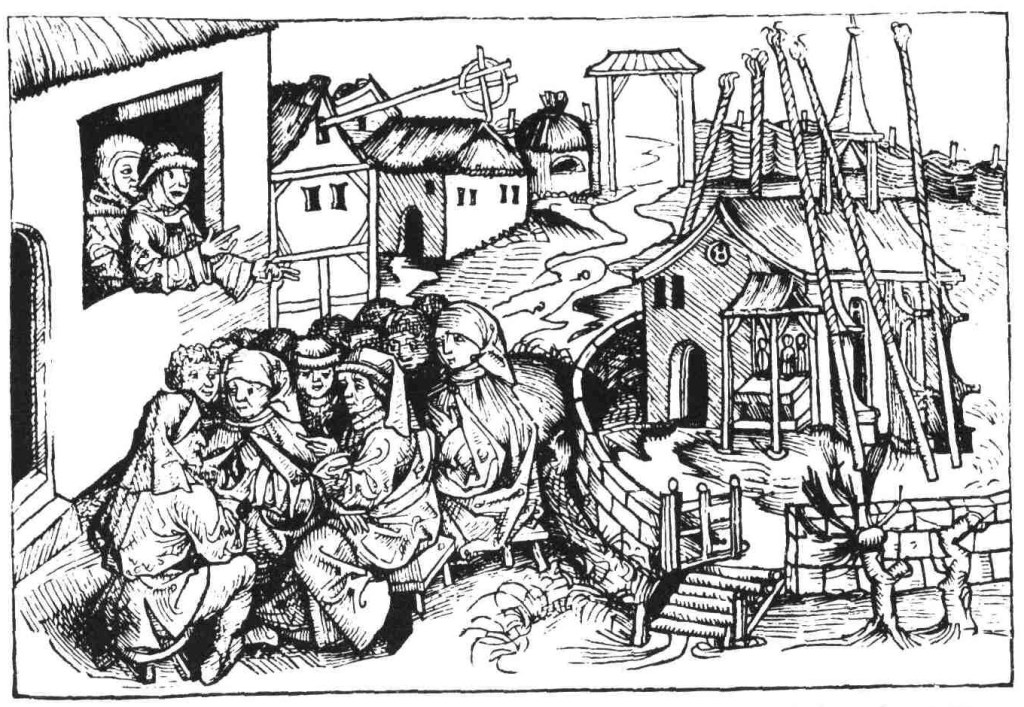
A young German herdsman draws crowds while preaching about the evils of the nobility and the clergy and a new world where goods and land are shared. In hindsight, he is offering the elites of the Holy Roman Empire a warning about the near future, but will they listen?
Sources:
The German Peasants’ War: A History in Documents, eds. Tom Scott and Bob Scribner (Humanities Press International, Inc., 1991).
Peters, Margaret E. “Government Finance and Imposition of Serfdom After the Black Death.” European Review of Economic History 27.2 (2023): 149-173.
Roper, Lyndal. Summer of Fire and Blood: The German Peasants’ War (Basic Books, 2025).
Wazer, Caroline. “Medieval Peasants Only Worked 150 Days Due to ‘Frequent, Mandatory’ Holidays?” Snopes.com (August 31, 2024). Last accessed: 3/28/2026.
Wunderli, Richard. Peasant Fires: The Drummer of Niklashausen (Indiana University Press, 1992).
Transcript
Support this project: turningmodern.com/support
In the spring of 1476, peasants from all around southern and central Germany began to converge at the village of Niklashausen in a valley just outside Bavaria. Pilgrimages by groups of peasants to sacred sites weren’t unusual, but there was nothing of note at or near Niklashausen, just a small shrine to the Virgin Mary.
What was especially odd was that some of the peasants left abruptly, sometimes leaving their tools behind in the fields. They were also singing songs. These weren’t well-known hymns or folk songs either, these were new. And if any of the reports were to be believed, the songs alone were proof that this was not a normal pilgrimage. In fact, there was very good reason for the clergy to be alarmed.
They were joyfully singing about killing priests.
This is Turning Modern.
First, a couple of housekeeping notes. The next episode is going to be the last one I’m going to post to the Medici Podcast channel, so if you’re enjoying the new show, please subscribe to Turning Modern on whichever podcast platform you prefer.
And second, I just want to thank my friend Andy Stelling for giving me the idea for this episode.
Finally, if you like the show and want to support it, go to turningmodern.com for ways you can help me keep the lights on or tell a history lover in your life about us.
So with that, let’s get started.
Somewhere online you might have stumbled across a meme claiming that peasants only worked 150 days a year because there were so many church holidays. At least in England, it may actually be more or less true based on the records. But it’s not because of holidays, just the fact that an average of 150 days was possibly all peasants wanted and needed to work. Even then, it’s likely that at least some peasants might have still been working the medieval equivalent of gig jobs on their so-called days off. At the very least, though, it is safe to say that peasants had more control over their time than your typical retail or office worker.
Still, I don’t think most people today would trade their life in for a peasant’s. Aside from the lack of toilets, you still had to work hard during the harvest and pay for the privilege of existence through not just taxes but fees and dues to your lord and tithes to the church. And no matter how much you gave to the authorities you were still one or two bad harvests away from starvation.
In the fourteenth century, though, things had gotten better because of the Black Death of all things. In the plague’s aftermath, so many people had died that peasants suddenly found that their labor was in high demand. For the first time within anyone’s living memory they had some choice in where to live and who to work for. Wages went up while the prices of common goods and the cost of rents went down. There were attempts by those in power to try to turn the clock back to before the plague, which ignited a number of violent revolts like the Peasants’ Revolt in England, the Jacquerie revolts in France, and the Ciompi Rebellion in Florence, which was perhaps the first proletarian revolt in history. Check out Episode 9 of the Medici Podcast for a description of that. Some laws restricting peasants’ newfound freedom did get put into place in different areas, but for the most part in western Europe serfdom ended up being one of the casualties of the Black Death. Yet in parts of central Europe and much of eastern Europe, the opposite eventually happened with serfdom either becoming more entrenched or even made stricter than it was before. The economic historian Margaret Peters argues that the stark difference was because western Europe was much more urbanized than much of eastern Europe. This meant that monarchs in eastern Europe had to depend much more on landowning magnates for both tax money and soldiers for their armies, so to keep them happy the serfs had to be kept down. I think another reason, but a related one, was that eastern Europe was facing more existential threats right at their doorstep than western Europe. For Poland, Hungary, and their Christian neighbors, it was the Ottoman Empire, while the Russian principalities were still threatened by the vestiges of the Mongol Empire.
In the case of the west, since governments had more of a tax base in the cities, kings and queens there could sit back and watch serfdom collapse and have the satisfaction of knowing that all of those annoying nobles with their own private fortresses and armies were losing their captive workforce. But none of this means that peasants had an easy time in Germany or the Holy Roman Empire if you want to refer to the polity that encompassed modern-day Germany. While serfdom did die out in most of Germany, peasants still had to live with numerous fees, restrictions, and injustices, and by the late fifteenth century, it was getting worse. Europe’s population had not only recovered by then, it was beginning to reach heights not seen since the heyday of the Roman Empire. This meant jobs and opportunities to relocate to a better area or to a town were drying up, rents were going up again, and inflation was kicking in. The landlords took advantage of this by trying to reintroduce some of the old feudal obligations and dues. Peasants weren’t forced back into being serfs, but they did find themselves having to provide more services and pay additional dues to their lords.
Laws and customs varied from region to region, even village to village, but some things that peasants had to deal with come up over and over again in the documents we have. There were forests, streams, and lakes that peasants couldn’t fish or hunt in because they exclusively belonged to the lord. They couldn’t even gather wood from such places. If a deer was eating their crops or a fox was threatening their livestock, they would be punished if they killed the animal on the lord’s land. There’s even one case on the record where peasants complained about having to keep the lord’s hunting dogs, even though the dogs kept killing their chickens. A woman had to pay a fee if she married a peasant who lived on another lord’s land, the reasoning being that she had to compensate the lord for depriving him of her children’s future labor. There was even a fee that had to be paid by the family when a peasant died. On top of the usual dues and tithes, peasants had to give up a share of every harvest to the lord. There were certain days – the number varied wildly from place to place – when peasants were obliged to do services for their lord, such as repairing buildings or weaving hemp or building dams, and that was even if such dams caused their own land to get flooded. On these days they could also be ordered to transport food and supplies. In those cases, they had to provide their own horses or oxen. They also often had to provide their own food and drink while doing whatever chores for the lord. If you’re thinking, “I wouldn’t put up with any of that”, I bet at least some of you had to work a job where you had to pay for a permit to park your car at your own place of work or pay for your own uniform or you prepared food but had to pay full price if you wanted to eat any of the food you’d been making.
To be fair, though, not everyone put up with it. That finally brings us to the protagonist of our story today, Hans Behem or Bohm, depending on what spelling in the records you go with. A young man in his late teens or early twenties, he lived in the countryside near the village of Niklashausen and worked herding either sheep or cows. One source claims he herded pigs, but given how hostile said source is, it was probably just a flourish to make Hans look even more disreputable. He would come from the fields to Nilkashausen wearing a drum around his neck and carrying a flute to perform folk songs. One day, though, Hans returned to Niklashausen claiming that at night he had a vision where the Virgin Mary spoke to him. At her urging he gave up his worldly goods by burning his drum and flute in a ‘bonfire of the vanities.’ We don’t really know what Hans believed she said, but we can make an educated guess based on later records: God was angry at the world because the princes and nobles and priests had been exploiting the people for too long and a new world was coming where everything would be shared in common between the people.
This was a time when medieval veneration of the Virgin Mary hit its peak. In fact, one could argue that by this point she had become the unofficial fourth member of the Christian Trinity. The idea that Mary had been born free of sin became commonly accepted in the Church even if it wasn’t official dogma yet, and some even claimed that Mary didn’t truly die but was carried to Heaven. Unlike other Christian saints who were limited to specific roles, groups, or countries, the Virgin Mary was the intercessor between God and all of humanity. Still, though, from back in the time when she was just one prominent saint among many, she was still said to favor two particular groups most of all: shepherds and herd animals, because shepherds and their flocks were the first to witness and honor her and Jesus.
Hans preached to the astonished villagers that the Virgin Mary was calling on people to take a pilgrimage to the humble village shrine. The word spread, and thousands from around the region were convinced to come hear the strange young man that some were already calling the Holy Youth or the Prophet. On July 2, 1476, which happened to be the Feast of the Visitation of Mary, Hans preached to crowds between 10,000 to 30,000 people. Whatever the exact number, the crowds were so large that Hans had to speak from a window that overlooked the village square. Even then how he was able to preach to such a massive number of people is something of a mystery; perhaps there were people standing around further back who repeated his words. Among the people present were informants sent by Rudolph von Sherenberg, the prince-bishop of Wurzburg, whose jurisdiction encompassed the countryside where Hans lived. The secular lords were not yet panicking; in fact, Count Johann III of Wertheim, whose own jurisdiction was over Niklashausen itself, was pleased to have so many peasants coming to spend money on his road tolls and buying food and supplies from his merchants. Bishop Rudolph was frightened, though, and he planned to use the reports written by his informants as proof of what he already suspected was heresy.
Although a document survives based on the informants’ reports, it doesn’t record what the sermon said. Instead it’s mostly a series of heretical claims listed from the sermon written in the third person, so Hans’ own actual words are all but lost. Still, scraps survive here and there. He is reported to have said, “Ach we, ir armen tubel”, which means “Oh dear, you poor stubborn fools”, with “poor” likely having the same double meaning of pitiful and impoverished as in modern English. Our only other possible direct quotation is “The priests say that I am a heretic and they will burn me. If they knew what a heretic was then they would know that they are heretics and I am not. As they burn me, so they burn you.”
Hans’ one sermon gave Bishop Rudolph more than enough ammunition. Hans claimed or at least allegedly claimed that the Virgin had given him special powers, including the power to save souls from Hell. He called for all forests and bodies of water to be held in common with no one allowed to claim them as their exclusive property. He claimed the Virgin Mary demanded that the nobles stop collecting payments from the people. He said there was no such thing as Purgatory. He accused the emperor of being an evil man who let the nobles of Germany exploit the people and the Pope of having no real interest in reforming the Church. Most damning of all, he called for priests to be killed. Hans’ followers even had a catchy little ditty:
“Oh God in Heaven, on you we call, Kyrie Eleison, Help us seize our priests and kill them all, Kyrie Eleison.”
A fair question to ask is, why do they want to kill the priests but not the nobles? Shouldn’t they have more reason to hate the nobles than the priests? Well, to understand their mindset you have to remember that there’s a contradiction that’s haunted Christianity since it became the state religion of the Roman Empire in the fourth century. In the Gospels, Jesus is pretty explicit about the topic of wealth. Matthew 19:24 reads, “Again I tell you, it is easier for a camel to go through the eye of a needle than for someone who is rich to enter the kingdom of God.” Three of the four gospels share versions of the same quote where Jesus tells people or specifically a rich young man to sell their possessions and give the money to the poor. Besides that, people at the time knew very well it was a little odd that a religion that started with a group of men sharing everything in common and wandering around the Levant in poverty ended up with leaders living in palaces and dining on the finest meals. Officially the Church would address the dissonance with verses like Genesis 3:19, “By the sweat of your brow you will eat your food”. For them such verses proof that the hard work of peasants was atonement for the sins of humanity. In the later Middle Ages, as societies in western Europe became more urban and richer, the issue of whether or not Christians or at least the clergy were called upon to forsake wealth became a major and more pressing controversy, with new religious movements forming in order to imitate the holy poverty practiced by Jesus and the Apostles. The debate even caused the Franciscan order to split between those who wanted to return to the humble ideals of their founder Saint Francis and those who argued it was necessary for Franciscan monasteries to support themselves by owning land and having tenants. Defenders of the status quo would claim that the biblical verses cited by their opponents were not meant to be taken literally while the verses that backed their own position were clear-cut. Or they would say that the point being expressed in the Gospels is that Jesus will redeem even the rich; it’s the sins of those other people – you know the ones, them – that are really the problem. The more things change, the more they stay the same indeed.
The issue was especially galling for German peasants. Centuries ago Germany had been the fault line between Christianity and paganism. So bishops had been granted land, castles, and even vassals to support their missionary efforts and protect themselves. Later on, the emperors found it expedient to grant more land and special political powers to clergy and monasteries, so they could lighten the administrative burden. They were a more attractive alternative to lay persons because besides being educated, clergy were also celibate, meaning they wouldn’t start some pesky dynasty that would gain more land through marriages and inheritances and eventually pose a threat to the emperor’s power. Soon enough, these bishops and abbeys were controlling practically independent states within the empire. Called prince-bishops, prince-archbishops, and princely abbeys because they were literally both clergy and secular lord, the elite clergy of the Holy Roman Empire had more political power right in their hands than any European clergy outside Italy. Three prince-archbishops – those of Cologne, Mainz, and Trier – were even formally involved in the election of new emperors. Of course not all clergy were worldly and corrupt, but people did not easily forget when these princely clergy flaunted their wealth and abused and exploited the peasants on their estates. Hans was said to have even explicitly called out one notorious practice common in the Holy Roman Empire, where a high-ranking member of the clergy would claim various church offices in order to access the incomes funding those offices, but they would never set foot in those dioceses, much less give sermons or talk with the parish priests there.
While we don’t know Hans’ own words, we do have an eyewitness testimony in the form of a letter written on July 21 1476 letter written by a priest to his superiors. The priest’s name is unknown; we just know that he was at the nearby town of Eichstatt:
I tell you the truth that people were hurrying to Niklashausen as if they were frantic and fleeing from an attacking enemy during a war. They said simply that no one could stop them, and that they were compelled to hurry along. Wives left their husbands, children quit their homes, and farmers abandoned their fields. Frequently as many as eight thousand people came to Niklashausen during one day, sometimes ten or fifteen or even sixteen thousand. Among the great multitudes, one could find always ten boys for every adult male. Thus, the Youth, that is, the aforesaid peasant began to preach, asserting that his authority was from God, and that he was able to lead souls from hell. He spoke openly against the pope and the authority of the church, not fearing excommunication, and he even said with impunity that the priests ought to be killed. The hearts of the laity rejoiced at such words, and they even joked about it. I can describe to you the articles that were prepared by certain notaries public all tend toward the same thing: that all the goods of the entire world ought to be held in common and divided equally among all, and that all authority of superiors is worthless. From these ideas the pilgrims composed a song which they sang when returning to their homes carrying their banners before them: o God in Heaven, on you we call Help us seize our priests and kill them all. And so forth. Thus, they entered Eichstatt, marching through the middle of the streets in troops; then entering the church, they sang their pernicious song in loud voices. This all began so suddenly, and the lord bishop [of Eichstatt] was not here, but in the town of Herriden. I had encouraged the vicar and the preacher of the cathedral to resist and oppose such evil behavior-one of whom answered in an impious manner that he would do nothing, so ignorant were they of the justice of God. At these words, of course, I was aggravated, but remained silent, and only with difficulty stopped myself from reproaching them. One day, however, about a hundred or more pilgrims entered the cathedral singing their hateful song. They even circled the high altar while singing and calling upon God to help them kill all priests. I then entered the church, snatched up a staff, and drove them all from the church. They all fled, with the exception of one of them, who was stretched out on the ground near the church door. No one resisted me except a cook from this city of Eichstatt, who had joined them and invited them to eat at his place. He made an effort to incite them to defend themselves against me, but he could not persuade anybody, and he himself was driven from the church. Needless to say, a report of what took place immediately circulated, not only throughout the city, but also throughout the entire diocese, that I was in such a rage-as if possessed by a demon-that I was able only to be restrained with fetters, and then only with great difficulty by fourteen men.”
The report drawn up by Bishop Rudolph’s informants was circulated to the princes of the Holy Roman Empire and it was enough to convince most of them to enact laws against peasants leaving their territories to join the pilgrimage. There were stories circulating that Hans was performing miracles, such as restoring sight to a blind child and bringing a child who had drowned back to life. Bishop Rudolph’s officials drafted and circulated a memorandum debunking the specific miracles. At one point a representative of the Church had to assure the town council of Wurzburg: “This affair did not come from God, and if all the miraculous signs took place that people say took place in Niklashausen, then they would amount to more miraculous signs than had ever taken place under our God and all his saints. They were all vain inventions and false roguery.” It seems some people in power needed some assurance that Hans Behem was not an agent of God after all.
Aware that the wolves were circling, Hans urged his followers to arm themselves and leave their wives and children behind by July 13, which in that area was the feast day of Saint Margaret of Antioch, the patron saint of among other things peasants. Before that day, while Hans was asleep, 34 knights burst into the house he was staying in and abducted Hans. Hans and his followers were completely unprepared, so much so there was no resistence whatsoever. Hans was taken to the dungeons of Bishop Rudolph’s castle and would be tried for heresy.
With Hans gone, a miller stood apart from the crowd waving a sword and tried to claim that he too had visions of the Virgin Mary. But somewhat ironically it was a local nobleman, Conrad von Thulman, and his son who became the new leaders of the pilgrimage. They led the pilgrims to the gates of the bishop’s castle and cried up to the walls, “Return the Youth to us, return the holy and innocent man, or else we will destroy the fortress and the city.” The bishop’s marshal came out to speak with them, calmly pointing out that without canons or catapults they had no chance of taking the castle. That was enough to cause many of the pilgrims to walk away, though a sizable mob remained at the gates. The bishop ordered the castle’s canons be aimed over the crowd’s heads to try to scare them off. Unfortunately, the pilgrims assumed that the canons had been aimed directly at them and God had protected them. When they still refused to leave, now the canons were fired on the crowd, killing several people and wounding many more. The castle gates then opened and a retinue of knights rode out of the castle, rounding up some of the pilgrims and the Thulmans and chasing the others away. Hans’ pilgrimage was truly over, but the bishop had no way of knowing that Hans actually was a prophet in a way. His short life and career were a warning that within fifty years’ time Germany would be ground zero for an unstoppable religious schism that would remake Christianity for countless people and, after that, Germany would also be rocked by the Peasants’ War, the most violent outbreak of popular rage until the French Revolution.
The pilgrims held by the bishop were eventually freed with no further punishments. The Thulmans were forced to agree to become direct vassals of the prince-bishop. Hans was to die, however, along with two other men. One was a religious hermit who lived in a cave near Niklashausen whose name was not preserved. Possibly he had influenced and even encouraged Hans, but we know nothing of their exact relationship, if there even was one. The miller who claimed to share in Hans’ visions was to be executed as well. Hans was convicted of heresy, but, since trial records did not survive, we don’t know what the other two men were charged with. Possibly it was treason. Even though Hans was condemned, for a conviction of heresy Bishop Rudolph still needed a confession. To get it, Hans was tortured by the strappado, a common torture method. Hans’ hands were tied behind his back and attached to a rope thrown around a beam in the ceiling. Hans was pulled up with the rope, violently twisting his arms and dislocating his shoulders. No doubt physically and mentally broken, Hans confessed that he had lied about his visions and that he had been coached by an unnamed friar who had escaped. The friar’s identity or if he existed at all is a mystery. Most likely there was some confusion and the friar was actually the hermit already in custody. Even so, it was important for the authorities to blame the entire affair on a member of clergy gone rogue. It was unthinkable that an uneducated peasant could preach so persuasively and effectively.
As a heretic, Hans was to be burned at the stake, while the miller and the hermit were to be beheaded. Unfortunately, our only source for the execution is an account written years later by Abbott Johann Trithemius, who wrote about Hans with undisguised contempt. Nonetheless, the details of his account have a depressingly authentic feel. Hans was forced to watch as the hermit and the miller were beheaded. Either because he was genuinely ignorant of what was happening or because he was in a state of shock, he asked the official overseeing the execution, “Are you going to hurt me?” The official answered, “No, but someone has prepared a bath for you.” As the executioner tied Hans’ hands to the stake, Hans started singing a song about the Virgin Mary. He seems to have composed the song himself, but the lyrics, like so many of Hans’ words, are lost to time. A crowd watched all the proceedings but they stood back as far as they could. Some believed it was better to be cautious in case Hans was a prophet after all and there would be a deadly display of divine wrath, others thought Hans truly was a heretic and when he died the demons that possessed him would come roaring out to find a new host to possess. Hans kept singing as the flames were lit, but he stopped once the fire began to singe his flesh. He screamed three times before he died. Abbot Johann notes simply that “No miracles happened.”
 Turning Modern
Leave a comment