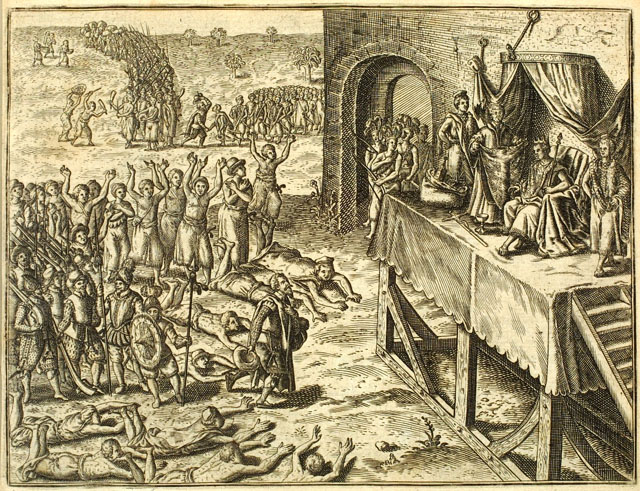
The Kingdom of Kongo establishes a rare partnership with an up-and-coming European power, Portugal, to the point that the King of Kongo and his family embrace Christianity and take Portuguese royal names. However, this partnership will also be ground zero for one of the greatest atrocities in human history.
Sources:
Almeida, Marcos Abreu Lelitão de. “Speaking of Slavery: Slaving Strategies and Moral Imaginations in the Lower Congo” (Doctoral dissertation, Northwestern University, September 2020).
Bosma, Ulbe. The World of Sugar: How the Sweet Stuff Transformed Our Politics, Health, and Environment over 2,000 Years (Harvard University Press, 2023).
Etherington, Norman. “Christian Missions in Africa”, The Wiley-Blackwell Companion to African Religions, ed. Elias Kifon Bongba (Wiley-Blackwell, 2012).
Garretson, Peter P. “A Note on Relations Between Ethiopia and the Kingdom of Aragon in the Fifteenth Century.” Rassegna di studi etiopici 37 (1993): 37-44.
Gondola, Ch. Didier. The History of Congo (Greenwood Press, 2002).
Hanno. “Gorilla Warfare.” Lapham’s Quarterly, Last accessed: 3/12/2026. https://www.laphamsquarterly.org/animals/gorilla-warfare
Klein, Herbert S. The Atlantic Slave Trade, 2nd edition (Cambridge University Press, 2012).
MacGaffey, Wyatt. “Economic and Social Dimensions of Kongo Slavery (Zaire)”, Slavery in Africa: Historical and Anthropological Perspectives, eds. Suzanne Miers and Igor Kopytoff (University of Wisconsin Press, 1977).
Russell-Wood, A.R. The Portuguese Empire, 1415-1808: A World on the Move (Johns Hopkins University Press, 1998).
Thornton, John. A Cultural History of the Atlantic World, 1250-1820 (Cambridge University Press, 2012).
___________. Afonso I, Mvemba a Nzinga, King of Kongo: His Life and Correspondence, trans. Luis Madureira (Hackett Publishing Co., 2023).
Support this project: turningmodern.com/contact
Transcript
As soon as his secretary finished scratching the letter he dictated out on parchment, the king waved him away, ignoring his protests that there were still other matters to address. The king was weary in both body and mind. The letter would be headed over the sea to his fellow monarch, the man he called brother. As much as he could within the smothering limits of diplomatic language, he pleaded for help. But by now he was under no illusions that his pleas would be answered with anything but sweet, empty words.
He groaned as he relaxed himself onto his couch, the pain in his back making itself known as he did so. He was so young when the pale men from beyond the great river first came, sweating and stinking under their heavy clothes and metal helmets and breastplates. Their priests, dressed in plain black, spoke to him of the Great Creator that both their peoples worshipped and how He had come to their lands dressed in human flesh, to suffer as men suffered, and the king believed. And he still believed, even as these people who called themselves “Christians” schemed with their merchants and forced his people to follow foreign priests who would not even deign to speak their language. These men of God mocked their people’s customs and a few even slept with the wives of great nobles. These self-described men of God had even known of a conspiracy to kill him and said nothing.
Then there were the rumors. A man of the royal family, distantly related but the king himself had been there to celebrate the birth of his first child, had disappeared, his wife saying he had been ambushed and taken to the sea. A village near the coast was found a smoldering ruin, its people nowhere to be seen. And people in the royal court were telling each other stories of a woman who fled from an island just over the sea, of people being worked to death just to grow a plant that was as sweet as honey.
All he could do was make himself forget, and pray that God would give his successors more wisdom than he had.
This is Turning Modern.
A forgotten milestone in the history of European colonialism, one that actually took place almost a decade before the voyages of Christopher Columbus, was the first contact between Europeans and the Kingdom of Kongo in Central Africa. Up to that point, West and Central Africa might as well have been across an ocean from Europe. On land, you had around one thousand miles of the Sahara Desert. By sea, a strong, one-way current in the Atlantic Ocean made it seemingly impossible to sail back north by a certain point, effectively preventing Europeans from safely sailing further south than the Moroccan coast and stopping West Africans from reaching North Africa and Europe. Europeans who tried to make the journey down the West African coast either had to make it home by land or were never heard from again. It was this all-powerful current that also reportedly doomed all but one of the 200 ships that, according to legend, the Mali Empire of West Africa sent to explore the Atlantic.
Yet there was one ancient account of someone from the Mediterranean who made the Atlantic voyage and lived to tell the tale, suggesting it was in fact possible. An account left by the Carthiginian explorer Hanno claims that he made it possibly as far as Mount Cameroon, although historians still argue over whether or not he actually made it that far south or if the account was entirely or partially fabricated. Still, at least the story of Hanno’s voyages gives us this one intriguing and rather violent passage that capped off what sounds like an otherwise peaceful adventure:
Sailing along by the fiery torrents for three days, we came to a bay called Horn of the South. In the recess of this bay there was an island with a lake in which there was another island, full of savage men.
There were women too, in even greater number. They had hairy bodies, and the interpreters called them gorillas [apparently a local term meaning hairy people]. When we pursued them we were unable to take any of the men—for they all escaped by climbing the steep places and defending themselves with stones—but we took three of the women, who bit and scratched their leaders and would not follow us. So we killed them and flayed them, and brought their skins to Carthage. For we did not voyage farther, provisions failing us.
Pliny the Elder claims that the skins were placed in the temple of the goddess Tanit but were lost when Carthage was burned down by Rome. Again, some classicists and historians are skeptical of the account, but if anyone knew how to make the perilous journey down the coast of West Africa and get back, it would have been a Carthaginian.
This all changed thanks to an accident. A Genoese merchant who was involved with the grain trade between northern Europe and the Mediterranean was blown off course to the Canary Islands, which had been forgotten since antiquity when they were known as the Isles of the Blessed. The merchant discovered that the islands were plentiful with orchil, a lichen used to make blue dye. Unfortunately for the people already living on the Canary Islands, this chance discovery almost immediately made the Canary Islands a hotspot for conquest and settlement. After decades of fierce resistance most of the natives were wiped out, and the age of European colonization made its bloody debut.
As more Europeans made the voyage to the Canary Islands, they began to learn more about the currents and countercurrents that ran around the islands and into the Atlantic, leading to the further discoveries of uninhabited islands further out in the Atlantic, Madeira and the Azores. By 1434 sailors worked out that if you went out to sea and then to the Atlantic islands at the right point, you could catch a current that would take you back to mainland Europe.
This discovery just so happened to almost coincide with an apocalyptic event that happened on the other side of Europe. In 1453, the Byzantine Empire, which had been on life support for at least a century, finally perished when its capital of Constantinople fell to the Ottoman Empire. This was not only a huge symbolic victory for the Ottomans, who could now claim that they had seized the mantle of the Roman Empire, but it also meant that they practically controlled the trade routes of spices and silk coming into Europe from Asia. But what if Europeans could reach Asia another way, by finding an uncharted route around Africa?
Adventurers like the Portuguese prince Henrique the Navigator dreamed of discovering either this new Asian trade route or the source of all the gold that for centuries had made its way from West Africa to the Mediterranean or even discovering the mysterious kingdom of Prester John, the legendary Christian king who could help finally turn the tide against the seemingly invincible Ottoman Empire.
Now because a lot of the men leading these voyages were the younger sons of the nobility, who stood to inherit no land and since joining the Church didn’t appeal to them, they instead decided to dedicate their life to fighting and looting. So the first thing the Portuguese tended to do when they came across coastal villages in lands no European had seen in over a thousand years if ever was raid them. They must have thought that these people don’t even wear real armor, so we might as well, right? Unfortunately, what the Africans did have were arrows dipped in extremely effective and fast-acting poisons. So many of the early clashes between the Portuguese and natives ended in death and disaster for the Portuguese, so much so the Portuguese monarchy made the wise policy decision of discouraging raids and sending official explorers and representatives to approach the natives peacefully.
Reading about this while doing research did make me wonder if the Aztecs weren’t caught so off-guard by Hernan Cortes and his crew and Cortes wasn’t nearly as lucky as he was, if the history of American-European relations might have gone very differently, but that’s a whole other story.
One of these explorers working on behalf of the crown was the mariner Diogo Cão. He was explicitly sent to find Prester John and iron out an anti-Muslim alliance with him. By this point it was widely believed that Prester John’s kingdom and Ethiopia were one in the same, but it was also thought that the African continent’s southernmost point was somewhere around Benin and that it would be possible to easily sail around Africa to Ethiopia. Cão must have thought he found a way to reach Ethiopia after all when instead he came across the Congo River, which would have been the largest and deepest river Cão and his men had ever seen. Instead of a convenient express waterway to Ethiopia, though, Cão found people who told him that they were in the territory of another large kingdom, Kongo.
In an example of what counted for benevolent diplomatic relations in those days, Cão accused the Kongolese of harming or detaining the scouts he sent ahead and kidnapped four high-ranking locals to send back to Portugal. But they were given the best possible treatment under the circumstances and returned to Kongo with tales of a far-off country where the people lived in strange but astonishing houses of stone.
Like Cão let’s get acquainted with the Kingdom of Kongo. Once its territory was comprised of three separate kingdoms, but through the usual series of conquests and marriage alliances they became consolidated into one entity by the fourteenth century. When he finally saw it, Cão compared the size of the kingdom’s capital Mbanza Congo to the Portuguese city of Evora. At the time, Kongo’s iron and steel and textile industries also rivaled anything in Europe. Kongo was certainly much less urbanized than much of Europe, but based on tax and baptism records, the historian John Thornton argues that Kongo and Portugal had similar rates of children surviving into adulthood and roughly the same levels of agricultural development.
As for how the Portuguese viewed the Kongolese, it does seem like their perceptions ranged from seeing the Kongolese as a noble people to whom poverty was unknown to strange barbarians who needed to be educated in the proper ways of civilization. But skin color wasn’t a factor, not yet. It would take an entire separate podcast to delve into how modern racism evolved, and it’s a topic we’re definitely going to be coming back to. But to give you an idea of how much skin color was not part of the equation, at around this time the king of the Spanish kingdom of Aragon was seriously considering a double marriage with the imperial family of Ethiopia, with his sister marrying the emperor and the heir to the Aragonese throne would marry a woman from the imperial family. The negotiations aren’t very well documented and they came to nothing in the end, but it still seems like any modern idea of race wasn’t an issue. Nor does it seem to have been a problem when Cao was warmly welcomed by the royal court at Mbanza Congo and managed to establish normal diplomatic relations between his lord King João of Portugal and King Nzinga Nkuwu. Soon enough, men from the Kongolese nobility were sent to Portugal to serve as ambassadors and cultural observers of a sort, and the King of Kongo agreed to allow Portuguese merchants and missionaries in his country. Back in Portugal there was soon a new fad for the lavish textiles and elaborately carved ivory statuettes of Kongo while the Kongolese requested that the King of Portugal send experts who could teach them two things: how to grow wheat and make bread, and how to build houses made of stone.
Of course, it helped that the king seemed eager to embrace the Christian faith, either out of genuine devotion or because the Portuguese were willing to help him put down a rebellious vassal. This is where our story gets a bit buried under lots of half-remembered oral traditions, distorted legends, religious propaganda, and scholarly speculation. It’s still hotly debated how much the Kongolese at the time of European contact understood Christianity and what exactly their conversion meant. It doesn’t help that the pre-colonial religion of Kongo isn’t well understood. We just know from early missionary reports that the Kongolese worshipped a large number of regional gods and ancestral spirits. Some missionaries were even dismayed to meet Kongolese people who didn’t believe in anything divine or supernatural at all.
It’s thought that there was a widely recognized supreme deity Nzambi Mpungu who was seen as the creator of the world and the god of the sky. This would have been easy enough to fit with the Christian God. There was also a widespread belief that many regions were protected by the powerful spirit of the first ancestor who lived in that region, an idea that missionaries thought they could relate to the Christian veneration of the saints. John Thornton suggests that it was likely many Kongolese sincerely accepted Christianity, but many still continued worshipping their gods and ancestral spirits. If so, it would have been similar to many other cases throughout history where Christianity was made to fit into a new culture it encountered.
In any case, Nzinga Nkuwu took on Christianity with gusto. Most of the royal family were baptized and given the names of the Portuguese royals, with the king himself becoming João, his wife taking the Portuguese queen’s name of Leonor, and their son adopting the name of João’s son and heir, Afonso. All of the high nobility of the kingdom were then ordered to undertake a mass baptism. Later in a letter written to the king of Portugal, Afonso would claim that around the outdoor spot where the baptisms were taking place they had to build high walls topped with thorny bushes to keep people from escaping, suggesting that maybe not everyone was on board.
Curiously, maybe not even the renamed king João of Kongo was that committed. In one of the many letters he wrote to the Portuguese kings, Afonso would later mention that his father renounced Christianity in the last years of his life, but he does not elaborate. Maybe he had second thoughts or the whole thing was just political theater after all. Even then, it doesn’t seem King João tried to slow down the flood of missionaries and priests into his country before his death in 1509. As soon as his father died, Afonso was warned by his mother and told to come to the capital immediately, giving him a strong position when his brother Mpanzu challenged his claim to the throne. John Thornton is skeptical of Afonso’s claim in his letters that Mpanzu had refused baptism and made himself the champion of the country’s religious traditionalists, thinking it was just a way for Afonso to get the Portuguese to support him in his eventually triumphant campaign against Mpanzu, who either died in battle or was executed on the battlefield. But it certainly wouldn’t be the first time in history the popularity of a brand new religion caused a civil war.
Afonso’s letters seem to reflect a sincere faith, declaring in one letter that “our former religion is all fantasy and empty air.” One story that still gets told in modern-day Congo is that he saw his mother wearing a pagan idol around her neck. He became so furious with holy anger that he ordered her to be buried alive. Given that Afonso’s mother paid out of her own pocket to support missionaries and to help construct a church and there’s no indication she passed away anywhere other than in her bed, the tale doesn’t pass under any scrutiny. Even so, maybe it has a crumb of truth, revealing that Afonso was a sincere and devout convert.
As I mentioned we have many of the letters he wrote to King João II of Portugal, then his cousin and successor Manuel I, and finally King João III. João II’s son, Afonso’s namesake, was killed when he fell and was dragged behind his horse. Despite Afonso’s zeal, the letters betray a growing disillusionment. But to really understand this disillusionment, we need just one more interlude to see how Congo’s fate was intertwined with a sweet but sinister substance that would be the cause of the destruction of millions of lives over the centuries: sugar.
I won’t go into the details of how sugarcane gets turned into sugar, except to say it’s a very torturous process. The crop requires a lot of land and water and refining it into sugar takes a great deal of backbreaking labor and wood to burn. On top of it all, sugarcane thrives only in climates that are hot year-round. When the cultivation of sugar cane spread from India to the Middle East, sugar plantations were established in Mesopotamia with work forces that in no small part used enslaved labor from around the Mediterranean and East Africa. However, after thousands of East African slaves launched an especially deadly revolt at sugar plantations on the Euphrates River in the ninth century, other sugar plantations started to avoid enslaved labor. When sugar became a major cash crop in medieval Egypt, for example, the farms there ran entirely on free labor. After the Crusades had the odd side effect of introducing sugar to Europe, the Republic of Venice opened up sugar plantations on the island of Cyprus and used some slaves, although soon enough they found that trying to grow a crop that causes a massive amount of deforestation as a matter of course and hogs a lot of land that could be used to grow, well, actual food on a relatively small island…it just wasn’t a sustainable long-term plan. Would-be sugar farmers in Sicily and southern Spain and Portugal ran into similar logistical problems, not the least of which was that the work wasn’t exactly appealing to free peasants and sharecroppers.
At first the island of São Tomé near the mouth of the Kongo River was just used by the Portuguese as a base to monitor and impose duties on the trade coming out of Kongo. But then somebody realized that the island’s tropical climate was ideal for growing sugar cane and wood and land would be plentiful. At first, they tried to get peasants from Portugal to work the farms there, but few were willing, and anyway none of them adapted well to the tropical heat and diseases. Well then, they probably thought, we’re already exporting slaves out of West Africa, so why not use them? They’re used to the heat, have an immunity to the diseases, and since it’s an island we won’t have to worry about escapees, so…
Of course, slavery had existed in Central Africa since time immemorial. But slavery wasn’t the same in every society, even within these regions in Africa. In Kongo and neighboring countries, slavery was, in the words of historian Wyatt McGaffey, more about social dependency than labor. Slaves were prisoners of war or given up as tribute. They would be given to a particular family and assimilated into the new culture they now found themselves in. While they were still considered to be of an inferior social rank, they could make their own money and work their own businesses and they even had a chance of one day becoming a leader of whatever family they were placed in. Slavery functioned as a way to place new blood in a dying lineage or to place fertile women and skilled workers in a newly established town or in underpopulated areas. It’s probably telling that one of the words and terms for slave in Kongo was also the word for “child.”
I don’t want to soften this. These people were still being violently stripped away from their homes and their own families and spouses and pressured to acclimate to an unfamiliar culture. And they could still be traded or sold by their new families. Also there was in some areas apparently a chance they might be sacrificed to commemorate the death of a great leader, so there’s that. But for those who for whatever reason want to insist slavery is basically the same everywhere, you need to honestly ask yourself if you’d rather be enslaved under the system I just described or have to spend every waking moment of your life toiling away in the tropical heat at the sugar cane fields.
Since trading slaves had already long been part of the Kongo economy, the Portuguese quickly became involved. At first African slaves were sent to Portugal as typical farm and household laborers. As sugar production took off in São Tomé and the newly discovered Caribbean and Brazil, though, the demand for slaves skyrocketed. As early as 1516, 2,000 slaves a year were coming out of Kongo. The trade grew so rapidly that King Manuel became concerned he wasn’t getting his cut and he tightened government control over Kongolese trade, establishing government outposts around the African coast. This only drove more of the slave traders and other merchants further south to modern-day Angola. It was a territory the kings of Kongo long claimed sovereignty over, but there were a number of kingdoms there, with one in particular growing strong and rich on the slave trade and beginning to challenge Kongolese authority.
I opened up this episode with a bit of artistic license. The truth is we don’t know if King Afonso fully understood what happened to the slaves who ended up in São Tomé, and at any rate Afonso clearly didn’t want to be muscled out of the profits from the slave trade either. Still, I think one can detect in the letters a genuine alarm at how far the trade was going and the devastation it was causing, with his people being abducted in slave raids and parents selling their own children to slavers out of desperation caused by poverty, poverty that the slave trade itself was helping to spread. In one letter, Afonso cries out, “Sire, this corruption and depravity has reached such a level that our homeland is becoming completely depopulated.” In another, oft-cited letter, Afonso pleaded, “Many of our countrymen capture and sell many of our free people to satisfy their immense greed for the goods that your subjects bring from your kingdom. They often abduct noblemen and their children as well as relatives of ours and sell them to the white men in our kingdoms. As soon as the white men buy these captives, they brand them with hot irons, and our guards find them when they are about to be shipped out. The white men claim they purchased them but cannot say from whom.” It finally got to a point where Afonso threatened to cut off all trade with Portugal. Whether he was dissuaded from this course of action or he reconsidered because he thought that Kongo had gotten too dependent on the trade from Portugal, Afonso stepped back from that particular precipice, but he did create a commission comprised of Kongolese officials and one member of the Portuguese merchant community to judge cases of illegal enslavement, all in order to combat the plague of kidnappings. It’s unknown if this attempt was at all successful.
Afonso had other reasons to feel embittered by the men from the north. According to his letters, Portuguese merchants were ignoring Kongolese laws and the priests sent from Portugal were hopelessly corrupt. In Afonso’s own words to the Portuguese king, “My lord and brother, the present time is more mean-spirited than times past, for the very same people who administer the body and blood of our Lord Jesus Christ are the ones who chase away the truth, and are enticed by the world, by greed, by the devil, and the temptations of the flesh. They forsake the promise they have made of their own free will to raise the host at the altar and preach the doctrine and teach the word of eternal life that is the word of our Lord Jesus Christ.” Afonso tried dealing with the problem by encouraging the ordainment of more homegrown priests, sending his own son Henrique to be educated and ordained as a priest in Rome by Pope Leo X himself. Afonso’s hope for Henrique was that he would become the first archbishop of a Kongolese church answerable only to the Pope himself. However, under Portuguese diplomatic pressure, the Pope just gave Henrique the title of Bishop of Utica, an ancient but totally empty church title since Utica happened to be in Tunisia, a Muslim country. Throughout Afonso’s reign, the souls of the Kongolese would stay in the hands of Portuguese priests and bishops.
While the king and his court were hearing Easter Mass in 1540, seven or eight Portuguese men fired their muskets at Afonso. Appropriately enough for the first fully Christian king of Kongo, Afonso was miraculously unscathed, although the shots still killed a bystander and wounded several courtiers. The reasons behind such a dramatic assassination attempt are unknown and it’s difficult to tease out the facts from the flurry of letters between Afonso, the King of Portugal, and various Portuguese notables in Congo denying involvement or accusing others over it. Most likely, the Portuguese were conspiring with some of Afonso’s various sons and grandsons who were scheming to be the next on the throne. If someone from Afonso’s own family did sign off on the assassination attempt, they were jumping the musket since just three years later, Afonso was dead at the age of 85.
The kings that followed Afonso would continue to take Portuguese names, even as the slave trade that the Portuguese stoked robbed the kingdom of its people and condemned them to Hell while sapping the kingdom’s own vitality. The reign of Afonso I would prove in hindsight to be the kingdom’s apogee. The Kingdom of Kongo would still survive, though, until 1914, when Kongo’s former benefactors the Portuguese had what was left of the kingdom merged with their colony of Angola with a stroke of a pen and unceremoniously deposed the last king, who to the very end bore the distinguished Portuguese royal name of Manuel III.
 Turning Modern
Leave a comment