A genius prodigy sets out to change the world by resolving all philosophical and religious disputes with one book, his own 900 Theses, and a debate in Rome between Europe’s brightest intellectual lights. And he will leave his mark on history, just not in the way he wants…
Sources Cited:
Hanegraaf, Wouter J. Esotericism and the Academy: Rejected Knowledge in Western Culture (Cambridge University Press, 2012).
Bradatan, Costica. Dying for Ideas: The Dangerous Lives of Philosophers (Bloomsbury Academic, 2015).
Kristeller, Paul Oskar. Eight Philosophers of the Italian Renaissance (Chatto & Windus, 1965).
Mirandola, Pico della. Syncretism in the West: Pico’s 900 Theses (1486), ed. and trans. S.A. Farmer, 2nd edition (Arizona State University, 2003).
____________. “Oration on the Dignity of Man”, trans. Cosma Rohilla Shaizi. Cosma’s Home Page, 21 November 1994. Last accessed 2/23/2025: .
Slattery, Luke. “A Renaissance Murder Mystery.” The New Yorker (20 July 2015).Last accessed 2/25/2025: .
Stethern, Paul. Death in Florence: The Medici, Savonarola, and the Battle for the Soul of a Renaissance City (Pegasus Books, 2015).
Transcript
In the winter of 1486, a wealthy 24-year-old man arrived in Rome. He brought with him most of his library of books and manuscripts, which encompassed the languages of Latin, Greek, Arabic, and Hebrew as well as thousands of years of history and accumulated knowledge. Also he had freshly printed copies of the book he wrote himself, with the title 900 Theses or, to use another possible English translation, 900 Conclusions. He had copies sent to universities across Italy, to some of the most well-known scholars and theologians of western Europe, and to the distinguished circle of academics in Florence sponsored by the powerful Medici family. The book included an announcement, inviting each recipient to come to Rome for a debate and promising to pay for any travel expenses himself.
The young man audaciously claimed that the 900 Theses contained every single controversial or unclear point ever raised by the great thinkers of the world since the days of the ancient Egyptians. Using these theses as the topic, he wanted, quite literally, the debate to end all debates. He truly believed that all religious conflicts and philosophical disagreements could be resolved right there in Rome with the result that the grand truth behind all doctrines would be revealed. The high hopes he had was symbolized in the date he chose for the first day of the debates: January 6, the feast of the Epiphany, when the three wise men or magi visited the infant Jesus. Such debates were standard exercises for universities and were even often held in public, but usually it was just one thesis being discussed. To debate 900 at once was completely unheard of.
Still, he was very certain that this debate would not just change minds, it was going to change the world.
This is Turning Modern.
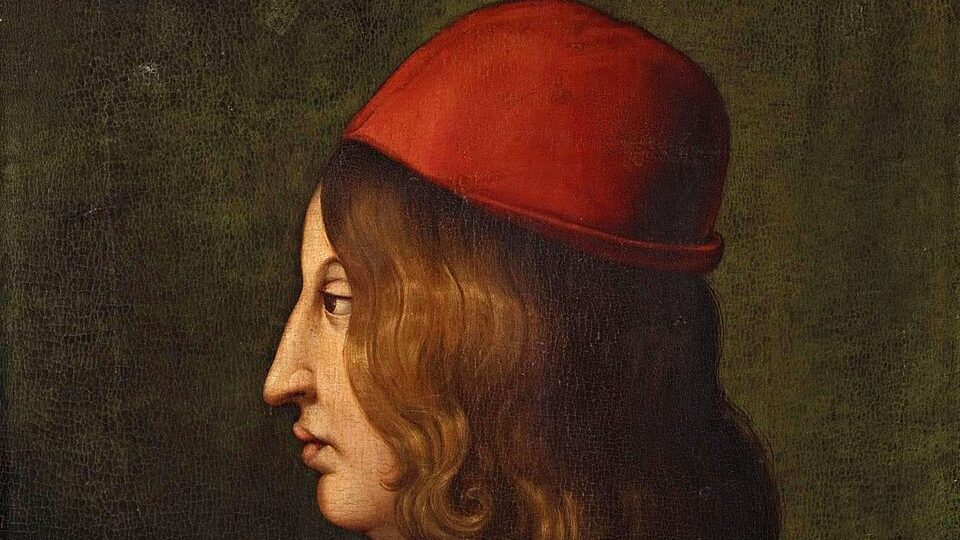
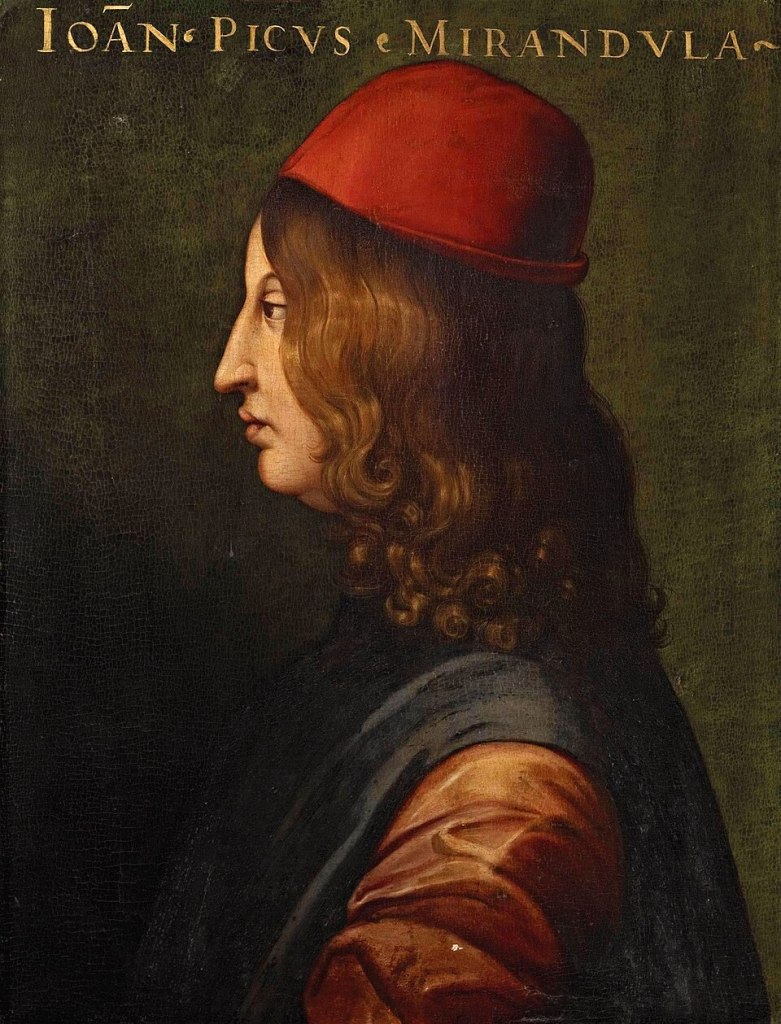
Giovanni Pico della Mirandola was a son of northern Italian nobility. His family ruled a small but independent fiefdom or technically two neighboring fiefdoms, the county of Concordia and the lordship of Mirandola. They weren’t among the power players of Italy, but they were quite rich as well as related by blood or marriage to the major dynastic houses of northern Italy, the Gonzagas of Mantua, the Sforzas of Milan, and the Estes of Ferrara. As the third son of Count Gianfrancesco Pico, Giovanni Pico’s career options were limited like any other younger son of the northern Italian aristocracy. Basically, he could choose between becoming a condottieri, a mercenary captain, or a bishop or cardinal in the Church. Probably noticing that Pico as a child was remarkably intelligent, his mother Giulia Boiardo already had him singled out for a career in the Church.
For reasons that aren’t completely clear, Mirandola seems to have decided to take a risky third option: to become a full-time intellectual and writer. He abandoned studying canon law at the University of Bologna, probably not coincidently not long after his mother died, and transferred to the University of Ferrara where he took up philosophy. Within a couple of years he would move again to continue his studies at the University of Padua, whose faculty were famous for their studies of the philosopher Aristotle. It wasn’t long before Pico became known for his precocious intellect, astonishing memory, and aptitude for languages. On top of being fluent in Latin and ancient Greek, Mirandola also learned Hebrew and Arabic. Later he would become famous as one of only a handful of scholars in all of Europe who could read Aramaic, the language of Jesus Christ, in the Syriac alphabet or Chaldean as it was commonly known at the time. Pico took up even more esoteric interests. Under the tutelage of the rabbi and philosopher Yohanan Alemanno, Mirandola learned about Kaballah, the school of Jewish mysticism. From Kaballah he took an overall interest in the occult and magic, believing that it was one avenue for understanding the divine, and the ancient Iranian religion of Zoroastrianism, which Westerners also associated with the esoteric and magic. After a trip to Florence, he became involved with the circle of intellectuals patroned by the banker and Florence’s unofficial leader, Lorenzo “the Magnificent” de’ Medici, taking on as a mentor Marsilio Ficino, who had translated the works of Plato into Latin and made them accessible to western Europe for the first time since antiquity.
For all that, Pico didn’t neglect his looks. He wore his brown hair long and dressed in the latest fashions, accenting his already handsome appearance. Nor did he forego a love life. The historian Paul Stethern suspects he might have been the lover of the poet and scholar Angelo Poliziano. If true, then Pico must have been in modern terms bisexual, because he also got involved in a love scandal that might have cut short his academic career. At some point Pico met and fell in love with Margherita, a woman from the city of Arezzo, then under the control of Florence. She had been forced by her family to marry a local tax official, Giuliano Mariotto de’ Medici, a distant relative of Lorenzo “the Magnificent” de’ Medici. She offered to wait for Pico just outside Arezzo. He arrived on horseback leading a group of twenty armed retainers and took Margherita with him. The city militia took off in pursuit and caught up with them, leading to a clash that cost fifteen lives on both sides. In the chaos, Pico, his secretary, and Margherita escaped into the nearby hills, but they were caught at the village of Marciano and arrested. Margherita was a willing participant who must have convinced Pico to rescue her from an odious marriage like one of the chivalric heroes of medieval romances. Nonetheless, Pico was charged with abduction. Laws in that rather less feminist time usually made no distinction between a woman eloping or just running off with a man and her being kidnapped. Lorenzo de’ Medici stepped in, sending Margherita back to her husband and having Pico freed from imprisonment. To try to mitigate the embarrassment to his family and to Pico in addition to the strained relationships with the leaders of Arezzo, Lorenzo put the word out that the whole fiasco was somehow the fault of Pico’s secretary. Throwing an underling under a bus is a timeless tradition.
Now under Lorenzo’s protection, Pico stayed in Florence where he lived under Lorenzo’s patronage and enjoyed the company of Marsilio Ficino and Lorenzo the Magnificent’s other star academics. It was there that Pico got his audacious idea. He would not only be the one to accomplish the Renaissance intellectual project to establish a synthesis between the works of Aristotle, which had been the core of medieval western Christian and Islamic thought, and the newly rediscovered philosophy of Plato; he would reconcile all schools of philosophy, religious divisions, and the occult. That was what he would accomplish with his scholarly masterpiece, the 900 Theses.
For a book destined to bring down the wrath of the papacy and create a controversy that Paul Stethern argues would alter the course of the Renaissance, the 900 Theses isn’t exactly a thrilling page-turner, unless maybe your idea of entertainment is sitting down with some medieval logic exercises. To give a tantalizing taste:
Thesis 7.39: The essence of each intelligence exists substantially in a state of relation.
Even books that were notorious and controversial in their own time aren’t always enticing reads. That’s a lesson I learned the hard way when I was nineteen and read the novel The Satanic Verses. I just naively and stupidly assumed a book with a title like that and that got the author threatened by the Ayatollah would be more riveting.
Anyway, regardless of The 900 Theses’ entertainment value, if you knew to look there was dynamite in those pages. Pico agreed with the kabbalists that Moses bestowed a secret knowledge upon humanity, passed down only by an elite and applied that and other kabbalah concepts to Christianity. Just the suggestion that a Jewish occult tradition could apply to Christianity would raise eyebrows. Likewise it was one thing for scholars to study and admire and debate over the writings of pagan, Jewish, and Islamic philosophers; it was quite another thing to suggest their ideas could be incorporated with those of superstar Christian theologians like John Scotus and Thomas Aquinas, which was what the 900 Theses did. And while Pico was careful to distinguish between the holy magic within the secret truths passed down from Moses and the evil arts of witchcraft and demon summoning, a thesis like “There is no science that assures us more of the divinity of Christ than magic and Cabala” was enough to make many orthodox Christians choke on their drink.
I can’t help but wonder if Pico were alive today he would be considered what we call neuroatypical. There’s just something about the way Pico thought all he had to do was gather together the best and brightest and after some weeks or months of debate they could just come up with proposals that the world would just calmly accept. It makes me think of the neuroatypical person who thinks they can just calmly explain to his aunt why the email she forwarded him about vaccines being laced with DNA-altering chemicals is wrong.
To be fair, Pico did anticipate a little pushback, so he wrote down a speech he would give at the commencement of the grand debate he planned, remembered by historians as the Oration on the Dignity of Man. In one portion, he admits the massive ambition of his project and the fact that he is only 24 years old.
Others do not disapprove this type of exercise, but resent the fact that at my age, a mere twenty-four years, I have dared to propose a disputation concerning the most subtle mysteries of Christian theology, the most debated points of philosophy and unfamiliar branches of learning; and that I have done so here, in this most renowned of cities, before a large assembly of very learned men, in the presence of the Apostolic Senate. Still others have ceded my right so to dispute, but have not conceded that I might dispute nine hundred theses, asserting that such a project is superfluous, over-ambitious and beyond my powers. I should have acceded to these objections willingly and immediately, if the philosophy which I profess had so counseled me.
The Oration also expressed bold ideas of its own. Pico imagines God telling Adam:
We have given you, O Adam, no visage proper to yourself, nor endowment properly your own, in order that whatever place, whatever form, whatever gifts you may, with premeditation, select, these same you may have and possess through your own judgement and decision. The nature of all other creatures is defined and restricted within laws which We have laid down; you, by contrast, impeded by no such restrictions, may, by your own free will, to whose custody We have assigned you, trace for yourself the lineaments of your own nature.
This is a bolder statement than it might seem at a glance. According to Pico, God created humans not for a designated role, but to become something of their own making. To quote the Romanian historian Costica Bradaton’s interpretation of Pico’s Oration, “The self is not something one is entrusted with at birth and then has to carry around as long as one lives, but an ongoing process.” Such an understanding of humanity had few precedents. The ancient Romans thought every person’s character and fate was fixed at birth, the mainstream medieval Christian view had more or less been that humanity was created in the image of God and each person was obliged to discover God’s predetermined purpose for them. The idea that humanity, even each individual, is free to fashion themselves however they choose would become a rallying call of Renaissance humanism and later Enlightenment thought, even modernity itself.
It was in that spirit of inquiry and self-discovery that Pico tried to start his debate. However, from the moment he sent out copies of his magnum opus, the Church had been keeping tabs on Pico’s every move. The reigning pope, Giovanni Battista Cybo, Pope Innocent VIII, already had a particular concern over a supposed epidemic of witchcraft in Germany and over the spread of the Waldensian heresy in southern France and northwestern Italy, so he was hardly sympathetic to Pico’s intellectual ambitions. Innocent denied permission for the debate to be held in Rome and had a committee evaluate Pico’s 900 Theses. At first, Pope Innocent denounced only thirteen of the 900 Theses, but later he denounced the whole lot as heretical and as, in the words of the papal bull condemning Pico’s work, “scandalous and offensive to pious ears.” Pico fired back with a book titled the Apologia defending his work from allegations of heresy. He had it published in the Kingdom of Naples, which was just far enough from the Pope’s reach, and dedicated it to Lorenzo “the Magnificent.” Finally realizing the danger he was in, though, Pico then tried fleeing to France, only to be arrested at the urging of the Church. Loyal as always to the scholars and artists under his patronage, Lorenzo intervened and convinced the then regent of France, Anne de Bourbon, to order Pico’s release, but Pico, the man who thought he could live up to his family’s title of Count of Concordia by bridging all divisions, was still branded a heretic. Worse, the Pope had ordered copies of the 900 Theses to be confiscated and burned, giving it the dubious distinction of being the first printed book banned by the Church. The order was successful; most copies of the 900 Theses were, in fact, destroyed.
The entire experience had to have been traumatic for Pico. After he was freed and returned to Florence, he turned to a man he had befriended during his university days, a devout friar named Savonarola. Pico convinced Lorenzo the Magnificent to invite Savonarola to Florence, a fateful decision for Florence whose consequences Lorenzo could not have even guessed at. At Savonarola’s urging, Pico recanted his interest in the occult, burned the secular poems he had written in the past, gave most of his inheritance to charity, and considered becoming a monk, although one report claims that at this time he was also living with a mistress. Pico did continue writing, although only topics Savonarola would approve of, like a book denouncing astrology. Even so, while such a book easily fit with Savonarola’s puritanical views, an anti-astrology stance also happened to validate Pico’s own radical concept of free will and self-determination.
In 1492, Lorenzo the Magnificent died, leaving the reins over the Republic of Florence to his inept and dumb jock-esque son Piero. Savonarola became a thorn in the side of the regime and was destined to play a massive role in Florence’s politics after Piero and the entire Medici family were driven out of Florence. Pico did not live to see that day, however. He died after a sudden and brief illness on November 17, 1494. He was only 31 years old. Savonarola delivered his funeral oration and would admit that he feared for Pico’s salvation, but he also claimed he had a vision where the spirit of Pico assured him that his soul resided in purgatory. And despite Pico’s status as a heretic, his death was mourned across Italy and lamented even in far-away England by fellow intellectual Thomas More.
Pico’s dear friend, possible ex-lover, and another supporter of Savonarola, Poliziano, died at around the same time and suffered similar symptoms. In 2007, their remains were exhumed and examined by scientists, who found traces of arsenic in both of their remains. It is possible that Pico had died from accidental exposure, especially because arsenic was an ingredient in medicines taken to treat syphilis. Given Pico’s love life, it was not outside the possibility that he suffered from the disease. Or quite possibly the arsenic levels were just because of contaminated samples from the remains. Still, there is a distinct possibility that Pico was murdered. The most likely suspect in that case would be Piero de’ Medici, who (rightfully, it turned out) considered Savonarola a threat and would want to take out two of his most trusted advisors. Barring some miraculous discovery in the archives, we’ll never know for sure.
Some historians today downplay Pico’s significance. Despite his radical efforts, they see him as less in line with modern notions of the individual and more in tune with the old tradition of medieval mysticism. I have to disagree. In his view of mankind as being defined by the need to fashion the self and in his attempt to find a single unifying theory that would unite different fields of knowledge, Pico refined the humanist impulse toward self-reflection and was even a harbinger of the Enlightenment belief in a universal order that can be glimpsed through reason. Perhaps the Pope too glimpsed something of the future in Pico’s writings, and that’s why his book had to burn.
 Turning Modern
Leave a comment