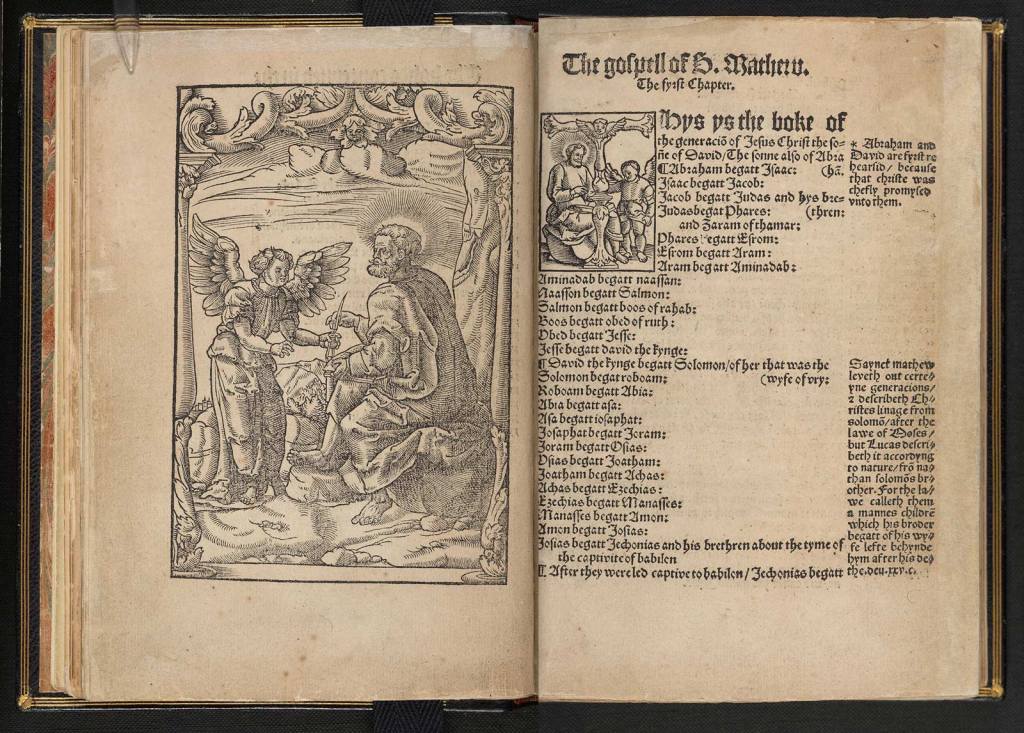
An Oxford grad and private tutor has a dream of making the first English Bible translated directly from Hebrew and Greek. Unfortunately, his ambition becomes a matter of life and death once his scholarly endeavors become just another front in the war to decide Europe’s religious future.
Sources
Daniell, David. The Bible in English: Its History and Influence (Yale University Press, 2003).
Foxe, John. Foxe’s Book of Martyrs: Selected Narratives, ed. John N. King (Oxford University Press, 2009).
___________. William Tyndale: A Biography (Yale University Press, 1994).
Moynahan, Brian. William Tyndale: If God Spare My Life (Abacus, 2002).
Transcript
The scholar from England prayed aloud as he was bound to the stake. The path of his destiny brought him from the halls of Oxford to London and finally to the old duchy of Burgundy, where his fate was discussed in the halls of power. Diplomats and ministers all either tried in vain to save him or signed off on his condemnation.
He had time to cry out to the watching crowd, “Lord, open the king of England’s eyes!” before his very breath was cut off. The executioner strangled him with a rope before his body was to be burned as punishment for heresy. This was the only mercy that God or humanity granted him. But still, he must have thought, at least it was preferable to the flames.
His body was burned, any bits of bone were smashed into powder, and the ashes were scattered, all to present anyone from claiming his remains as relics of martyrdom. It was too late though. Already his name had become a rallying cry, a watchword for resistance and defiance.
What crime or revolutionary act did this man do? He translated a book.
This is Turning Modern.
One of the annoying things about us historians is that you can ask us a simple question and the odds aren’t bad that we’ll just answer, “Well, it depends on what you mean.” Case in point: what was the first English translation of the Bible? Well, it depends on what you mean by “English” and by “the Bible.” If you count Old English and any of the Books of the Bible, then it would be the monk Bede’s translation of the Gospel of John in the eighth century. According to legend, a century later King Alfred himself translated parts of Exodus and the Book of Psalms. There were other Old English translations of other parts of the Bible, including all four Gospels. There were also Middle English translations, but of just parts of the Old and New Testaments.
Now if you mean the complete Bible in English, then that honor would go to the Bible translation made by John Wyclife in the fourteenth century. His translation was based on the version of the Bible used by the clergy of the Catholic Church for centuries, the Vulgate of St. Jerome, so named because it was written in the popularly spoken or vulgar version of the Latin.
It wasn’t so much that the Catholic Church totally rejected all other versions of the Bible. They authorized translations for missionary purposes, like the invention of the Cyrillic alphabet in the ninth century to allow passages of the Bible to be written for Slavic readers. While that particular project had the backing of the Pope himself, though, there was still some opposition among the clergy, anxious that the Bible could be transmitted in a new and unfamiliar form.
This fear grew more acute as Latin became a dead language – or more like an undead language that still shambled on as the language of the Church and diplomacy and scholarship, just not a language average people actually spoke – and vernacular languages becoming not just spoken but written as well. The thing is, the Catholic Church was right to be anxious over vernacular translations of the Bible. The first complete translation of the New Testament in a Western European vernacular language we know about was made in the twelfth century by the Waldensians, a heretical sect hounded by the Church. After all, translation is an art, not a science, and the act of interpretation itself can be inflammatory.
Still, the Catholic Church itself never technically banned translations of the Bible. Like the punishment and execution of heretics, that was left to states, what the Church referred to as the “secular arm.” In the High Middle Ages, as literature written in vernacular languages became more common and as the Church reached the height of its power, laws against unauthorized biblical translations spread. In England, the so-called heretical movement sparked by John Wycliffe, the very same Wycliffe who produced the first English Bible translation, became the object of persecution. Wycliffe’s desire to make the Bible more accessible went hand in hand with his criticisms of the Catholic Church, especially papal authority. At the end of the fourteenth century, King Henry IV came to the throne by overthrowing his cousin Richard, so to secure his reign he felt obliged to get the Church on his side. Persecutions and executions for heresy in England had been rare until in 1400 Henry IV got the Parliament of England to pass a law cracking down on heretics, namely John Wycliffe’s followers, called the Lollards. The text of the law reads, “It is a dangerous thing, as witnesseth blessed St Jerome to translate the text of the holy Scripture out of one tongue into another, for in the translation the same sense is not always easily kept… We therefore decree and ordain, that no man, hereafter, by his own authority translate any text of the Scripture into English or any other tongue, by way of a book, libel or treatise; and that no man can read any such book, libel or treatise, now lately set forth in the time of John Wycliffe, or since, or hereafter to be set forth, in part or in whole, privily or apertly, upon pain of greater excommunication.”
But even under the threat of being burned alive, the Lollards persisted, even if they did have to go underground. And it was perhaps inevitable, especially as the Middle English of John Wycliffe became increasingly incomprehensible to future generations, that someone else would take up the challenge of producing an English Bible. That man came from an unassuming gentry family in Gloucestershire in southwest England, William Tyndale. We don’t know much about his family and even the year of his birth, 1494, is just a guestimate. But his family must have been well-off as his brothers were a government official and a successful merchant based in London.
Tyndale doesn’t truly appear on the historical record until he became an undergraduate student at Oxford. He aspired to become a priest, but even at the university with England’s premier faculty of theology, according to his own writings Tyndale was quickly disillusioned at how the professors and his fellow students were much more interested in logical propositions derived from Aristotle’s philosophy than they were in the Bible itself. There were other reasons why Tyndale would have been disgruntled with the Catholic Church in general. He had to have known that the bishops of Worcester, who oversaw the pastoral care of Tyndale’s home community, were just absentee bishops. Three consecutive bishops of Worcester from 1512 on were Italians in Rome, who lived off the income that came from the office but never set foot on English soil, much less in their own diocese. Tyndale’s youth also coincided with the rise of the English church prelate Cardinal Wolsey, who essentially became the prime minister under the young King Henry VIII. Wolsey made so much money off the church and his worldly career he built a palace for himself more extravagant than any owned by the king. Later in life, Tyndale wrote scathingly about Wolsey, calling him “Wolfsee” and saying “this wily wolf, I say, and raging sea, and shipwreck of all England.”
After Tyndale finished his Bachelors degree and spent the required year after graduation as a lecturer at Oxford, Tyndale chose not to continue his graduate studies there. Instead, he went to Cambridge, which at the time had a reputation as what we might call today Oxford’s safety school. For Tyndale, though, while Oxford was a stronghold for stale orthodoxy, Cambridge had a reputation for Lollard sympathies lurking just under the surface.
It was an exciting but also frightening time for those like Tyndale who had serious doubts over the status quo. The Dutch humanist Erasmus, who had even taught at Cambridge for several years, published through the new printing press the first bilingual editions of the books of the New Testament, which had passages from St. Jerome’s Latin Vulgate alongside the original Greek the New Testament was written in along with detailed scholarly annotations. Then a rebellious monk named Martin Luther made a stir with his highly publicized dispute with the Catholic Church itself. By 1522, Luther and his sympathizers translated the entire canonical Bible, also with annotations, into German from the original Hebrew and Greek. Tyndale had his inspiration.
After completing his Masters at Cambridge, Tyndale took a job as a private tutor for a family of Welsh landowners back in Gloucestershire. His life was comfortable and he was well-liked, but the desire to become a preacher and possibly even more never left Tyndale. According to John Foxe’s Book of Martyrs, which is the only source for several details about Tyndale’s life, Tyndale cut his teeth on preaching at an open space in the nearby city of Bristol, a spot today called College Green.
Eventually Tyndale left for London with just some savings, a letter of recommendation from his former employers, and a hope that he would find a patron who would help him fulfill his dream of writing an English translation of the entire Bible. I don’t think I’m going out on a limb when I say that a fair number of intellectuals at least tend to be not very skillful at dealing with people or politics. Tyndale was one such scholar. His first major contact in London was the bishop of London himself. He genuinely hoped that the bishop would sponsor him and use his authority to suspend the heresy law to allow the translation to be published. The bishop politely but firmly refused. Tyndale turned instead to a group of merchants who sympathized with Luther. They raised enough money for Tyndale to support himself and leave for Germany, where he could solicit support from the Lutherans themselves and work without fear of persecution. Either right away or eventually he set himself up in the city of Hamburg, where he began work on what you could call the first real English bible, since it was the first one translated into English directly from the original Hebrew and Greek. While he likely learned Greek from Cambridge, we don’t actually know where he learned Hebrew, which was still a difficult language to learn outside Europe’s Jewish communities. What we do know for sure is that Tyndale also taught himself German just so he could use Martin Luther’s German Bible as a resource along with Erasmus’ New Testament. What Tyndale did not use as a source was Wycliffe’s English translation. Tyndale wanted his work to be wholly original.
Indeed it was. Perhaps only Shakespeare played a larger role in shaping modern English than Tyndale and his biblical translations. In fact, he created new words by combining existing ones and devised phrases still used today, so much so that some words and phrases are mistakenly attributed to him when they are older. It was Tyndale who combined two English words to come up with Passover as a name for the Jewish holiday of Pasech. In his bible Wycliffe had erroneously termed the holiday “Easter.” He did the same to invent the word “scapegoat.” His translation also gave us the phrases “eat, drink, and be merry,” “the powers that be”, “sign of the times”, and “it came to pass”, among others.
It was the originality of Tyndale’s translation that made it dangerous, so much so it vindicated the authorities’ concerns about new and unauthorized translations of scripture. The controversy was inflamed by Tyndale’s interpretations of two particular Greek words. He interpreted the Greek word ecclesia as “congregation” instead of “church.” This was a total rewriting of the verse Matthew 16:18, in which Jesus declared to the apostle Peter, “Upon this rock I will build my church.” The Catholic Church’s entire claim to special authority rested on this verse, since the Popes were held to be the successors of Peter. Take “church” out of the verse and arguably you take away the entire foundation stone for the papacy’s legitimacy.
The other word was presbuteros. Traditionally it was seen as a Greek word for “priest.” Tyndale instead rendered it in English as “senior” or “elder.” This one simple word choice was also explosive. The implication was that the presbuteros referred to in the Bible was not meant to be a special elite but simply an experienced leader of their congregation. Of course, Tyndale’s translations were not made in a vacuum. His choices were informed by the Lollard and Lutheran ideas he harbored most of his life. Even so, through translation, he was making these choices historically and theologically defensible, presenting them as not just a difference of scholarly opinion but a much more authentic understanding of the original text.
Tyndale started publishing his Bible as separate books, beginning with the New Testament in 1526 and then Genesis in 1530 with Tyndale also continuously producing revised editions. Like the Waldensian bibles, these were published in slim volumes that people could easily carry with them – and easily hide from hostile eyes if necessary. Of course, Tyndale couldn’t just have his volumes of the Bible printed in England. Instead, he went to the northern German city of Cologne, which had already become a major center for the burgeoning book industry. The city was ruled by an archbishop and any book published there needed his permission to be legally printed, but since it was a publication by a foreign author in a foreign language, it was not difficult to get around the law. Tyndale turned to other publishers, soon relocating to the city of Antwerp, He hoped to eventually provide a translation of the entire Bible, the first directly translated into English.
His books were contraband and copies were publicly burned, with authorities having to rather awkwardly explain that they weren’t burning true copies of the books of the Bible, just deliberate heretical mistranslations. Already in 1526 when Tyndale’s New Testament just started appearing in England the bishop of London, the same one Tyndale tried approaching, issued a proclamation banning copies of Tyndale’s translation, declaring, “Many children of iniquity, maintainers of Luther’s sect, blinded through extreme wickedness and wandering from the way of truth and the catholic faith, craftily have translated the New Testament into our English tongue, intermeddling therewith many heretical articles and erroneous opinions…”
Tyndale’s most ferocious enemy was Thomas More, who had taken the place of Cardinal Wolsey as King Henry VIII’s Lord Chancellor after Wolsey fell spectacularly from grace when he failed to secure papal support for the annulment of Henry’s marriage to his queen Catherine of Aragon over her not producing a male heir. More had a personal revulsion for Lollards and Lutherans, and he used his position to escalate persecutions and executions of heretics. He singled out Tyndale and his bibles, snarkily declaring that finding errors in Tyndale’s translations was like finding water in the sea.
However valid or biased More’s criticisms were, it wasn’t really Tyndale’s academic cred that was at issue. In his biography of Tyndale, Brian Moynahan explains the big deal this way: “The real horror of Tyndale’s Testament to the Church was not so much the words in themselves, however, but that they were English words. As heretical polemic moved out of Latin and into the vernacular, the whole of English society was open to the infection; and one book, passed from hand to hand, read out aloud by a literate to a company of illiterates, and spread by them in turn, could infect a multitude.” One conservative opponent of Tyndale put it this way, remarking on the impact Tyndale’s translations were already having: “Even silly little women want to pass judgment on the Bible as they might on their needle and thread.”
Henry VIII was no friend of the reformers. He wanted the annulment of his marriage to Catherine of Aragon and his marriage to his mistress Anne Boleyn to be recognized in and outside of England. And, into the bargain, he wanted to be the sole head of the Church of England and break away from papal authority, but he still had no tolerance for the theological claims of men like Tyndale or Luther. So More’s efforts to have Tyndale brought back to England or persecuted on the continent had the king’s full support. Then there was Emperor Charles V, whose realms included Germany and the Netherlands. Charles V also wanted to root out Lutheranism and his aunt happened to be Henry VIII’s ex Catherine of Aragon. But still as an English national Tyndale had support among some of Henry VIII’s officials and among the English merchant community in Brussels, Tyndale was a huge diplomatic snafu in the making for Charles V.
For the time being, though, Tyndale was safe. He hid out in the so-called English House in Antwerp, which city officials had given to the English merchant community. Essentially, the English House functioned as an embassy, and nobody wanted the legal and diplomatic headaches that would come from trying to force someone out. Unfortunately, for all his work with the Bible, Tyndale did not recognize a Judas when he saw one. This Judas went by the name of Henry Philipps. Like Tyndale himself, Henry Philipps was an Oxford graduate who came from a respectable and well-off family. His father was a landowner, a customs official, and a Member of Parliament prominent enough to have been invited to the wedding of Henry VIII and Anne Boleyn. Unlike Tyndale, for whatever reason Philipps’ life fell apart after he graduated. He lived off any scraps he could beg off or steal from his relatives and friends. Then, suddenly, he came into some money from an unknown source. He arrived at Brussels and enrolled in the University of Louvain, which was known to be a hotbed of reactionary Catholic sentiment. Philipps himself was a devout Catholic, hostile toward Luther and Henry VIII as well. One day, Philipps convinced Tyndale to leave the English House to go to dinner at a restaurant. While they were walking down a narrow ally, Tyndale was ambushed and taken into custody.
Obviously someone paid Henry Philipps, who disappears from the historical record after this point. But who? Brian Moynahan argues that it was likely Thomas More, but the evidence is circumstantial. If More was behind it, then ironically at almost the same time More himself was sitting in a jail cell, imprisoned for refusing to recognize King Henry VIII as the Head of the Church of England. He would be beheaded, becoming a martyr for Catholics just as Tyndale would become a martyr for Protestants.
For over a year, Tyndale was kept in prison at the castile of Vilvoorde not far outside of Brussels. Henry VIII’s new right-hand man, Thomas Cromwell, made some effort to secure Tyndale’s release, but complicating matters was that Tyndale was not only a heretic, but was also critical of Henry VIII’s marriage annulment and marriage to Anne Boleyn. Charles V and his officials also dithered, afraid that the ever unpredictable Henry VIII would end up siding with Charles’ archenemy King Francois of France. In the end, though, Tyndale would die.
Of course Tyndale himself would have probably preferred to live, but I suspect he would also be sorely disappointed to learn that he never got to finish the entire Bible and that the King James Bible would overtake his translation in fame. Still, a modern study found that the majority of words used in the King James Bible were still taken from Tyndale’s translations, with some major exceptions. For example, the King James Bible went back to translating ecclesia as “church”, since the new Church of England had its own legitimacy that had to be traced back to the Apostles of Jesus.
At the very least, though, I think a language nerd like Tyndale was would be delighted to learn that it’s impossible to avoid his fingerprints in the language English-speakers talk today.
Thank you for listening.

