In 1519, Europeans made their first diplomatic contact with an urbanized empire in the Americas—and, within a few years, that empire will no longer exist, in no small part because of a failed law student from Spain.
Sources
Cortés, Hernán. Letters from Mexico, trans. A.R. Pagden (Orion Books, 1971).
Florentine Codex, vol. 9, trans. Arthur J.O. Anderson and Charles E. Dibble, rev. ed. (School of American Research, 1973).
Gómara, Francisco López de. Cortés: The Life of the Conqueror by His Secretary, trans. Lesley Byrd Simpson (University of California Press, 1964),
Restall, Matthew. Seven Myths of the Spanish Conquest (Oxford University Press, 2003).
Townsend, Richard F. The Aztecs, rev. ed. (Thames & Hudson, 2000).
Transcript
Today the Basilica of Our Lady of Guadalupe watches over the Plaza of the Americas in Mexico City. Countless pilgrims come there to see the centerpiece, an image of the Virgin Mary, as it has done since 1531. Although a newer building was constructed next to the old church in 1976 and claimed the Virgin Mary’s holy icon for itself, the older basilica not only still stands but remains open to visitors. However, the entire church hides something of a secret. It was built at the site a temple sacred to the goddess Tonantzin, the “Honored Grandmother” who presided over fertility. This is far from the only case of Christianity placing a thin veneer over older religious practice, but it is perhaps more appropriate than most. More than a place for Catholics to prove their devotion to the mother of Jesus Christ, the Basilica of Our Lady of Guadalupe remains a patriotic symbol for Mexico.
The very name of the country of Mexico refers to the society that once worshipped Tonatzin, the Aztecs. The story of how the Aztecs’ empire ended was not a simple one of enemy armies swooping into their land. Instead it was the preposterous story of how circumstance and the decisions of one man, who was acting against the orders of his superiors the entire time, devastated an entire civilization.
This is Turning Modern.
Contrary to his reputation as a conqueror, Hernán Cortez was born a chronically ill child, who seemed destined to become a clerk or a member of the church. In truth, he was too unmanageable to be made into a decent student, although he did learn quite a bit about law from the years he spent working as a notary. Cortez came back home as arguably the sixteenth-century Spanish equivalent of a college dropout. Yet while he wasn’t going to become a secretary for some prominent nobleman or a magistrate working for the monarchy, Cortez still had ambitions that were inflamed by the stories coming about a sailor named Christopher Columbus and lands unknown to both the Bible and the ancients.
Using his family connections, Cortez seized on the first opportunity to go to the New World. Eventually he got a job as a notary and secretary for the governor of Cuba, Diego Velazquez. Cortez went far enough to secure his position in the new colony that he married Velazquez’s sister-in-law. However, being a man on the rise in a new colony was not enough for Cortez, although he may have also been motivated to leave Cuba because relations with Velasquez were starting to go south. In any case, Cortez worked hard to get appointed the commander of an expedition into Mexico, especially since he was interested in the rumors that there were vast hordes of gold and silver to be found there.
The risks were incalculable. Just two years ago, members of one Spanish expedition into the Yucatan ended with the expedition’s members getting massacred. However, the possible rewards were enough that Cortez easily found a crew of around one hundred men. Along with religious missionaries, their ranks included professional mercenaries, younger sons of noblemen shouldered out of their inheritance by older brothers, and less distinguished men who were simply desperate or greedy for wealth and land.
Velasquez signed off on the mission at first, but Cortez had gone too far. Velasquez attempted to recall the expedition, but Cortez shrugged off the order, even though it made him guilty of mutiny. Instead, Cortez used his knowledge of the law to start building a case that he was acting directly under the authority of the Holy Roman Emperor and King of Spain, Charles V, and not a mere colonial governor.
From this point on the true story is buried under layers of myth, legend, and outright propaganda. One persistent claim would have it that the natives that Cortez came across were overawed by the strange men from across the sea who seemed connected to blindingly fast beasts with four legs, so much so they thought the god Quetzalcoatl had returned to reclaim his kingdom. This is nonsense; the Aztecs could easily understand that the Spanish were simply a people they had never encountered before. Now it does seem to be true that the Aztecs were frightened by horses and were at a disadvantage because of the Aztecs’ steel armor and guns.
Cortez had help, though. The first was the greatest ally of Cortez and all would-be conquerors of the Americas from Europe, the disease of smallpox, which preyed on the American populations that had no natural defense against it. Some modern estimates hold that smallpox claimed as much as 90 percent of the indigenous population of the Americas. A possible eyewitness account of the outbreak of the plague from an Aztec perspective might have been preserved in the Florentine Codex, which was written by a Franciscan friar decades after Cortez arrived in the Americas but was drawing on the testimonies of indigenous converts to Christianity. It reads, “But before the Spaniards had risen against us, first there was prevalent a great sickness, a plague. […] No longer could they walk; they only lay in their abodes, in their beds. […] There was death from hunger; there was no one to take care of another; there was no one to attend to another.”
Fate also put essential allies on Cortez’s path. Cortez came across a friar named Geronimo de Aguilar. Stranded by a shipwreck, he was captured by some Mayans and escaped, but not before he learned the local Mayan language. Then a local Aztec leader gave Cortez twenty enslaved women. One of them as Malintzin, who became remembered with notoriety as La Malinche, who spoke both the Mayan Chontal language and the Aztec language of Nahuatl. With her help as a translator, Cortez was able to negotiate and strike deals with local leaders.
This made Cortez especially dangerous. The Aztecs’ authority was built on the obedience, grudging or otherwise, of regional chieftains. Some were only kept in line by the threat of force. This was probably why the emperor of the Aztecs, Moctezuma II, made the move he did. In a decision still debated by historians, Moctezuma didn’t send an army to crush Cortez and his band, but instead sent a formal delegation to invite them to come to the Aztec capital of Tenochtitlan. This was his way of containing the threat, especially as it was undeniable that the presence of the Spanish was already sending ripples through the Aztecs’ delicate system of alliances and vassals. His greed inflamed by the extravagant gifts offered by the delegates, Cortez agreed to go, leaving some of his men behind to guard the territory they occupied in modern-day Veracruz.
In his letters back to Spain, Cortez expressed astonishment over Tenochtitlan, a vast, well-populated city built over a lake, its streets and buildings interlaced with canals and connected with countless bridges. He writes, “The city is so big and so remarkable that, although is much I could say of it which I shall omit, the little I will say is, I think, almost unbelievable, for the city is much larger than Granada and very much stronger, with as good buildings and many more people than Granada had when it was taken.”
Less positive was their impression of the Aztec priests who staffed the temples. A memoir written by one of Cortez’s comrades, Bernal Diaz, says: “They wore black cloaks like cassocks and long gowns reaching to their feet. Some had hoods like those worn by canons, and others had smaller hoods like those of Dominicans, and they wore their hair very long, right down to their waist, and some had it even reaching down to the ankles. Their hair was covered with blood, and so matted together that it could not be separated, and their ears were cut to pieces by way of penance. They stank like sulfur and they had another bad smell like carrion.”
There’s no doubt this account was biased, but it does raise an issue worth addressing given the way people have been, let’s say, using history in recent years: the Aztec practice of human sacrifice. I don’t want to argue the point, so let me just have an interlude with a hypothetical of sorts. Let’s say there’s a parallel world where the Aztecs colonized Europe or at least they colonized Portugal and Spain. In other words, it’s a world where the Sunset Conquest took place; people who are fans of Crusader Kings will know what I’m talking about. In their version of the 21st century, the descendants of the Aztecs gave up human sacrifice centuries ago, and their political commentators and scholars are having their own debates over how the Aztec colonization of Europe should be viewed. Some still hold the traditionalist view that the Aztecs brought civilization to Iberia. After all, their descendants may have sacrificed humans to the gods, but these Spanish and Portuguese, they had crowds watch while people were burned alive just because they were accused of secretly worshipping their god the wrong way or they loved people of the same sex.
That’s just something to keep in perspective if one is tempted to think a society was better off experiencing a Hernán Cortez.
Anyway, let’s get back to Cortez himself, who is about to have his first meeting with Moctezuma. The first meeting is recounted in Cortez’s letters: “And they were all dressed alike except that Moctezuma wore sandals whereas the others went barefoot; and they held his arm on either side. When we met I dismounted and stepped forward to embrace him, but the two lords who were with him stopped me with their hands so that I should not touch him; and they likewise all performed the ceremony of kissing the earth.”
For two weeks Cortez through his interpreters negotiated with Moctezuma, trying to get him to acknowledge Charles V as his God-given sovereign. Matters came to a head when he heard reports of a violent clash between his men in Veracruz and some locals, which made him believe that Moctezuma was trying to cut Cortez off from the rest of his forces, or so he would later claim. Whatever the exact truth, Cortez tricked Moctezuma into giving him a private audience in his chambers, giving his men the opportunity to take Moctezuma hostage. After several tense days, Moctezuma gave in. He would allow Christian worship to take place in the Great Pyramid of Tenochtitlan and would acknowledge Charles V as his overlord. With a hint of genuine sympathy, Cortez’s secretary, Francisco Lopez da Gomara, described the speech Moctezuma gave to an assembly of the Aztec elite:
“You will please me by giving yourselves to this captain as vassals of the Emperor and King of Spain, our sovereign lord, to whom I have already submitted as his servant and friend. And I implore you to obey him henceforth, as you have obeyed me, and give and render him the tributes, taxes, and services that you have rendered me, for you cannot give me greater pleasure.” Moctezuma could say no more, because of his tears and sobs, and all the people wept so bitterly that for a good while they could not even answer him. They sighed and groaned so heavily that they even moved the hearts of our men; but in the end they said they would do as he commanded.”
Moments like this is why in some historical narratives Moctezuma is seen as a cowardly dupe, cowed and outmaneuvered at every turn by the Spanish. Rather, I think this was a deliberate move to get the Spanish to press their luck too far. He might have also been aware that Cortez had got disturbing news. Velasquez sent a small army to capture Cortez and bring him back to Cuba to be tried for insubordination and treason. Reluctantly, Cortez again split his forces, leading some of his men to confront Velasquez’s squad while leaving one of his lieutenants, Pedro de Alvarado, in charge in Tenochtitlan.
For reasons lost in the chaos – either Alvarado had been acting out of fear and hatred or he had been tricked by one of the Aztecs’ native enemies – he ordered a massacre of the Aztec people during a religious festival. The Florentine Codex, again likely using the words of an Aztec eyewitness, says, “And the blood of the brave warriors ran like water; it was as if it lay slippery. [. . .] And the Spaniards went everywhere as they searched in the. . . [buildings]. Everywhere they went making thrusts as they searched, in case someone had taken refuge.”
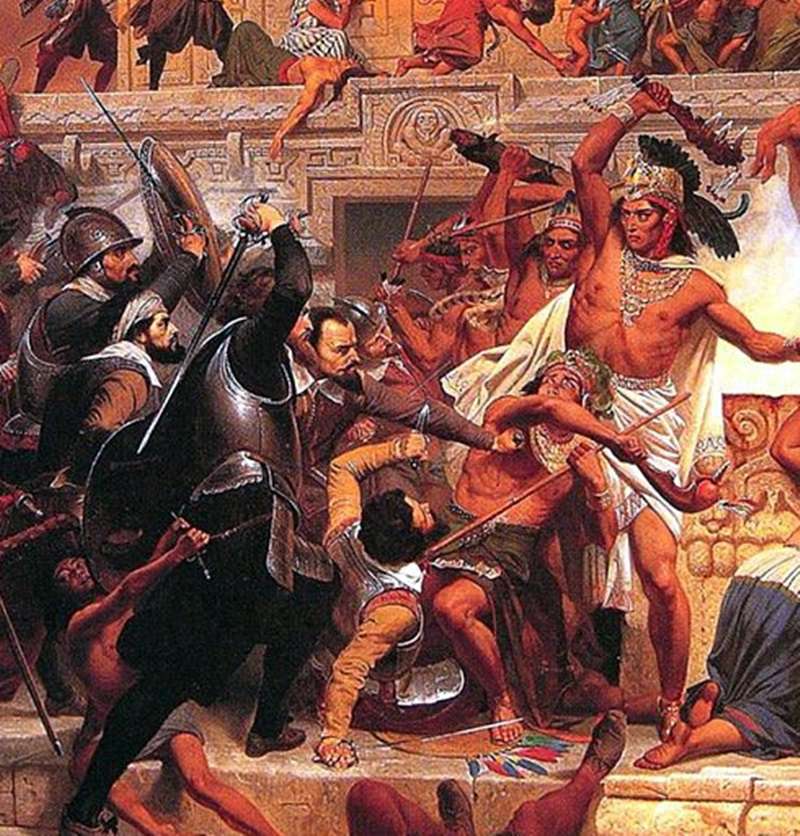
The manhandling of their monarch was bad enough; the massacre of most of the empire’s nobles in the middle of one of the holiest festivals on the calendar was too much. The inhabitants of Tenochtitlan came out in force, pelting any of the Spanish they saw with stones and darts. Cortez had beaten Velasquez’s squad, only to return to a city that had slipped into chaos. At his urging, Moctezuma stood above the mob on a palace parapet, wearing the turquoise crown, begging for calm from his people. His subjects responded with furious shouts and with stones, one of which dealt a fatal blow to his head. Falling back, Moctezuma’s Spanish jailers hurried him to his bed where he would linger in agony for three days. Cortez and his priests tried to convince him to convert to Christianity, but Moctezuma died a believer in the gods of his ancestors. In his imagining of Moctezuma’s final moments, the writer Arthur Miller, in his play The Golden Years, has Moctezuma turn on his deathbed to a remorseful Cortez who hopes to atone for his crimes by saving the emperor’s soul and quip, “Your god is bloodier than mine.”
Not long after Moctezuma breathed his last, the Spanish were driven out of Tenochtitlan by its people. This might have marked the moment when destiny finally turned against Cortez, but unfortunately, he was saved by his most precious ally, smallpox. The potential leaders of the empire who were not slain in Alvarado’s massacre, including Moctezuma’s brother and successor, were mostly killed by the plague. Soon enough, Tenochtitlan and the entire Aztec Empire would be claimed and remade by the Spanish.
Was all this inevitable? How much of a part did one man, a failed law student named Hernán Cortez, play in the downfall of not just an empire but a society? If you go by scholars who are of the persuasion that geography and environment shape history, it was indeed inevitable. Any meeting of the peoples of the Old World and the New would have ended in violence, which the Old World was geared by circumstance to win. I don’t agree. Not just because I find such understandings of history to be callous and simply wrong, but because I just don’t believe in inevitabilities in history. What if someone other than Cortez had made first contact with the Aztecs, leading not to conquest but to agreements, albeit rather unequal agreements, similar to those reached between the Congolese and the Portuguese? I could be wrong. Even before the discovery of the Americas, Charles V already had pretenses of becoming the world emperor worthy of biblical prophecy, and the brutality of the European colonization of the Canary Islands and the Caribbean had already set the tone for what was to come.
But that’s the thing about counterfactuals. You can never be completely sure; don’t trust anyone who says history ran a predictable course. After all, who can say we actually do live in the best of all possible worlds?
Thank you for listening.

