Tag: reformation

  • The Actual First Bible Translated into English (And The Man Who Died For It)

    The Actual First Bible Translated into English (And The Man Who Died For It)

    An Oxford grad and private tutor has a dream of making the first English Bible translated directly from Hebrew and Greek. Unfortunately, his ambition becomes a matter of life and death once his scholarly endeavors become just another front in the war to decide Europe’s religious future.

    Sources

    Daniell, David. The Bible in English: Its History and Influence (Yale University Press, 2003).

    Foxe, John. Foxe’s Book of Martyrs: Selected Narratives, ed. John N. King (Oxford University Press, 2009).

    ___________.  William Tyndale: A Biography (Yale University Press, 1994).

    Moynahan, Brian. William Tyndale: If God Spare My Life (Abacus, 2002).

    Transcript

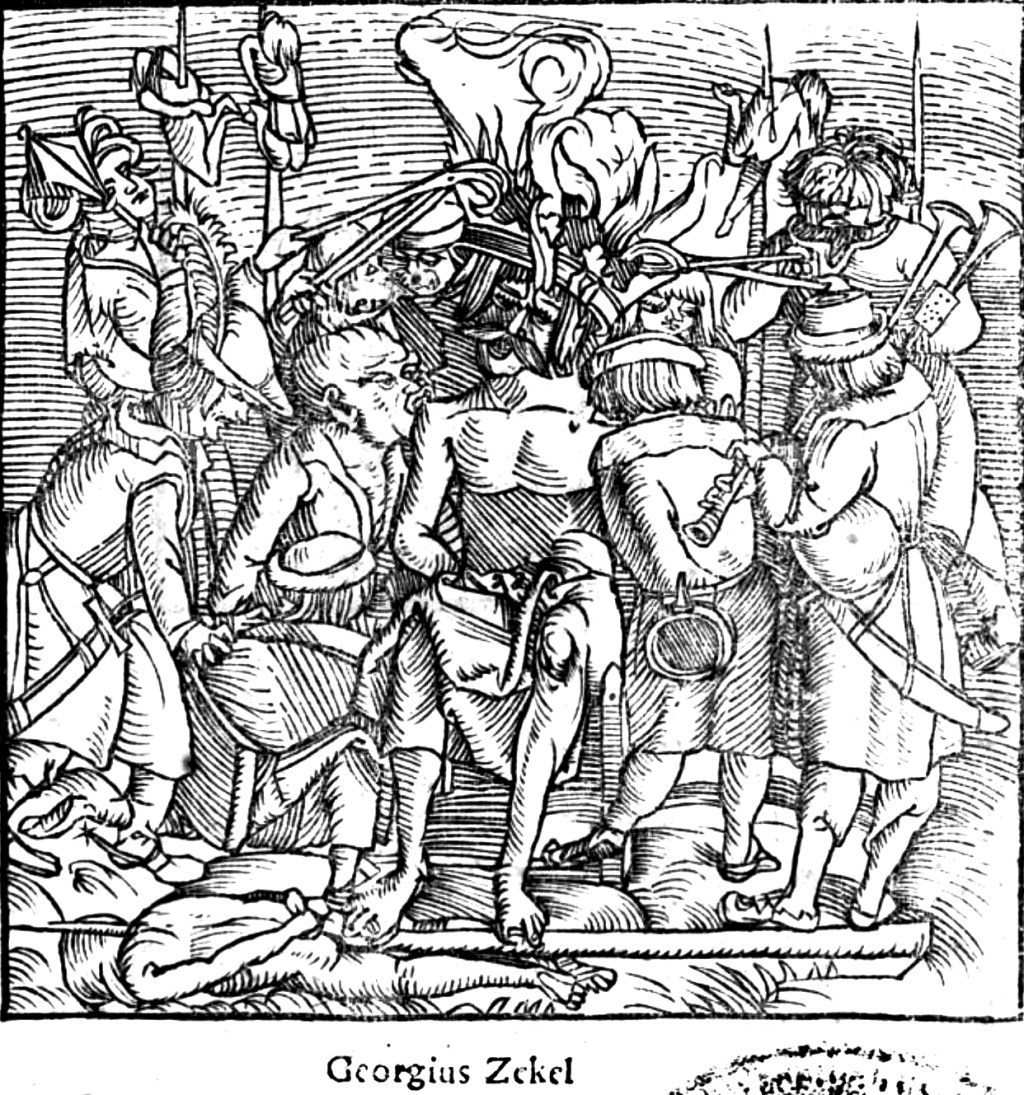
    The scholar from England prayed aloud as he was bound to the stake. The path of his destiny brought him from the halls of Oxford to London and finally to the old duchy of Burgundy, where his fate was discussed in the halls of power. Diplomats and ministers all either tried in vain to save him or signed off on his condemnation.  

    He had time to cry out to the watching crowd, “Lord, open the king of England’s eyes!” before his very breath was cut off. The executioner strangled him with a rope before his body was to be burned as punishment for heresy. This was the only mercy that God or humanity granted him. But still, he must have thought, at least it was preferable to the flames.

    His body was burned, any bits of bone were smashed into powder, and the ashes were scattered, all to present anyone from claiming his remains as relics of martyrdom. It was too late though. Already his name had become a rallying cry, a watchword for resistance and defiance.

    What crime or revolutionary act did this man do? He translated a book.

    This is Turning Modern.

    One of the annoying things about us historians is that you can ask us a simple question and the odds aren’t bad that we’ll just answer, “Well, it depends on what you mean.” Case in point: what was the first English translation of the Bible? Well, it depends on what you mean by “English” and by “the Bible.” If you count Old English and any of the Books of the Bible, then it would be the monk Bede’s translation of the Gospel of John in the eighth century. According to legend, a century later King Alfred himself translated parts of Exodus and the Book of Psalms. There were other Old English translations of other parts of the Bible, including all four Gospels. There were also Middle English translations, but of just parts of the Old and New Testaments.

    Now if you mean the complete Bible in English, then that honor would go to the Bible translation made by John Wyclife in the fourteenth century. His translation was based on the version of the Bible used by the clergy of the Catholic Church for centuries, the Vulgate of St. Jerome, so named because it was written in the popularly spoken or vulgar version of the Latin.

    It wasn’t so much that the Catholic Church totally rejected all other versions of the Bible. They authorized translations for missionary purposes, like the invention of the Cyrillic alphabet in the ninth century to allow passages of the Bible to be written for Slavic readers. While that particular project had the backing of the Pope himself, though, there was still some opposition among the clergy, anxious that the Bible could be transmitted in a new and unfamiliar form.

    This fear grew more acute as Latin became a dead language – or more like an undead language that still shambled on as the language of the Church and diplomacy and scholarship, just not a language average people actually spoke – and vernacular languages becoming not just spoken but written as well. The thing is, the Catholic Church was right to be anxious over vernacular translations of the Bible. The first complete translation of the New Testament in a Western European vernacular language we know about was made in the twelfth century by the Waldensians, a heretical sect hounded by the Church. After all, translation is an art, not a science, and the act of interpretation itself can be inflammatory.

    Still, the Catholic Church itself never technically banned translations of the Bible. Like the punishment and execution of heretics, that was left to states, what the Church referred to as the “secular arm.” In the High Middle Ages, as literature written in vernacular languages became more common and as the Church reached the height of its power, laws against unauthorized biblical translations spread. In England, the so-called heretical movement sparked by John Wycliffe, the very same Wycliffe who produced the first English Bible translation, became the object of persecution. Wycliffe’s desire to make the Bible more accessible went hand in hand with his criticisms of the Catholic Church, especially papal authority. At the end of the fourteenth century, King Henry IV came to the throne by overthrowing his cousin Richard, so to secure his reign he felt obliged to get the Church on his side. Persecutions and executions for heresy in England had been rare until in 1400 Henry IV got the Parliament of England to pass a law cracking down on heretics, namely John Wycliffe’s followers, called the Lollards. The text of the law reads, “It is a dangerous thing, as witnesseth blessed St Jerome to translate the text of the holy Scripture out of one tongue into another, for in the translation the same sense is not always easily kept… We therefore decree and ordain, that no man, hereafter, by his own authority translate any text of the Scripture into English or any other tongue, by way of a book, libel or treatise; and that no man can read any such book, libel or treatise, now lately set forth in the time of John Wycliffe, or since, or hereafter to be set forth, in part or in whole, privily or apertly, upon pain of greater excommunication.”

    But even under the threat of being burned alive, the Lollards persisted, even if they did have to go underground. And it was perhaps inevitable, especially as the Middle English of John Wycliffe became increasingly incomprehensible to future generations, that someone else would take up the challenge of producing an English Bible. That man came from an unassuming gentry family in Gloucestershire in southwest England, William Tyndale. We don’t know much about his family and even the year of his birth, 1494, is just a guestimate. But his family must have been well-off as his brothers were a government official and a successful merchant based in London.    

    Tyndale doesn’t truly appear on the historical record until he became an undergraduate student at Oxford. He aspired to become a priest, but even at the university with England’s premier faculty of theology, according to his own writings Tyndale was quickly disillusioned at how the professors and his fellow students were much more interested in logical propositions derived from Aristotle’s philosophy than they were in the Bible itself. There were other reasons why Tyndale would have been disgruntled with the Catholic Church in general. He had to have known that the bishops of Worcester, who oversaw the pastoral care of Tyndale’s home community, were just absentee bishops. Three consecutive bishops of Worcester from 1512 on were Italians in Rome, who lived off the income that came from the office but never set foot on English soil, much less in their own diocese. Tyndale’s youth also coincided with the rise of the English church prelate Cardinal Wolsey, who essentially became the prime minister under the young King Henry VIII. Wolsey made so much money off the church and his worldly career he built a palace for himself more extravagant than any owned by the king. Later in life, Tyndale wrote scathingly about Wolsey, calling him “Wolfsee” and saying “this wily wolf, I say, and raging sea, and shipwreck of all England.”

    After Tyndale finished his Bachelors degree and spent the required year after graduation as a lecturer at Oxford, Tyndale chose not to continue his graduate studies there. Instead, he went to Cambridge, which at the time had a reputation as what we might call today Oxford’s safety school. For Tyndale, though, while Oxford was a stronghold for stale orthodoxy, Cambridge had a reputation for Lollard sympathies lurking just under the surface.

    It was an exciting but also frightening time for those like Tyndale who had serious doubts over the status quo. The Dutch humanist Erasmus, who had even taught at Cambridge for several years, published through the new printing press the first bilingual editions of the books of the New Testament, which had passages from St. Jerome’s Latin Vulgate alongside the original Greek the New Testament was written in along with detailed scholarly annotations. Then a rebellious monk named Martin Luther made a stir with his highly publicized dispute with the Catholic Church itself. By 1522, Luther and his sympathizers translated the entire canonical Bible, also with annotations, into German from the original Hebrew and Greek. Tyndale had his inspiration.

    After completing his Masters at Cambridge, Tyndale took a job as a private tutor for a family of Welsh landowners back in Gloucestershire. His life was comfortable and he was well-liked, but the desire to become a preacher and possibly even more never left Tyndale. According to John Foxe’s Book of Martyrs, which is the only source for several details about Tyndale’s life, Tyndale cut his teeth on preaching at an open space in the nearby city of Bristol, a spot today called College Green.

    Eventually Tyndale left for London with just some savings, a letter of recommendation from his former employers, and a hope that he would find a patron who would help him fulfill his dream of writing an English translation of the entire Bible. I don’t think I’m going out on a limb when I say that a fair number of intellectuals at least tend to be not very skillful at dealing with people or politics. Tyndale was one such scholar. His first major contact in London was the bishop of London himself. He genuinely hoped that the bishop would sponsor him and use his authority to suspend the heresy law to allow the translation to be published. The bishop politely but firmly refused. Tyndale turned instead to a group of merchants who sympathized with Luther. They raised enough money for Tyndale to support himself and leave for Germany, where he could solicit support from the Lutherans themselves and work without fear of persecution. Either right away or eventually he set himself up in the city of Hamburg, where he began work on what you could call the first real English bible, since it was the first one translated into English directly from the original Hebrew and Greek. While he likely learned Greek from Cambridge, we don’t actually know where he learned Hebrew, which was still a difficult language to learn outside Europe’s Jewish communities. What we do know for sure is that Tyndale also taught himself German just so he could use Martin Luther’s German Bible as a resource along with Erasmus’ New Testament. What Tyndale did not use as a source was Wycliffe’s English translation. Tyndale wanted his work to be wholly original.

    Indeed it was. Perhaps only Shakespeare played a larger role in shaping modern English than Tyndale and his biblical translations. In fact, he created new words by combining existing ones and devised phrases still used today, so much so that some words and phrases are mistakenly attributed to him when they are older. It was Tyndale who combined two English words to come up with Passover as a name for the Jewish holiday of Pasech. In his bible Wycliffe had erroneously termed the holiday “Easter.”  He did the same to invent the word “scapegoat.” His translation also gave us the phrases “eat, drink, and be merry,” “the powers that be”, “sign of the times”, and “it came to pass”, among others.

    It was the originality of Tyndale’s translation that made it dangerous, so much so it vindicated the authorities’ concerns about new and unauthorized translations of scripture. The controversy was inflamed by Tyndale’s interpretations of two particular Greek words. He interpreted the Greek word ecclesia as “congregation” instead of “church.” This was a total rewriting of the verse Matthew 16:18, in which Jesus declared to the apostle Peter, “Upon this rock I will build my church.” The Catholic Church’s entire claim to special authority rested on this verse, since the Popes were held to be the successors of Peter. Take “church” out of the verse and arguably you take away the entire foundation stone for the papacy’s legitimacy.

    The other word was presbuteros. Traditionally it was seen as a Greek word for “priest.” Tyndale instead rendered it in English as “senior” or “elder.” This one simple word choice was also explosive. The implication was that the presbuteros referred to in the Bible was not meant to be a special elite but simply an experienced leader of their congregation. Of course, Tyndale’s translations were not made in a vacuum. His choices were informed by the Lollard and Lutheran ideas he harbored most of his life. Even so, through translation, he was making these choices historically and theologically defensible, presenting them as not just a difference of scholarly opinion but a much more authentic understanding of the original text.

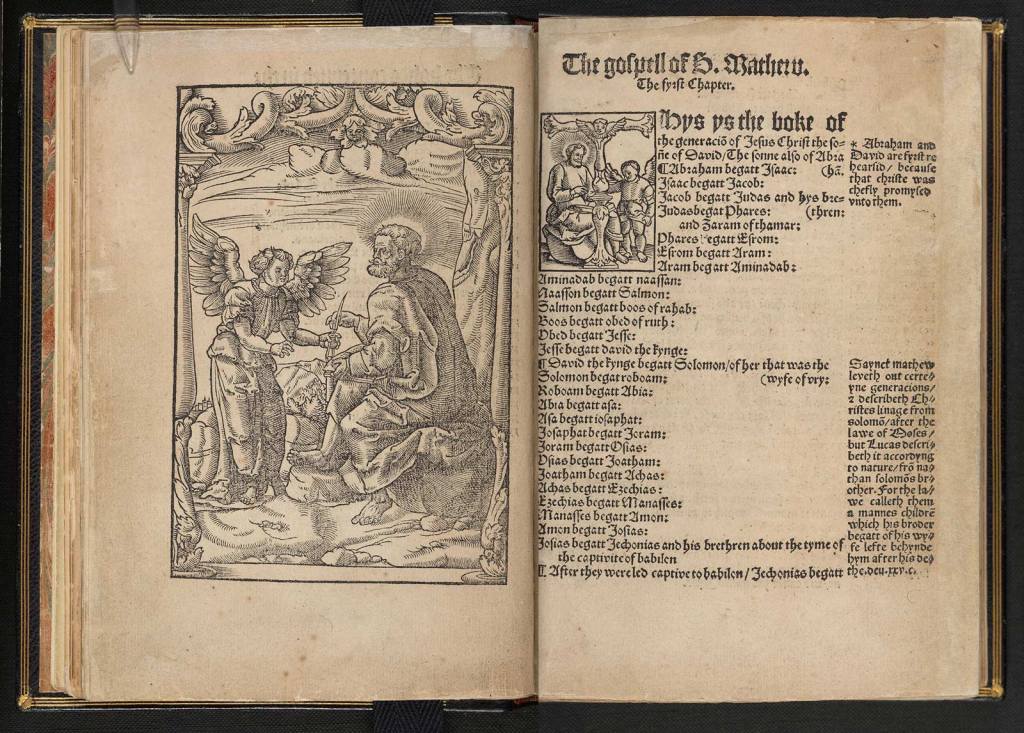
    Tyndale started publishing his Bible as separate books, beginning with the New Testament in 1526 and then Genesis in 1530 with Tyndale also continuously producing revised editions. Like the Waldensian bibles, these were published in slim volumes that people could easily carry with them – and easily hide from hostile eyes if necessary. Of course, Tyndale couldn’t just have his volumes of the Bible printed in England. Instead, he went to the northern German city of Cologne, which had already become a major center for the burgeoning book industry. The city was ruled by an archbishop and any book published there needed his permission to be legally printed, but since it was a publication by a foreign author in a foreign language, it was not difficult to get around the law. Tyndale turned to other publishers, soon relocating to the city of Antwerp, He hoped to eventually provide a translation of the entire Bible, the first directly translated into English.

    His books were contraband and copies were publicly burned, with authorities having to rather awkwardly explain that they weren’t burning true copies of the books of the Bible, just deliberate heretical mistranslation. Already in 1526 when Tyndale’s New Testament just started appearing in England the bishop of London, the same one Tyndale tried approaching, issued a proclamation banning copies of Tyndale’s translation, declaring, “Many children of iniquity, maintainers of Luther’s sect, blinded through extreme wickedness and wandering from the way of truth and the catholic faith, craftily have translated the New Testament into our English tongue, intermeddling therewith many heretical articles and erroneous opinions …”

    Tyndale’s most ferocious enemy was Thomas More, who had taken the place of Cardinal Wolsey as King Henry VIII’s Lord Chancellor after Wolsey fell spectacularly from grace when he failed to secure papal support for the annulment of Henry’s marriage to his queen Catherine of Aragon over her not producing a male heir. More had a personal revulsion for Lollards and Lutherans, and he used his position to escalate persecutions and executions of heretics. He singled out Tyndale and his bibles, snarkily declaring that finding errors in Tyndale’s translations was like finding water in the sea.

    However valid or biased More’s criticisms were, it wasn’t really Tyndale’s academic cred that was at issue. In his biography of Tyndale, Brian Moynahan explains the big deal this way: “The real horror of Tyndale’s Testament to the Church was not so much the words in themselves, however, but that they were English words. As heretical polemic moved out of Latin and into the vernacular, the whole of English society was open to the infection; and one book, passed from hand to hand, read out aloud by a literate to a company of illiterates, and spread by them in turn, could infect a multitude.” One conservative opponent of Tyndale put it this way, remarking on the impact Tyndale’s translations were already having: “Even silly little women want to pass judgment on the Bible as they might on their needle and thread.”

    Henry VIII was no friend of the reformers. He wanted the annulment of his marriage to Catherine of Aragon and his marriage to his mistress Anne Boleyn to be recognized in and outside of England. And, into the bargain, he wanted to be the sole head of the Church of England and break away from papal authority, but he still had no tolerance for the theological claims of men like Tyndale or Luther. So More’s efforts to have Tyndale brought back to England or persecuted on the continent had the king’s full support. Then there was Emperor Charles V, whose realms included Germany and the Netherlands. Charles V also wanted to root out Lutheranism and his aunt happened to be Henry VIII’s ex Catherine of Aragon. But still as an English national Tyndale had support among some of Henry VIII’s officials and among the English merchant community in Brussels, Tyndale was a huge diplomatic snafu in the making for Charles V.

    For the time being, though, Tyndale was safe. He hid out in the so-called English House in Antwerp, which city officials had given to the English merchant community. Essentially, the English House functioned as an embassy, and nobody wanted the legal and diplomatic headaches that would come from trying to force someone out. Unfortunately, for all his work with the Bible, Tyndale did not recognize a Judas when he saw one. This Judas went by the name of Henry Philipps. Like Tyndale himself, Henry Philipps was an Oxford graduate who came from a respectable and well-off family. His father was a landowner, a customs official, and a Member of Parliament prominent enough to have been invited to the wedding of Henry VIII and Anne Boleyn. Unlike Tyndale, for whatever reason Philipps’ life fell apart after he graduated. He lived off any scraps he could beg off or steal from his relatives and friends. Then, suddenly, he came into some money from an unknown source. He arrived at Brussels and enrolled in the University of Louvain, which was known to be a hotbed of reactionary Catholic sentiment. Philipps himself was a devout Catholic, hostile toward Luther and Henry VIII as well. One day, Philipps convinced Tyndale to leave the English House to go to dinner at a restaurant. While they were walking down a narrow ally, Tyndale was ambushed and taken into custody.

    Obviously someone paid Henry Philipps, who disappears from the historical record after this point. But who? Brian Moynahan argues that it was likely Thomas More, but the evidence is circumstantial. If More was behind it, then ironically at almost the same time More himself was sitting in a jail cell, imprisoned for refusing to recognize King Henry VIII as the Head of the Church of England. He would be beheaded, becoming a martyr for Catholics just as Tyndale would become a martyr for Protestants.

    For over a year, Tyndale was kept in prison at the castile of Vilvoorde not far outside of Brussels. Henry VIII’s new right-hand man, Thomas Cromwell, make some effort to secure Tyndale’s release, but complicating matters was that Tyndale was not only a heretic, but was also critical of Henry VIII’s marriage annulment and marriage to Anne Boleyn. Charles V and his officials also dithered, afraid that the ever unpredictable Henry VIII would end up siding with Charles’ archenemy King Francois of France. In the end, though, Tyndale would die.

    Of course Tyndale himself would have probably preferred to live, but I suspect he would also be sorely disappointed to learn that he never got to finish the entire Bible and that the King James Bible would overtake his translation in fame. Still, a modern study found that the majority of words used in the King James Bible were still taken from Tyndale’s translations, with some major exceptions. For example, the King James Bible went back to translating ecclesia as “church”, since the new Church of England had its own legitimacy that had to be traced back to the Apostles of Jesus.

    At the very least, though, I think a language nerd like Tyndale was would be delighted to learn that it’s impossible to avoid his fingerprints in the language English-speakers talk today.

  • Martin Luther on Trial

    Martin Luther on Trial

    Martin Luther braves persecution by the Church to come to the city of Worms to have his case heard by Emperor Charles V. In this contest between a reviled monk who is the son of a mine owner and a monarch whose empire spans an ocean, the victor is perhaps not the person one would normally expect…

    Sources

    Gregory, Brad S. The Unintended Reformation: How a Religious Revolution Secularized Society (Harvard University Press, 2012).

    Luther, Martin. Works: Letters I, vol. 48, ed. and trans. Gottfried G. Krodel (Fortress Press, 1963).

    Parker, Geoffrey. Emperor: A New Life of Charles V (Yale University Press, 2019).

    Roper, Lyndal. Martin Luther: Renegade and Prophet (Penguin Random House, 2016).

    Transcript

    On a spring day in 1521, a crowd of over 2,000 clogged the streets of the German city of Worms. Many of them were locals, but some had travelled from other towns and regions, just to catch a glimpse of the man who would be arriving.

    A wagon slowly weaved around the hordes of people. Suddenly, it stopped. The man who stepped out of it before the curious and admiring gazes of dozens of people was no king or general or bishop, but a monk and professor of theology whose father owned some copper mines. Even so, people across Europe from peasants to nobles now knew his name: Martin Luther. Once Luther had left the carriage, another monk emerged from the mob and embraced him like an old friend. He also touched his robes three times, like a petitioner hoping for a blessing from a saint.

    Someone who may have glimpsed Martin Luther’s arrival without knowing who he was or why he was there might have guessed that it was a joyous occasion. Instead, Luther was there to be judged before the most powerful man in Europe, Emperor Charles V. If Luther felt any genuine terror in that moment, no one knew but him. As far as his confidents knew, Luther would dive into the lion’s den without hesitation. In fact, he was even prepared to become a martyr.

    This is Turning Modern.

    According to Martin Luther himself, it was a thunderstorm that put him on the path to becoming one of the chief architects of the modern world. When he was a law student and traveling home to visit his family, he was caught in a severe summer thunderstorm near the village of Stotternheim. Likely because his father Hans owned several copper mines, Luther cried out to Saint Anna, the patron saint of miners, and swore that he would become a monk if he survived the storm. And that is exactly what Martin Luther did. In a sign of the defiance he would show throughout his life, he became a monk against the wishes of his stern father, who wanted him to become a lawyer who could represent their family’s interests. It should be said, though, that Martin did everything he could to avoid seeing his father for months after he went to a monastery. As Martin Luther’s modern biographer Lyndal Roper remarks, Luther’s “first step was the rebellion against his father.”

    While his decision to become a monk was likely also motivated by Luther’s lifelong struggles with depression and the recent death of a close friend, there really isn’t much of a reason to doubt Luther’s sincerity here, especially because that part of Germany was known for its violent thunderstorms in the summer. As he settled into the monastic life and rose through the ranks to become a professor of theology, Luther continued to be haunted by depression and the sense that he was awash with sin, much to the chagrin of his confessor, who had to endure Martin Luther’s hours-long, guilt-soaked confessions.

    Eventually Luther’s critical eye turned away from himself and toward the church, especially because of the practice of selling documents promising the remission of sins, called indulgences. Historians now tend to agree that Luther didn’t actually nail his famous Ninety-Five Theses criticizing the Church to the door of the cathedral in Wittenberg. Still, the Ninety-Five Theses were written with the purpose to start scholarly debates, and when they were disseminated through the newfangled technology of the printing press, they immediately provoked the ire of the Church. Luther himself seems to have genuinely had no idea how much controversy he was stirring up.

    Further writings published by Luther added fuel to the fire, both by giving his enemies in the Church ammunition and by making him famous across Germany. As we saw in the previous episode about Hans Behem and the peasant revolt that almost was, Germany had long been simmering with widespread resentment against the Church. For centuries the Church had clashed with Germany’s rulers, the Holy Roman Emperors. Also Germans were well aware that the tithes they paid to the Church more often than not went to funding the papacy’s construction projects in Rome or wars between the Papal States and their Italian rivals. The fact members of the upper ranks of the clergy and independent monasteries were also secular princes, more so in Germany than anywhere else in Europe, made the clergy a particularly unwelcome and burdensome presence in many Germans’ lives, from the members of city councils to the peasantry. One might say that it wasn’t so shocking that Martin Luther became such an overnight sensation, but that a Martin Luther didn’t come along sooner even without help from the printing press.

    In any case, Luther’s story might have turned out very differently if he didn’t have a powerful protector, one of the leading princes of Germany, Elector Frederick III of Saxony. When Pope Leo X excommunicated Luther and Luther kept publishing works critical of the Church, it was Frederick III who kept Luther from being packed off to Rome. Frederick arranged to have Luther’s case put before not the Pope, but the Holy Roman Emperor, Charles V. Charles V was the most powerful monarch the world had ever seen, at least on paper. Through lucky accidents of marriage and birth and political maneuvering, his family had gone from being upstarts on the brink of political extinction to one of the great powerplayers in Europe, claiming not just the office of Holy Roman Emperor but Austria, Naples, Sicily, the modern-day Netherlands and Belgium, Spain, and Spain’s colonies in South and Central America. Unfortunately, this meant Charles was stuck with the unenviable task of running a flimsy patchwork empire, comprised of peoples who all had their own languages, laws, and political institutions and traditions. Making it worse for him was the fact that Charles V was, in the words of Dirk Hoffman-Becking, host of the excellent History of the Germans podcast, “just an average man.”

    Even when the exact magnitude of what Luther would create was far from clear, the disgraced monk already posed a challenge to Charles V’s already overtaxed mind. The papal representative was already calling on Charles V to condemn Luther was a heretic, and alienating the papacy was dangerous since the Pope could side with Charles V’s most powerful rival, King Francois I of France. But on the other hand, the office of Holy Roman Emperor was an elective one, and to help ensure his own recent election Charles V had made a number of concessions to the German princes. One of these was promising that no subject of theirs would be put on trial before a foreign court, and that included the papal court in Rome. Besides that, Charles V was well-aware that Luther was already a celebrity in Germany. Having him killed risked a massive revolt, and since Charles V was already dealing with violent resistance in his dominions in Spain, he could ill-afford to fight rebellions on two separate fronts. Charles V’s advisors also saw in Luther a potential weapon that could be used to bring the Pope to heel, if need be.

    So, when Frederick III asked Charles V to allow Luther to be heard at a planned meeting of the German princes at Worms and to give him a safe conduct, Charles V agreed. It was a decision supported by most of his advisors, but the papal ambassador Girolamo Aleandro was, of course, outraged. During an argument with one of Charles V’s advisors, he prophetically warned, “You will soon see such a fire that all the water in your North Sea will not extinguish it.”

    When Luther heard that the emperor had granted him an opportunity to plead his case at Worms, he told his correspondents that he would not go if the emperor was just going to browbeat him into repenting. If ,on the other hand, he was going to be condemned and executed, he was willing to become a martyr. This was not a remote possibility. Everyone knew very well the case of Jan Hus, a Czech priest also accused of heresy by the Church and who was also promised a safe conduct so he could appear before the Holy Roman Emperor, only to be arrested and burned at the stake.

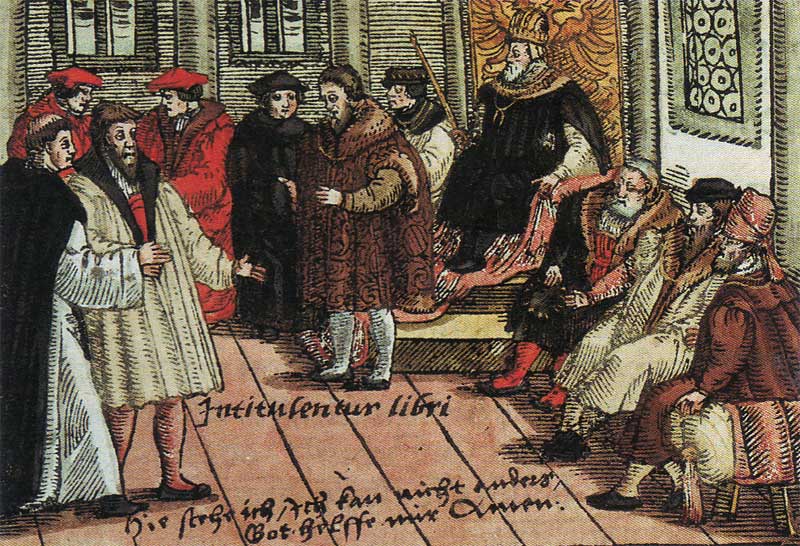
    Once Luther arrived for his hearing, he was brusquely told by the imperial marshal to answer as briefly as possible, an order that Luther would characteristically ignore. Then he was brought into a large, packed meeting hall. There were up to a thousand people present, not just foreign ambassadors, members of the clergy, German princes or their representatives, and members of the imperial family and court, but also locals from the city and average people who could afford to make the trip. Charles V himself sat on a raised dais, directly facing where Luther spoke. The theologian Johann Eck, who had been a friend of Martin Luther but in recent years had turned into one of his harshest critics, was there, representing the emperor. He pointed toward a pile of books on a bench, all written by Luther since the Church condemned the Ninety-Five Theses, and asked in Latin and then German if Luther had written these books. A theology professor who was acting as a defense attorney of sorts for Luther shouted that the titles of the books should be read for everyone assembled. With that, Eck read out the titles and a brief summary of each one. When he was done Luther cracked a joke: “You haven’t mentioned all my books!”

    Ignoring the jibe, Eck asked again in both Latin and German if he would admit to writing these books, and if he did write them, if he would recant of what they said. Observers remarked that Luther appeared anxious. He responded at first by swearing loyalty to the emperor. Then he admitted that he wrote the books, but as for the second question, he asked the emperor to grant him another day so he could consider his answer because “this is a question of faith and the salvation of souls, and because it concerns the divine Word, which we are all bound to reverence, for there is nothing greater in heaven or on earth.”  Charles withdrew from the court to consult with Eck and his advisors. Returning after some time, he granted Luther’s request.

    It was a delaying tactic. Luther had actually been informed beforehand what he would be asked. In fact, he was annoyed at the lack of a real debate. In one letter, Luther complained that he expected that an army of theologians would face him in a rhetorical battle. Instead, he was, in his own words, just asked, “Are these your books? Yes. Do you want to renounce them or not? No. Then go away!” Anxious and disgruntled as he was, at least Luther enjoyed accommodations near where the Diet was held that were worthy of a nobleman. In fact, it was the same building several distinguished knights were also staying in. Meanwhile the papal delegate Aleandro was stuck in a shabby, poorly heated room. It was a subtle but clear sign of where many people’s sympathies really laid.

    The next day, Luther was not called into the Diet until the late afternoon. When he arrived, he was brought to an even larger hall lit only by several torches and that was so crowded with spectators that even some of the German princes had to stand. Even then, he had to wait for two hours while delegates debated on the topic of administrative reforms. Finally, though, the audience got to see the main event. Luther was again asked if he wrote these books and if he recanted what he wrote. Speaking in Latin and then repeating himself in German, Luther began by apologizing to the emperor for being a man not used to the imperial court, but only life in a monastery. Then he moved on to his actual answer. He admitted he wrote the books, but he quickly added that the books were all written with different purposes in mind. Some he wrote just to explain God’s word in plain language, some to criticize what he saw as abuses in the Church and the papacy, and some he had written to argue against defenders of the papacy. He could not recant what he wrote in the first category of books since they were just reflecting biblical teachings, remarking “even my enemies themselves are compelled to admit that these are useful, harmless, and clearly worthy to be read by Christians.” As for his writings about papal tyranny, well, if he was compelled to recant of those writings, it would only vindicate his own criticisms of said papal tyranny. With his usual acidic wit, Luther added that he just did not want to “add strength” to allegations of papal tyranny, “especially if it should be reported that this evil deed had been done by me by virtue of the authority of your most serene majesty and of the whole Roman Empire”. When Luther declared that the “whole German Nation was vexed and oppressed in Rome”, Charles V, who had been silent up until now, became irritated and ordered Luther to move on.

    This time, Luther complied. As for the third kind of book, Luther could not repent of those either, because he hadn’t written anything in those that went against Scripture. Sure, he admitted that he might have been more vicious in his writing than was appropriate for a Christian, but, Luther added, “I do not set myself up as a saint.” If anyone there could prove that he had erred against the Word of God, Luther would be the first to throw his books into the flames. Otherwise, “he would not retract a single word he had written.” Then Luther addressed the emperor directly, pleading with him to allow his works to continue to be published.  

    It was now Eck’s turn to speak. He countered by saying “that everything that [Luther] admitted writing in his books. …was heresy that had long since been condemned by [church] councils” and ‘for that reason there was no point in discussing something that had already been discussed, declared to be evil, reproved and condemned by the Church, which had issued holy decrees and very good decisions on the matter:. Rather than just being defensible interpretations of Scripture, Luther’s writings instead claimed, according to Eck, that “we must believe that our predecessors for the past thousand years were heretics and were not saved; and it would be reckless and a great error to think that one man, with little authority, wanted to condemn so many good Christians.”  At this, Luther fired back with one of the most famous speeches in history: “Unless I am convinced by the testimony of the Scriptures or by clear reason (for I do not trust either in the Pope or in councils alone, since it is well known that they have often erred and contradicted themselves), I am bound by the Scriptures I have quoted and my conscience is captive to the Word of God. I cannot and will not retract anything, since it is neither safe nor right to go against conscience.” An account published by his supporters added these famous words that were not included in the original transcripts of the Diet of Worms: “I cannot do otherwise, here I stand, may God help me. Amen.’ Whatever Luther actually said in that moment, it caused the emperor to interrupt the proceedings again. Charles V had been raised in Burgundy with French as his main language and his German and Latin were both not up to par. Nonetheless, Charles V understood all he needed to. He stood up and declared, “That is enough: I do not wish to hear any more from someone who denied the authority of the councils!”

    Luther’s appeal to his conscience has often been seen as a pivotal moment in history, and rightfully so. Still, Lyndel Roper warns us that we shouldn’t interpret what Luther was talking about in a modern sense. Luther was not talking about a moral and strongly felt but still technically subjective stance, like what we might mean by “conscience.” He saw himself not as presenting a new interpretation of Christianity, but as fighting for the true understanding of the Christian Gospels.  This is what Roper means when she writes, “When Luther said his conscience was ‘captive to the Word of God’ he meant that it could not be moved or altered; he ‘knew’ with his whole being — mind and emotion — what God’s Word was, and could not deny it.” In his writings, Luther explicitly condemned the notion of an individual interpretation of Scripture. For him, there was only the truth of God’s Word and corruptions of it. I don’t doubt Luther would be horrified to learn about the present-day situation in my country of the United States, where even in a small-ish city you might find all within walking distance churches belonging to four or five different denominations, at least. Even so, in Luther’s own lifetime other would-be reformers were publishing their own challenges to his doctrine. If enough people claim that they know the truth but their truths all look different from one another, then the distinction between what’s truth and what’s individual opinion really just doesn’t matter anymore. Further, it’s a thin line between the kind of conscientious stand Luther made and one made for a secular cause, like democratic freedom or a particular understanding of human rights. Regardless of what Luther meant, it’s really not unreasonable to draw a straight line between Luther’s defiant declaration of conscience and modern ideas of the individual and subjectivity.

    The significance of what happened in that moment does not seem to have been lost on Luther and his supporters and enemies. The Elector Frederick later said that Luther “spoke well”, but added that “he is too bold for me.” After Charles V stormed out of the hall and the German princes began leaving the chamber themselves, the imperial court’s Spanish attendants tried blocking the doors, shouting, “Burn him! Burn him!” However, Luther’s German supporters swarmed around him and carried him out of the hall on their shoulders. As he was carried out of the building, Luther made to the crowds the same gesture German knights typically made when they won a joust. His allies also remarked that Luther’s anxieties and fears seem to have dissipated and he was unusually cheerful after the day’s events. Still, Luther didn’t press his luck. He quickly left Worms before there was any chance his safe conduct might expire or be revoked. In the middle of Luther’s travels, Frederick III had his agents kidnap Luther after a faked highway robbery. Luther was secretly set up in Wartburg Castle, isolated in the mountains of Thuringia. There Luther would remain for almost a year. Before then, Luther did write a letter addressed to Charles V, assuring him that he would have recanted if someone had just convinced him that his interpretation of Scripture was wrong. He concluded with a plea: “I beg Your Sacred Majesty once more for Christ’s sake not to allow me to be crushed by my enemies, to suffer violence and be condemned since I have so often made myself available, as is becoming to a Christian and obedient man.” Charles V never saw the letter because no one dared give it to him.

    Charles V himself was so disturbed by Luther’s defiance that he spent that night writing a response. In it, he argued that he had a sacred obligation to defend the Church because he was descended from several royal houses that were all famous for defending the true faith. He then wrote, “I am entirely determined to dedicate my kingdoms and lordships, my friends, my body, my blood, my life and my soul” to battling heresy. He continued that to permit “heresy or a diminution of the Christian religion to rest in the hearts of men through our own negligence would bring permanent dishonour on us and our successors. Having heard the perverse reply that Luther gave yesterday in the presence of all of us, I tell you now that I regret having delayed so long before proceeding against him and his false doctrine, and I have decided to hear no more from him.” After that, Charles V signed the Edict of Worms, which made Luther an outlaw, forbade anyone to give him a place to stay or to eat with him, and outlawed publications of his writings. By the time copies of the Edict were distributed, though, Luther was already safe in Wartburg Castle.  

    Both the Church and the emperor had now declared war on Luther, so his supporters were surprised that he remained cheerful in the following weeks. Perhaps Luther knew that he had already won, despite all the forces arrayed against him. If so, Luther wouldn’t have been the only one who glimpsed this. One of Charles’ Spanish secretaries, Ifonso de Valdes, said as much when he wrote after the issuing of the Edict of Worms, “Some imagine that this marks the end of the tragedy, but I believe it is not the end but the beginning. I see that the minds of the Germans are very agitated against the pope; and I also see that they do not attach much weight to the emperor’s edicts, because as soon as Luther’s books see the light of day, they are sold constantly and with impunity in every street and square. You can easily conjecture what will happen as soon as the emperor departs.”

    Thank you for listening.

  • Episode 52: The Little Duchess

    From the start of her life, the orphaned Catherine’s life was marred by politics. First, she was destined to be a figurehead for her great-uncle’s territorial ambitions. Then she was a hostage blamed for the crimes of her family, and next a pawn on the royal marriage market. No one could have guessed that the future had grander things in store for her than just a marriage to some prince…

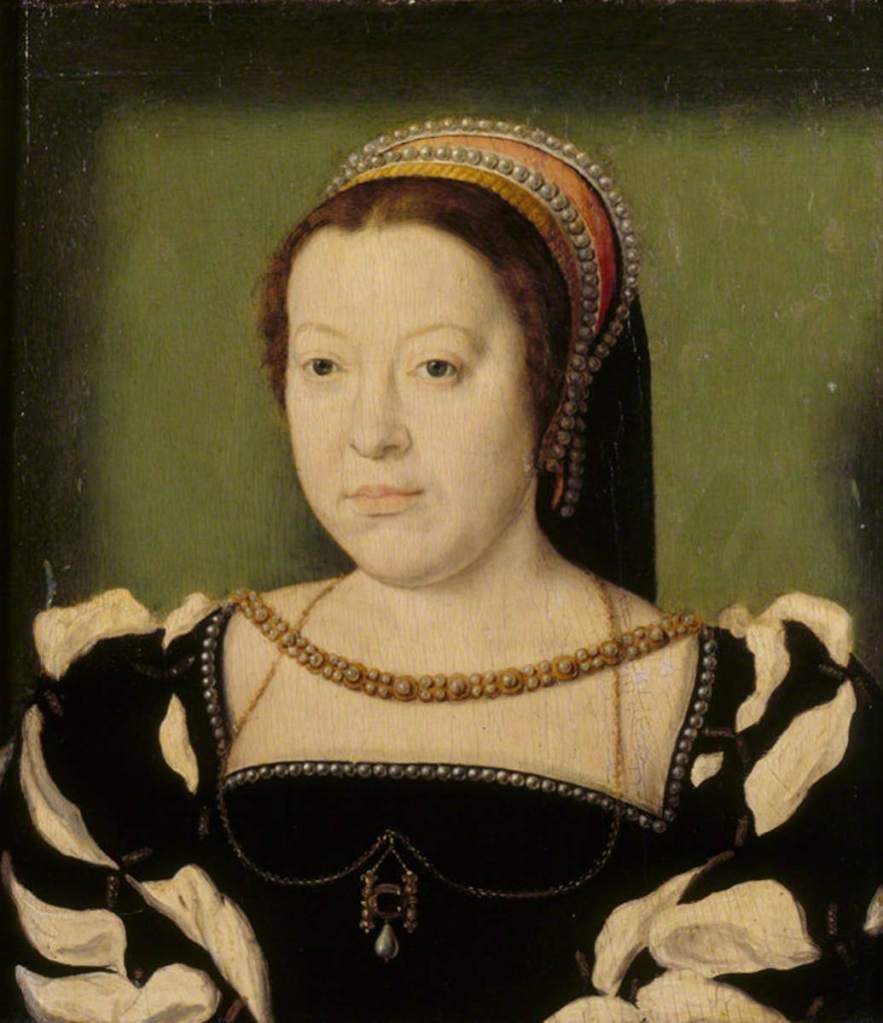
    Claude Corneille de Lyon’s portrait of Catherine de’ Medici as a young woman, circa 1540. Source: Polesden Lacey, Surrey.
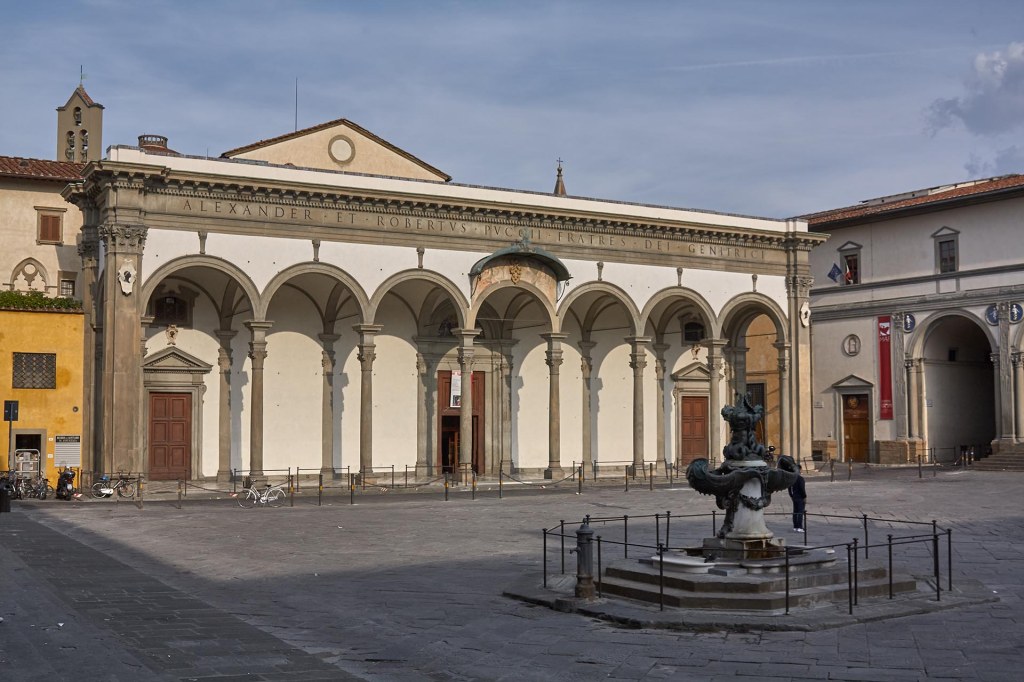
    The piazza of the church and convent of Santa Maria Annunziata, where Catherine spent perhaps the happiest years of her childhood. Source: Museo Galileo, Erik Franchi.

    Transcript

    If anyone in history was ever actually cursed from birth, it may have been Catherine de’ Medici. After giving birth to her, her mother Madeliene de La Tour d’Auvergne died less than a week after her birth from complications.

    (more…)
  • Episode 43: The Drunken German

    While Pope Leo works with the artist Raphael toward the preservation of Roman antiquities and tries to steer Italy between the deadly rocks of France, the Holy Roman Empire, and the Ottoman Empire, a little problem crops up to demand his attention. And that little problem had a name: Martin Luther. 

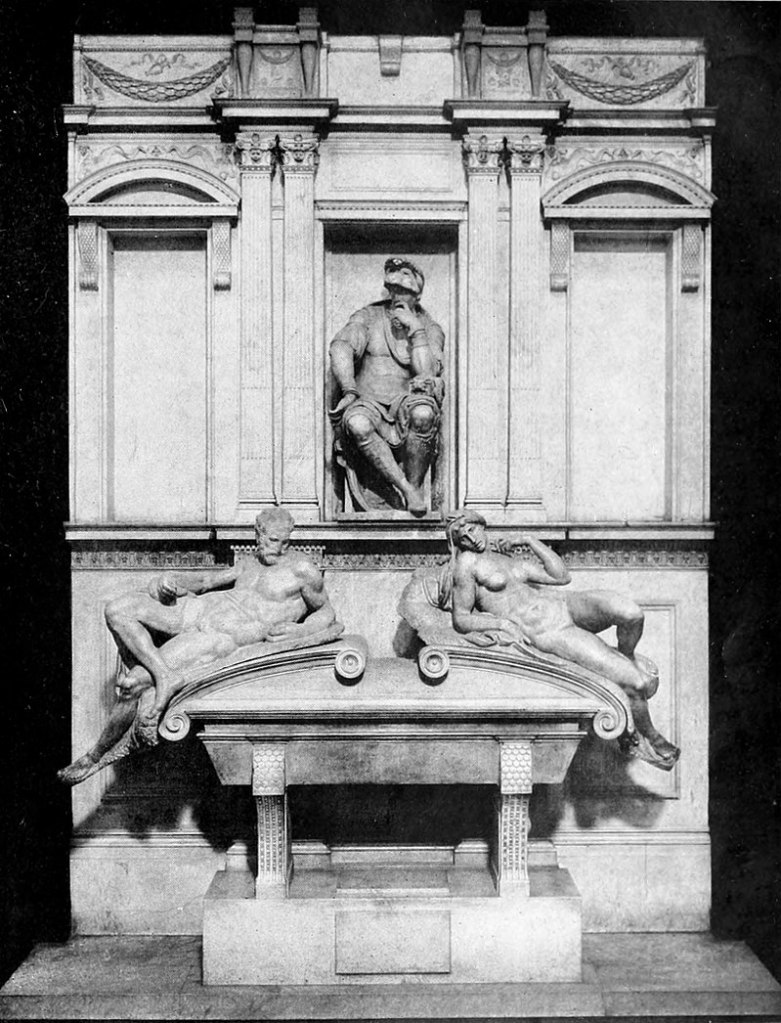
    Michelangelo’s engravings with the tomb of Lorenzo “the Younger” in the New Sacristy at the Church of San Lorenzo, depicting Dusk and Dawn. Source: Romain Rolland, The Life of Michael Angelo (1912).
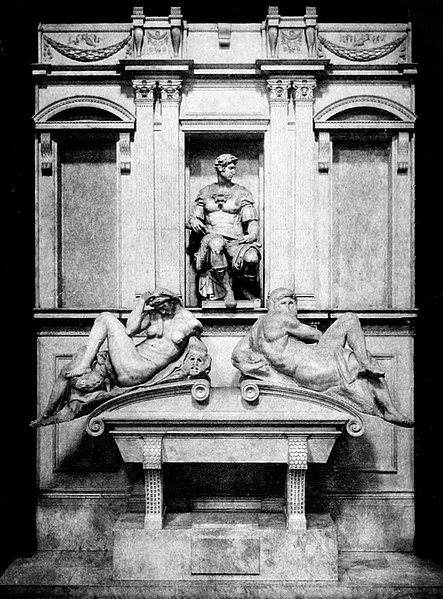
    Michelangelo’s engravings with the tomb of Giuliano de’ Medici in the New Sacristy at the Church of San Lorenzo, depicting Day and Night. Source: Romain Rolland, The Life of Michael Angelo (1912).
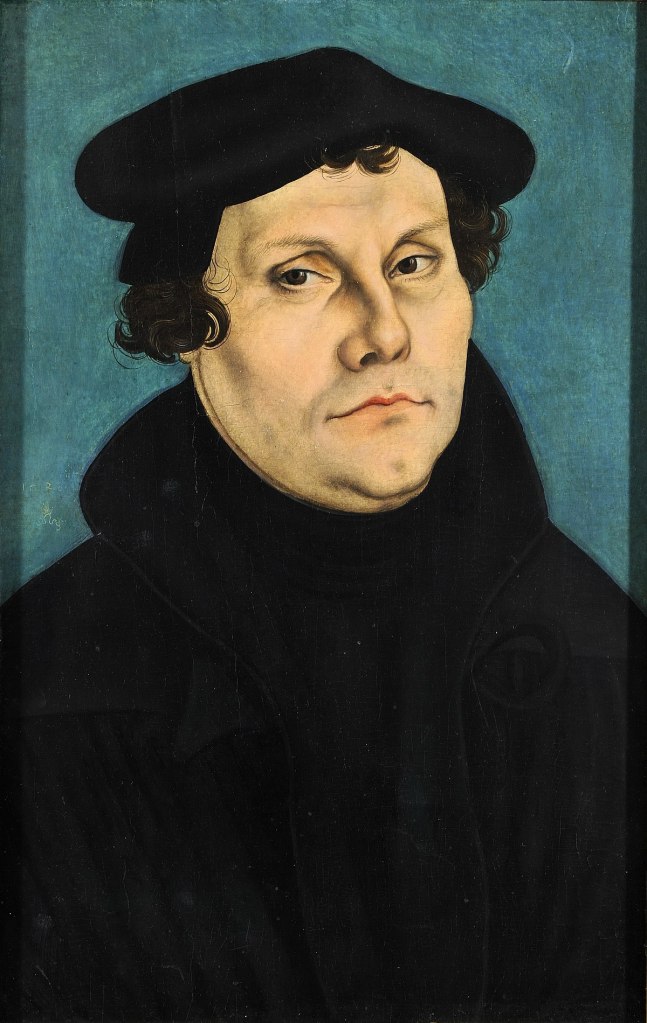
    A contemporaneous portrait of Martin Luther by Lucas Cranach the Elder. Date: 1528. Source: Coburg Fortress Gallery.

    Transcript

    So with that, let’s go back to the year 1505, on a July afternoon…

    A university student was returning home after visiting his parents. He found himself caught in the middle of a sudden thunderstorm. Lightning struck the ground near him. On the spot, Luther prayed to Saint Anne, vowing he would give up his studies in law and become a monk if he survived the thunderstorm. The young student did indeed survive and joined an Augustinian monastery. And that university student was Martin Luther.

    (more…)
  • Episode 41: The Prince

    Pope Leo X goes through his own “annus mirabilis.” Meanwhile the next generation of Medici men come into their own: the wannabe aristocrat, Lorenzo “the Younger”, and the juvenile delinquent turned freelance mercenary, Giovanni of the Black Bands. 

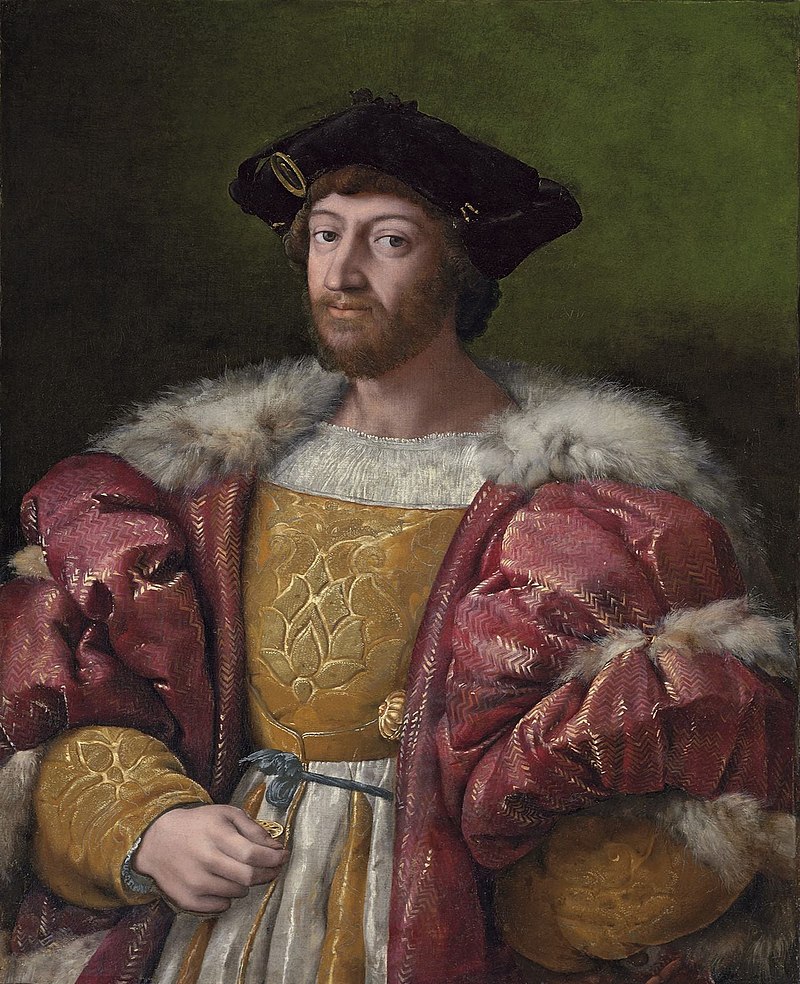
    A portrait of Lorenzo di Piero de’ Medici, Duke of Urbino, by Raphael (1518). Note the ostentatious dress in the style of a French nobleman in contrast to the more modest patrician clothing worn by his grandfather Lorenzo the Magnificent and his uncle Giuliano. Source: Private collection.
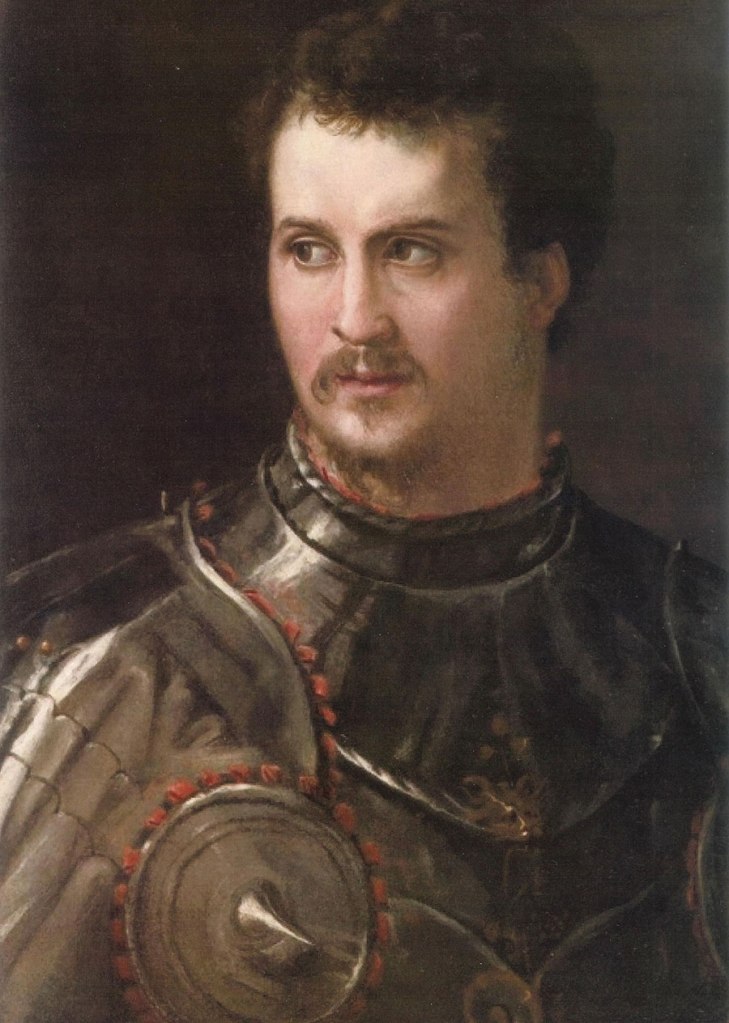
    A portrait depicting Giovanni “of the Black Bands” painted after his death by Francesco de’ Rossi (1548). Source: Soprintendenza Speciale Per Il Polo Museale Fiorentino.

    Transcript

    1516 was a very bad year for Leo X. To paraphrase Queen Elizabeth II of England centuries later, 1516 was Leo’s annus mirabilis. His brother Giuliano died in March, which was not only a personal loss but a political one for the family, since he seems he might have been the most politically talented and popular member of the family since his father Lorenzo the Magnificent. Then, that summer, a monk named Bonaventura had declared himself the true, “Angelic Pope”, excommunicated the Pope and all his cardinals, and warned that the Ottoman Turks would invade Italy before converting to Christianity thanks to the King of France.

    (more…)